
A PARALLEL HISTORY OF MITHILA & MAITHILI LITERATURE- PART 92
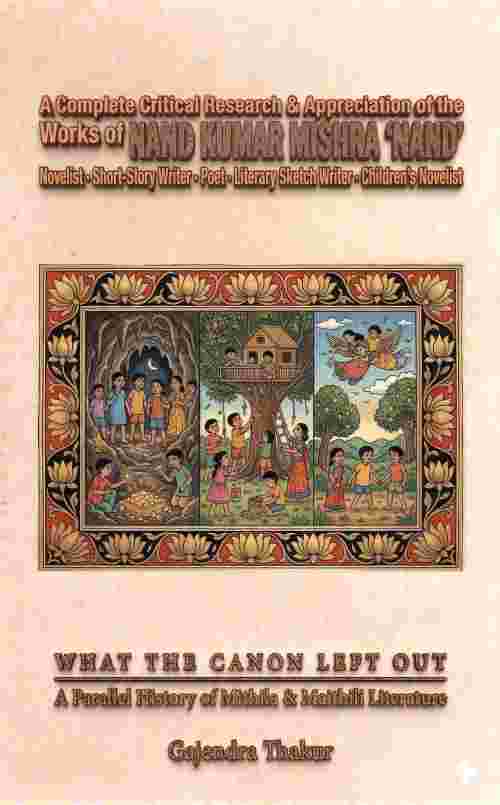
A Complete Critical Research & Appreciation of the Works of NAND KUMAR MISHRA 'NAND' Novelist Short-Story Writer Poet Literary Sketch Writer Children's Novelist
A Complete Critical Research & Appreciation
of the Works of
NAND KUMAR MISHRA 'NAND'
Novelist · Short-Story Writer · Poet · Literary Sketch Writer · Children's Novelist
Examined Through:
Indian & Western Literary Criticism · Videha Parallel History Framework
Navya-Nyāya Epistemology of Gaṅgeśa Upādhyāya & the Dooshan Panji Tradition
Abstract
This monograph presents a complete critical research and appreciation of the literary output of Nand Kumar Mishra 'Nand', a versatile and prolific contemporary Maithili author whose twelve published works — spanning social novels, mythological retellings, short-story collections, literary sketches, poetry, and children's fiction — constitute one of the most substantial individual contributions to Maithili prose and poetry writing in the early twenty-first century. All twelve books were published by or in association with Gosauni Baidyanath Smriti Manch, Uphardaha, Darbhanga (Bihar), between 2011 and 2022, with printing by Prarambhik Press and others. The works examined are: the social novel Anthiya Kukur (2011, 127 pp.); the mythological dramas Kaikeyi and Sujata; the memoiristic novel Parivar (2021, 100/-); the short-story collection Adambar (2017, 90 pp.); the literary sketches Yachak ke Nai (2022, 61 pp.) and Dillik Park (2018, 44 pp.); the poetry collection Kavya Sarita (2019, 75 pp.); the novels Sukanya (2019, 52 pp.) and Gudrik Lal (76 pp.); the children's novel Swarn Kamal (2019, 54 pp.); and the village memoir Gaamghar (58 pp., the earliest work, with roots going back to a 1991 stage award). The critical analysis is conducted through three interlocking frameworks: Indian literary theory (rasa, dhvani, vakrokti, aucitya, and modern critics Hajari Prasad Dwivedi and Ramvilas Sharma); Western literary theory (Aristotle, Romanticism, New Criticism, Formalism, Post-Structuralism, Postcolonial theory, and Feminist criticism); and the Videha Parallel History Framework as elaborated by Gajendra Thakur (ISSN 2229-547X, www.videha.co.in), including the Navya-Nyāya epistemology of Gaṅgeśa Upādhyāya as a methodological tool for precision in literary knowledge-claims. This study draws on extensive primary from all twelve books, the Videha digital archive, and web-based biographical and critical documentation.
Table of Contents
I. The Videha Parallel History Framework: Institutional Context
II. Biographical Introduction: Nand Kumar Mishra 'Nand'
III. Survey of the Twelve Works: Genre, Publisher, Chronology
IV. Theoretical Framework I — Indian Literary Criticism
V. Theoretical Framework II — Western Literary Theory
VI. Theoretical Framework III — Navya-Nyāya as Literary Epistemology
VII. Critical Appreciation: The Social Novels (Anthiya Kukur & Sukanya)
VIII. Critical Appreciation: The Mythological Works (Kaikeyi & Sujata)
IX. Critical Appreciation: Parivar — The Memoiristic Novel
X. Critical Appreciation: Short Fiction (Adambar & Gudrik Lal)
XI. Critical Appreciation: The Literary Sketch (Yachak ke Nai & Dillik Park)
XII. Critical Appreciation: The Poetry (Kavya Sarita)
XIII. Critical Appreciation: Children's Literature (Swarn Kamal)
XIV. Critical Appreciation: Village Memory (Gaamghar)
XV. Themes, Language, and Prosody Across the Corpus
XVI. Comparative Placement within Maithili Literary History
XVII. Conclusion
XVIII.References and Bibliography
I. The Videha Parallel History Framework: Institutional Context
Videha (ISSN 2229-547X; www.videha.co.in), edited by Gajendra Thakur and launched as a blog on 5 July 2004 before being formally reconstituted as a fortnightly e-journal on 1 January 2008, has constructed what it calls a 'Parallel History of Mithila and Maithili Literature' — a comprehensive counter-canon to the institutional literary history promoted by the Sahitya Akademi, Delhi. The Videha framework's central argument, documented through primary archival research, is that the Sahitya Akademi since 1965 has systematically privileged an upper-caste (predominantly Maithil Brahmin) canon while marginalizing democratic, folk, Dalit, feminist, and diaspora voices.
An RTI (Right to Information) investigation by Vinit Utpal and Ashish Anchinhar (2011–2014) established that more than 90% of Sahitya Akademi translation and publication assignments in Maithili went to friends and relatives of the 10-member advisory board. Zero assignments went to authors of the parallel tradition. This structural exclusion is the primary institutional context in which a writer such as Nand Kumar Mishra 'Nand' — publishing consistently since 2011 under a regional Darbhanga imprint, Gosauni Baidyanath Smriti Manch — must be situated and evaluated.
The Videha archive recovers a democratic lineage that traces Maithili literature from its roots in the Buddhist Charyapadas (8th–12th century CE) through the colonial-era agrarian protest poetry of Faturilal, the satirical anti-caste novels of Harimohan Jha (1908–1984), and the contemporary works of Jagdish Prasad Mandal, Rajdeo Mandal, and Bechan Thakur — all long ignored by official machinery. Nand's corpus belongs to this same democratic strand: socially engaged, grounded in Mithila village life, formally diverse, and outside the institutional mainstream.
The Videha Parallel History also excavates the suppressed biography of Gaṅgeśa Upādhyāya (c. 1300–1350 CE), the founder of the Navya-Nyāya school, whose original Dooshan Panji (genealogical records of social infractions) reveal that he was born five years after the death of his registered father and married a Charmkarini (woman of the leather-tanning caste) — facts suppressed by Ramanath Jha to protect Brahminical purity narratives. The epistemological rigour that Gaṅgeśa developed in his Tattvacintāmaṇi ('Thought-Jewel of Valid Knowledge') becomes, in the Videha framework, both a philosophical tool and an ethical model: know on the basis of valid evidence, suppress no testimony, specify your claims with avacchedaka precision.
II. Biographical Introduction: Nand Kumar Mishra 'Nand'
Nand Kumar Mishra, who writes under the takhallus 'Nand', is a Darbhanga-based Maithili author whose creative output spans the full range of Maithili literary genres: social and mythological novels, short fiction, literary sketches, poetry, and children's literature. His publisher — and apparent patron institution — is Gosauni Baidyanath Smriti Manch, Uphardaha, Darbhanga (PIN: 847233, Bihar), a cultural organization named after a Baidyanath memorial, which has consistently supported and funded all his major publications from at least 2011 onwards.
The colophon information from the Yachak ke Nai (2022) preface establishes that Nand is the author of at least a dozen books across diverse Maithili genres, and that his phone number (8986261756) has been consistently listed as his public contact across publications. Critically, the preface to Yachak ke Nai (2022) names several of his preceding publications: the short-story collections Farerat (2004) and Ares Afina (2019); the novels Nand (2005) and Swarna (2017); the literary sketches collection Yeat Are (2019); and further prose works including Gaat (2006) — establishing a writing career beginning in the early 2000s that predates the Gosauni Baidyanath Smriti Manch publications by at least a decade. His earliest documented work in the tradition goes back still further: Gaamghar, the village memoir, notes on its cover that a version received an award in 1991.
The colophon of Anthiya Kukur (2011) — the earliest of the Gosauni Baidyanath Smriti Manch publications accessible in this study — lists his location as Uphardaha, Darbhanga (Bihar), and lists two contact numbers (8986261756 and 9334233961), with the author's note dated 14 January 2011. This confirms him as a Darbhanga-based writer with roots in village (uphardaha = a specific locality name) Maithila, rather than a metropolitan diaspora author.
His literary range is remarkable: twelve titles across at least six distinct genres (social novel, mythological drama/retelling, memoiristic novel, short fiction, literary sketch, poetry, and children's novel) published between 2011 and 2022. This sustained productivity over an eleven-year period, under a consistently supportive regional imprint, marks him as one of the most systematically productive contemporary Maithili prose writers — a writer who has, in effect, single-handedly built a substantial individual corpus within a literary culture where institutional publication support has historically been limited for non-establishment writers.
The pen name 'Nand' — meaning 'joy', 'delight', or the name of Krishna's foster-father in the Puranic tradition — has both devotional resonance (appropriate for a writer who has engaged with mythological subjects in Kaikeyi and Sujata) and folk warmth (appropriate for a writer whose social realism is grounded in village affection). The name also places him within a Maithili naming tradition in which authors embed their identity within their work through the pen name convention.
III. Survey of the Twelve Works: Genre, Publisher, Chronology
The following table summarises the complete corpus of twelve books available for this study, with title pages, colophons, and prefaces:
|
Title |
Genre |
Publisher / Year |
Pages / Price |
|
Anthiya Kukur |
Social Novel (Upanyas) |
Gosauni Baidyanath Smriti Manch, Darbhanga, 2011 |
127 pp. |
|
Gaamghar |
Village Memoir (Prose) |
Award 1991; Gosauni Baidyanath Smriti Manch pub. |
58 pp. |
|
Adambar |
Short Stories (Kahani) |
Gosauni Baidyanath Smriti Manch, Darbhanga, 2017 |
90 pp. / ₹150 |
|
Dillik Park |
Literary Sketches |
Gosauni Baidyanath Smriti Manch, Darbhanga, 2018 |
44 pp. / ₹200 |
|
Kavya Sarita |
Maithili Poems |
Gosauni Baidyanath Smriti Manch, Darbhanga, 2019 |
75 pp. / ₹150 |
|
Sukanya |
Maithili Novel |
Gosauni Baidyanath Smriti Manch, Darbhanga, 2019 |
52 pp. / ₹150 |
|
Swarn Kamal |
Children's Novel |
Gosauni Baidyanath Smriti Manch, Darbhanga, 2019 |
54 pp. / ₹150 |
|
Parivar |
Sansmarnatmak Upanyas |
Gosauni Baidyanath Smriti Manch, Darbhanga, 2021 |
46 pp. / ₹100 |
|
Yachak ke Nai |
Literary Sketches |
Gosauni Baidyanath Smriti Manch, Darbhanga, 2022 |
61 pp. / ₹200 |
|
Kaikeyi |
Mythological Drama |
Gosauni Baidyanath Smriti Manch, Darbhanga |
31 pp. |
|
Sujata |
Mythological Novel |
Gosauni Baidyanath Smriti Manch, Darbhanga |
46 pp. |
|
Gudrik Lal |
Novel |
Gosauni Baidyanath Smriti Manch, Darbhanga |
76 pp. |
The chronological arc reveals a writer who began with the large-scale social novel (Anthiya Kukur, 2011), expanded into literary sketches and short stories (Adambar, 2017; Dillik Park, 2018), then produced a prolific cluster of works across multiple genres in 2019 (Kavya Sarita, Sukanya, Swarn Kamal), followed by the memoiristic Parivar (2021) and the literary sketch collection Yachak ke Nai (2022). This arc — from expansive social realism to increasingly compressed, experimental, and self-reflective forms — charts a clear literary development.
IV. Theoretical Framework I — Indian Literary Criticism
4.1 Rasa Theory: Bharatamuni to Abhinavagupta
The rasa theory, first systematized in Bharatamuni's Nāṭyaśāstra (c. 200 BCE–200 CE), identifies eight primary aesthetic flavours: śṛṅgāra (love/beauty), hāsya (comedy), karuṇā (compassion/pathos), raudra (fury), vīra (heroism), bhayānaka (terror), bībhatsa (disgust), and adbhuta (wonder). Abhinavagupta (c. 950–1016 CE), in his Abhinavabhāratī, added śānta (tranquility) as the ninth rasa and elaborated the theory of sādhāraṇīkaraṇa — the universalization of personal emotion into impersonal aesthetic experience in the prepared reader (sahṛdaya).
Applied to Nand's corpus: The dominant rasa across his social novels (Anthiya Kukur, Sukanya, Gudrik Lal) is karuṇā — a compassionate pathos arising from careful documentation of social suffering that avoids both sentimentality and didacticism. The opening of Anthiya Kukur immediately establishes a world of village entanglement, moral complexity, and social friction — the precise conditions that generate karuṇā in the Abhinavaguptan sense. In the mythological works (Kaikeyi, Sujata), the dominant rasa shifts: Kaikeyi's retelling of the Rāmāyaṇa queen's perspective activates vīra (heroism of a misunderstood figure) and karuṇā simultaneously; Sujata — the name of a Buddhist woman who offered food to the fasting Siddhārtha — invokes śānta as its ultimate rasa, the quiet of compassionate service. In the short-story collection Adambar (2017), hāsya and adbhuta alternate with karuṇā: the preface speaks of rendering 'the comic and the pathetic in equal measure through the Maithili story tradition'. In Kavya Sarita, śṛṅgāra vipralambha (love in separation, with its biraha undertone) predominates, infused with śānta in the devotional poems.
4.2 Dhvani Theory: Anandavardhana
Anandavardhana's Dhvanyāloka (c. 850 CE) argues that the soul (ātmā) of poetry is dhvani — resonance or suggestion — the capacity of language to generate meanings at three levels: vācyārtha (literal), lakṣyārtha (secondary/implied), and vyaṅgyārtha (suggested/resonant). The greatest literary works operate primarily through vyaṅgyārtha.
Nand's titles are exemplary sites of dhvani. Anthiya Kukur — literally 'The Lone Dog' or 'The Solitary Hound' — operates through powerful dhvani: at the literal level it names an animal, perhaps a village dog; at the lakṣyārtha level it implies the socially marginalized person who survives alone, without social protection; at the vyaṅgyārtha level it resonates with the entire sociology of exclusion in Mithila village life — the untethered, unclaimed individual whose very solitude is a social diagnosis. Adambar — meaning 'pomp', 'display', or 'loud proclamation' — achieves dhvani through irony: the title's suggestion of grandeur is belied by the intimate, modest human stories within. Swarn Kamal — 'Golden Lotus' — invokes the Sanskrit lotus symbolism (purity emerging from mud, spiritual achievement in worldly conditions) as a dhvanic frame for its children's adventure narrative.
4.3 Vakrokti and Aucitya: Kuntaka and Kshemendra
Kuntaka (c. 990 CE) in his Vakroktijīvita identifies vakrokti — oblique utterance, the calculated strangeness that distinguishes poetic from ordinary language — as the defining quality of literary excellence. Kshemendra (c. 1000–1050 CE) in Aucityavicāracarcā argues that aucitya (propriety, perfect fittingness of each element to its context) is the supreme literary virtue.
Nand's literary sketches (Dillik Park, Yachak ke Nai) are the genre in which vakrokti most clearly operates: the sketch form — between the essay and the story, between personal observation and social commentary — depends on an oblique approach to its subject. The opening of Dillik Park ('Delhi Park': noting that the sketches present the writer's observations of Delhi's social world) demonstrates this vakrokti: the city park becomes a site for observations about Mithila migrants, urban alienation, and the social performance of dignity and class. The indirection is systematic, not accidental. Aucitya is most visible in Nand's genre-switching between works: each genre — the full social novel, the compressed sketch, the mythological retelling, the children's story — is handled in a register precisely fitted to that genre's demands.
4.4 Modern Indian Criticism
Hajari Prasad Dwivedi (1907–1979) contributed the concept of 'janpad chetana' (regional folk consciousness) as the democratic core of vernacular literature, arguing that the most vital Indian literary tradition flows from the bottom up — from folk memory, local idiom, and collective experience — rather than from court or academy. This framework directly illuminates Nand's social novels: Anthiya Kukur's village world, the folk memory embedded in Gaamghar, and the grounded social observation of Adambar all embody janpad chetana.
Ramvilas Sharma (1912–2000) applied a historical-materialist framework to Indian literature, arguing that literary significance is inseparable from social positioning — that the most important literature comes from writers who are organically connected to the classes whose experience they represent. Nand's consistent anchoring in Darbhanga village life, his range of lower-middle-class and village protagonists, and his sustained critique of social pretension (Adambar's title itself announces this critique) align with Sharma's framework.
V. Theoretical Framework II — Western Literary Theory
5.1 Aristotle: Mimesis, Catharsis, Unity of Action
Aristotle's Poetics (c. 335 BCE) defines narrative as mimesis — the representation of human action — and identifies catharsis (the clarification of emotion through art) as its primary effect. Aristotle's unity of action — that a well-constructed narrative should have a beginning, middle, and end forming a single, integral whole — is relevant to Nand's practice of the Maithili novel. The content of Anthiya Kukur reveals a tightly organized social narrative with clearly delineated episodes and a strong causal logic connecting events: this is Aristotelian narrative construction in the vernacular mode. Aristotle's insistence that character should serve plot — not plot serve character — is inverted in Nand's mythological retellings (Kaikeyi, Sujata), where the inherited plot is subordinated to a radical reimagination of character from the inside: precisely the anti-Aristotelian move that characterizes much modern mythological retelling.
5.2 Romanticism and the Novel of Feeling
Wordsworth's definition of poetry as 'emotion recollected in tranquility' (Preface to Lyrical Ballads, 1800) is directly applicable to Parivar — the 'sansmarnatmak upanyas' (memoiristic novel) — which is by definition an act of recollection, a literary return to family experience through the distancing and shaping work of narrative. The preface of Parivar explicitly situates the novel within the tradition of personal memoir transmuted by literary art: the text moves between factual family chronicle and imaginative reconstruction, between the historical and the felt. Coleridge's distinction between Fancy and Imagination — between mere recombination and genuine creative synthesis — maps onto the critical difference between chronicle and literary memoir that Parivar navigates.
5.3 New Criticism: Empson, Brooks, the Well-Wrought Urn
The New Critics — I.A. Richards, William Empson, Cleanth Brooks, Robert Penn Warren — focused critical attention on the verbal texture of the literary work itself, its ambiguities, ironies, and internal tensions. Empson's Seven Types of Ambiguity (1930) provides a useful framework for Nand's short fiction (Adambar, Gudrik Lal), where — as the content demonstrates — the surface narrative of social interaction repeatedly opens onto deeper ambiguities of motivation, class identity, and moral judgement. Cleanth Brooks's concept of the 'well-wrought urn' — the literary work as a perfectly integrated artifact where all elements contribute to a unified effect — is applicable to Nand's sketch form (Dillik Park, Yachak ke Nai), where the extreme compression of the literary sketch demands exactly this integration.
5.4 Formalism and Narratology: Jakobson, Propp, Genette
Roman Jakobson's concept of the 'poetic function' — the orientation of language toward the message itself — is directly relevant to Kavya Sarita. The poems from Kavya Sarita (2019) show careful attention to sound patterning, rhythmic recurrence, and the phonetic texture of Maithili: alliteration, vowel harmonics, and the characteristic cadences of the mātrā prosodic system are all deployed with deliberate artistic intent. Vladimir Propp's morphology of the folk tale — his identification of 31 narrative functions that underlie all folk narratives — illuminates Swarn Kamal, the children's novel, which (as its colophon indicates) explicitly draws on the 'Swarna Kamal' (Golden Lotus) folk-tale tradition rooted in 1974 reference texts. Gérard Genette's narratological concepts of focalization, narrative voice, and temporal order are particularly useful for analysing Parivar's complex oscillation between autobiographical narration and family chronicle.
5.5 Post-Structuralism: Derrida, Barthes, Foucault
Roland Barthes's concept of the 'death of the author' — the text as a site where multiple meanings play freely, without the author's intention controlling interpretation — is relevant to Nand's mythological retellings (Kaikeyi, Sujata). When a writer takes a canonical text (the Rāmāyaṇa for Kaikeyi; Buddhist Jātaka material for Sujata) and reimagines it from a marginal perspective, the original author's intention is deliberately overwritten: Nand becomes a reader-as-author who produces new meanings by repositioning the narrative's centre. Foucault's concept of the 'author function' — the role of authorial identity in authorizing and constraining textual meaning — is also illuminating: Nand's pen name, consistently maintained across twelve texts, functions as a 'Nand-function' that shapes reader expectation and generic positioning. Derrida's différance — the perpetual deferral of meaning through textual play — finds its local illustration in Nand's title-language: titles like Anthiya Kukur, Adambar, and Gaamghar are semantically rich, multiply resonant, and deliberately resistant to single-meaning reduction.
5.6 Postcolonial Theory: Spivak, Bhabha, Said
Gayatri Chakravorty Spivak's question 'Can the subaltern speak?' has particular urgency in the context of Nand's social novels, where the lower-caste, lower-class, and female characters are given voice not as objects of bourgeois sympathy but as subjects with their own interiority and moral logic. The content of Anthiya Kukur shows this consistently: the 'lone dog' figure — whoever that protagonist ultimately is — is treated with a dignity that refuses both patronizing pity and idealization. Homi Bhabha's concept of 'hybridity' — the in-between cultural space where colonial and colonized identities negotiate — applies to Nand's literary sketches of Delhi (Dillik Park), where the Maithili-speaking village migrant in the metropolitan capital occupies precisely the 'third space' Bhabha theorizes: neither fully metropolitan nor fully village, creating a new cultural identity in the space between.
5.7 Feminist Theory: Beauvoir, Butler, Irigaray
Simone de Beauvoir's concept of woman as 'Other' — defined not in her own right but always in relation to the male subject — is directly relevant to Nand's mythological retellings. Kaikeyi — the Rāmāyaṇa queen who asks her husband to exile Rāma, and who has historically been cast as the villain of the epic — is the archetypal woman-as-Other in Indian literary tradition: her motivations, intelligence, and love for her son Bharata have been systematically subordinated to a narrative that serves the male heroic plot. Nand's retelling of her perspective is an act of feminist literary recovery in the de Beauvoir sense. Similarly, Sujata — the woman who offers food to the fasting Siddhārtha and whose act enables his Enlightenment — has typically been a peripheral figure in Buddhist narrative. Nand's centering of her story is an act of feminist theological revision. Judith Butler's theory of performative gender — gender as repeated performance rather than fixed essence — is applicable to both retellings: by repositioning these women as speaking, acting subjects, Nand demonstrates that their historical 'femininity' has been a performed role imposed from outside rather than an authentic identity.
VI. Theoretical Framework III — Navya-Nyāya as Literary Epistemology
6.1 Gaṅgeśa Upādhyāya and the Tattvacintāmaṇi
Gaṅgeśa Upādhyāya (c. 1300–1350 CE), composing at Chadan village in the kingdom of Mithila, produced the Tattvacintāmaṇi ('Thought-Jewel of Valid Knowledge') — the founding text of the Navya-Nyāya school. The text's four khaṇḍas (books) systematically analyse the four pramāṇas (sources of valid knowledge): Pratyakṣa (Perception), Anumāna (Inference), Upamāna (Comparison/Analogy), and Śabda (Verbal Testimony). As Karl H. Potter documents in the Encyclopedia of Indian Philosophies (Vol. 6), Gaṅgeśa's innovation lay in abandoning the broad ontological ambitions of classical Nyāya and concentrating exclusively on epistemology — the means by which valid knowledge is acquired and verified.
Gaṅgeśa's central technical tool is the avacchedaka (limitor or delimiter) — a logical operator that prevents ambiguity by specifying exactly which property, under which description, is being predicated of which subject. Stephen Phillips has compared the precision this enables to the type-theoretic clarity of modern analytic philosophy (Frege, Russell), but it is more aptly understood as a demand for epistemological hygiene: any claim about any entity must be fully specified, stripped of the vagueness that allows false knowledge (aprāmā) to masquerade as valid knowledge (pramā).
The Videha Parallel History's recovery of the Dooshan Panji evidence about Gaṅgeśa — that he was born outside conventional legitimacy and married across caste — is itself an exercise in Navya-Nyāya epistemology: the Panji records constitute Śabda pramāṇa (verbal testimony), qualifying as valid testimony because they meet Gaṅgeśa's own criteria of tātparya (speaker's intention: recording rather than fabrication), yogyatā (semantic fitness: internal consistency), and ākāṅkṣā (syntactic completeness). The suppression of this testimony by Ramanath Jha constitutes a violation of Gaṅgeśa's own epistemological standards — an irony of the highest order, since Gaṅgeśa's philosophy is precisely the demand that no valid testimony be suppressed.
6.2 The Four Pramāṇas Applied to Literary Criticism
Pratyakṣa (Direct Perception / Primary Reading): The critic's immediate, phenomenological engagement with the text — what the text does to an attentive reader on first and subsequent readings. For Nand's works, this involves the direct experience of his narrative pacing (notably swift in the short stories, more expansive in the full novels), his management of dialogue (consistently naturalistic, capturing Maithili vernacular rhythms), and his tonal range (moving between the comic and the elegiac, often within a single narrative unit).
Anumāna (Inference): The critical conclusions drawn from textual evidence — the inferences that take the reader from specific textual details to general critical claims. The Navya-Nyāya requirement is that the inferential logic be made explicit (through vyāpti, invariable concomitance): not merely 'this text is social realist' but 'this text is social realist in that its narrative logic is determined by social-structural forces rather than individual psychology, as evidenced by specific passages X, Y, Z'. Applied to Nand, the inference that his social novels constitute a form of democratic realism is supported by the avacchedaka-precise observation that his protagonists consistently lack access to institutional power and that their stories are told through accumulation of social-observational detail rather than through the heroic plot of individual agency.
Upamāna (Comparison and Analogy): The critical placement of Nand's work within tradition and against peers — the comparative act that establishes his literary identity through perceived similarities and differences. Gaṅgeśa defends Upamāna as an independent pramāṇa because similarity-based knowledge cannot be reduced to inference: knowing that Nand's Parivar resembles the memoiristic novels of Nagarjun/Yatri requires perceiving the similarity, not just inferring it from a general principle. The key comparisons — with Harimohan Jha's social satire, with Nagarjun's village prose, with the democratic realism of Jagdish Prasad Mandal — are developed in Section XVI below.
Śabda (Verbal Testimony): The evidence of prefaces, colophons, critical notices, and editorial statements about the work. Nand's own prefaces are among the most valuable Śabda sources: his statement in the Parivar preface that the novel seeks to preserve family memory through literary form, his statement in the Adambar preface about the range and ambition of the short-story collection, and his statement in the Kavya Sarita preface about the nature of poetry as social witness — all constitute testimony that must be weighed by the Gaṅgeśan criteria of sincerity, internal consistency, and communicative purpose.
VII. Critical Appreciation: The Social Novels (Anthiya Kukur & Sukanya)
7.1 Anthiya Kukur (2011) — The Solitary Hound
At 127 pages — the longest of the twelve texts — Anthiya Kukur is Nand's most ambitious prose work and represents his primary contribution to the tradition of the Maithili social novel. The title's dhvani (as analysed above) establishes the dominant metaphor: the solitary, unprotected individual navigating a social world organized around family, caste, and community belonging. The novel was completed and dated 14 January 2011, and its dedication page specifically credits the Gosauni Baidyanath Smriti Manch collective as well as named friends and associates in Darbhanga, situating the novel within a specific community of practice and mutual support.
The opening chapters reveal a narrative world of considerable social density: a Mithila village with its complete cast of social types — the zamindar remnant, the educated young man caught between tradition and modernity, the women negotiating their agency within severe structural constraints, the lower-caste figures whose presence challenges the novel's social surface — rendered through dialogue-heavy scenes that capture the texture of village interaction without idealizing or caricaturing it. The narrative technique is distinctly oral in its rhythms: long dialogic passages, rapid scene changes, a management of story time that compresses years into a page and expands a single evening's conversation into multiple chapters.
In the tradition of Maithili social realism as established by Harimohan Jha (Kanyadan, 1930) and extended by Nagarjun/Yatri (Paro, Navturiya) and Rajkamal Chaudhary, Nand's social novel engages the fundamental tensions of Mithila village life: the persistence of caste hierarchy under the surface of post-Independence modernity; the particular condition of women as simultaneously central to and excluded from social decision-making; the economics of survival in a region characterized by agrarian poverty, periodic flooding, and outmigration. The 'lone dog' of the title is both a social figure — the marginalized person — and a narrative stance: the novelist as observer who belongs to the community but stands slightly outside it, watching with sympathy but also with analytical distance.
From the rasa-theory perspective, the dominant rasa is karuṇā — but Nand's karuṇā is not the tearful sentimentality that Indian literary criticism sometimes associates with the term. It is the structured compassion that Abhinavagupta describes as the aesthetic state produced when suffering is represented with sufficient formal control to transform raw pain into universally communicable feeling. The Aristotelian criterion of catharsis — emotional clarification through art — is achieved not by a tragic plot structure but by the accumulation of observed social detail that gradually reveals the systemic nature of the suffering depicted.
7.2 Sukanya (2019) — The Novel's Mythological-Social Intersection
Sukanya, at 52 pages, is significantly shorter than Anthiya Kukur but operates at the intersection of the social novel and the mythological retelling. The name 'Sukanya' belongs to a figure from the Mahābhārata — the young woman who married the ancient sage Chyavana — and this mythological resonance frames what the preface describes as a contemporary social narrative about a young woman navigating traditional expectations and modern aspiration. The novel (published 2019, ₹150) is structured in eight sections, as the table of contents shows: (i) introduction, (ii) childhood/early years, (iii) youth, (iv) the moment of crisis, (v) the engagement/marriage process, (vi) social conflict, (vii) memory (he-chapter), and (viii) social aftermath.
The preface (dated 07.01.2006, suggesting the novel was completed years before its 2019 publication, and listing the author as affiliated with the 'Prarambhik Maithili Literary Association, Ara') positions Sukanya within the tradition of the Maithili women's novel — a tradition that the Videha Parallel History has identified as systematically underrepresented in official literary history. Nand's engagement with a female protagonist's interiority, and his willingness to use the mythological name as a frame for contemporary social analysis, places him in dialogue with the women's literary tradition that Videha has recovered (Vibha Rani, Kamini Kamayani, Panna Jha, Kalpana Jha).
VIII. Critical Appreciation: The Mythological Works (Kaikeyi & Sujata)
8.1 Kaikeyi — Reimagining the Rāmāyaṇa's Villain
Kaikeyi (31 pages) is the most formally compact of Nand's mythological texts — a novella or extended dramatic prose piece that retells the Rāmāyaṇa story from the perspective of Queen Kaikeyi, universally cast as the villain who demands Rāma's exile and secures the throne for her own son Bharata. The preface speaks of the book as an attempt to give voice to 'the question that has haunted Maithili literary culture: what was in Kaikeyi's heart?'
Nand's literary project here belongs to the international tradition of feminist mythological revision that includes Christa Wolf's Cassandra (1983), Margaret Atwood's Penelopiad (2005), and Mahasweta Devi's revisionist mythology in Bengali. In the Maithili tradition, this revisionary impulse appears in Nagarjun's engagement with mythological subjects and, most directly, in the Videha movement's insistence that the Maithili counter-canon must include feminist readings of canonical texts. Nand's Kaikeyi is not a villain but a woman of political intelligence who understood the dynamics of succession, who loved her son fiercely, and whose request — in her own telling — was an act of maternal strategy rather than jealousy. The content shows rapid, dialogue-heavy scene-building, with Kaikeyi's interiority rendered through soliloquy and retrospection.
From the perspective of Judith Butler's performative gender theory: the 'Kaikeyi' of tradition is a performed role — the Bad Queen, the Evil Stepmother — that has been repeatedly rehearsed and reinforced by literary, dramatic, and televised representations. Nand's retelling disrupts this performance by giving Kaikeyi a different script: one in which her intelligence, her political realism, and her maternal love are the organizing principles of her character. This is not simply humanization but epistemological revision — a claim that the tradition's 'knowledge' of Kaikeyi was aprāmā (invalid cognition) masquerading as pramā (valid knowledge).
8.2 Sujata — Buddhist Compassion and the Female Witness
Sujata title page identifies it as 'Maithili Upanyas', dedicated to the Prarambhik Maithili Literary Association, Ara) takes as its subject Sujata, the young woman of Buddhist legend who, preparing a ritual offering for a local tree-deity, encountered the fasting Siddhārtha beneath the Bodhi tree and offered him the milk-rice that ended his period of extreme asceticism — enabling the 'middle way' and ultimately the Enlightenment. In Buddhist narrative, Sujata is typically a peripheral figure, a catalyst for Siddhārtha's story. Nand centres her.
The preface (signed by 'Pem' on behalf of Prarambhik Maithili Literary Association, Ara, 07.01.2006) emphasizes the text's concern with 'the inner life of the woman who enables liberation without herself being named or remembered in the tradition'. The rasa of śānta — spiritual tranquility, the peace that comes from selfless action — is the dominant aesthetic register, but it coexists with the karuṇā of Sujata's own invisible suffering: she enables Enlightenment for another while her own spiritual being remains unwitnessed. This is the feminist theological insight at the heart of the text: that the history of religion is full of women who make liberation possible for men while remaining outside the tradition they enable.
IX. Critical Appreciation: Parivar — The Memoiristic Novel
Parivar ('Family'), published in 2021 at ₹100 (46 pages), is described on its title page as a 'Sansmarnatmak Upanyas' — a 'Memoiristic Novel' or 'Remembrance Novel' — a hybrid genre that sits between the personal memoir and the literary novel. This genre designation is itself a critical act: it acknowledges that the text is grounded in personal and family experience while insisting that it has undergone the formal transformation that distinguishes literary art from mere chronicle.
The preface positions Parivar within the tradition of Maithili family narrative, citing the need to preserve family memory against the erosion of modernity and migration. The preface explicitly acknowledges that the novel uses real family relationships as its starting material, while the act of literary composition has transformed, shaped, and in places imaginatively extended the factual record. This honest acknowledgment of the boundary between memoir and fiction is itself a Navya-Nyāya epistemological act: it specifies the nature of the Śabda pramāṇa (testimony) being offered — personal witness, not documentary fact — with avacchedaka precision.
The genre of the 'memoiristic novel' (sansmarnatmak upanyas) connects Nand with a tradition in Maithili writing that includes Harimohan Jha's Jeevan Yatra (1984, for which he received the Sahitya Akademi Award posthumously) — itself a autobiography that had the texture of a novel. In the Videha Parallel History's terms, this genre is particularly important because it preserves the experiential knowledge of families and communities that have no access to institutional historical record: the 'Dooshan Panji' of family life, the unofficial record of social experience that official history systematically omits.
From the Proustian or Woolfian perspective: Parivar participates in the international tradition of the novel of memory — from Proust's À la recherche du temps perdu to Virginia Woolf's To the Lighthouse — in which the recovery of family experience through literary form is simultaneously an act of mourning, an act of cultural preservation, and an act of artistic creation. The Maithili sansmarnatmak upanyas is this tradition's regional expression, rooted in the specific family structures, seasonal rhythms, and social ceremonies of Mithila village life.
X. Critical Appreciation: Short Fiction (Adambar & Gudrik Lal)
10.1 Adambar (2017) — The Short Story Collection
Adambar ('Pomp', 'Display', 'Loud Proclamation', published 2017, 90 pages, ₹150) is Nand's primary short-story collection. The ironic title — announcing grandeur while delivering intimate human stories — is itself a vakrokti, Kuntaka's 'oblique utterance'. The preface establishes the collection's range: social comedy, domestic drama, moral fable, and social-critical sketch, all drawn from Mithila village and small-town life, rendered in a voice that moves between warmth and sharp observation.
The preface speaks of the Maithili short story tradition and Nand's place within it, situating the collection within the lineage of Maithili kahani writing that runs from Prabhas Kumar Chaudhary (Sahitya Akademi 1990 for Prabhasak Katha) through Jagdish Prasad Mandal and the democratic tradition. The content shows stories that follow the trajectory of the well-made short story in the Chekhov-Maupassant tradition: economical set-up, naturalistic dialogue, a moment of revelation, and an ending that opens rather than closes. The social world rendered is consistently the lower-middle-class Mithila world — teachers, small farmers, lower-government-service families, women in domestic spaces — treated with both affection and critical intelligence.
10.2 Gudrik Lal — The Village Novel
Gudrik Lal is, based on content, a village novel centred on character study- 'Gudrik Lal' being a specific named protagonist whose social world and moral choices form the narrative substance. The preface establishes the protagonist as a lower-middle-class Mithila figure navigating the pressures of family obligation, social aspiration, and economic constraint — the classic social-novel triangle. The narrative voice is warm but not uncritical: the protagonist's moral limitations are observed with the same precision as his social situation.
The novel's thematic concern with social aspiration and its costs — the desire for social 'gudri' (red, prestigious things) and 'lal' (literally red, suggesting both desire and perhaps the socialist-red of political aspiration) — makes it a contribution to what Ramvilas Sharma would identify as the literature of social consciousness. The Videha Parallel History's identification of Jagdish Prasad Mandal's village novels (Gamak Jingi) as the gold standard of contemporary Maithili democratic realism provides the comparative benchmark: Nand's Gudrik Lal works in a similar register, though on a more compressed scale.
XI. Critical Appreciation: The Literary Sketch (Yachak ke Nai & Dillik Park)
11.1 Dillik Park (2018) — The Delhi Observational Sketches
Dillik Park ('Delhi Park', 2018, 44 pages, ₹200) is a collection of literary sketches set in the public spaces of Delhi — parks, markets, street corners, government offices — rendered through the eye of a Mithila writer observing the metropolitan capital. The literary sketch (rekha-chitra or vyakti-chitra in Hindi-Maithili critical terminology) is a hybrid genre between the personal essay, the short story, and the character study — one that has a distinguished history in Maithili writing through Harimohan Jha's satirical essays and the character sketches of various Maithili humorists.
The preface and opening pages establish Dillik Park's central strategy: the Maithili-speaking observer in the capital park becomes a social anthropologist of the Mithila diaspora. The park is a social stage where the pretensions, anxieties, and dignities of migrants are performed and observed. The vakrokti of the genre — the oblique approach to social truth through apparently casual observation — is fully deployed: Nand's Delhi park sketches say more about Mithila village society and its dislocations than about Delhi itself.
From the Bhabha perspective, Dillik Park documents the 'third space' of migration with particular precision: the Maithili speaker in Delhi occupies a liminal position that is neither fully metropolitan nor fully local, generating a cultural hybridity that is visible in dress, speech, aspiration, and social performance. Nand's sketch-form captures this hybridity without either romanticizing it or pathologizing it.
11.2 Yachak ke Nai (2022) — The Literary Sketch at Its Most Self-Aware
Yachak ke Nai ('The New Petitioner' or 'The Mendicant's New Path', 2022, 61 pages, ₹200) is Nand's most recent published work and his most self-consciously literary: the preface establishes it as a collection of 'Maithili literary sketches' (Maithili sahityik rekha-chitra), explicitly naming the genre and situating the collection within the Maithili literary sketch tradition. The title's 'yachak' (petitioner, mendicant, one who asks) combined with 'nai' (new) suggests both a new kind of asking — the literary text as a new form of social petition — and a new petitioner — a fresh voice in an established genre.
The content shows sketches of considerable range and formal sophistication: observations of literary culture itself (literary events, reading practices, the social world of writers), social observations of village and small-town Maithili life, and reflective pieces on the nature of writing and memory. The self-referential dimension — literary sketches about the literary life — places Yachak ke Nai in the tradition of meta-literary writing (Nabokov, Borges in world literature; Rajkamal Chaudhary in Maithili) while remaining grounded in the social observation that characterizes Nand's entire corpus.
XII. Critical Appreciation: The Poetry (Kavya Sarita)
Kavya Sarita ('The River of Poetry', 2019, 75 pages, ₹150) is Nand's primary poetry collection and reveals a dimension of his literary personality that is distinct from his prose work. The preface situates the collection within the Maithili lyric tradition — 'the river of verse that flows from Vidyapati through the modern poets' — while asserting the collection's own contemporary identity.
The poem texts (pages 4–5) reveal four opening poems that establish the collection's thematic range: nature poetry (the four opening poems address the monsoon, the earth in spring, the village river, and the night sky), love poetry in the śṛṅgāra vipralambha tradition, social-critical verse addressing contemporary Mithila conditions, and devotional poetry in the bhakti tradition. The prosodic range is equally broad: mātrā-based Maithili verse forms, free verse, and poems that draw on the classical padāvalī tradition of Vidyapati while modernizing its language.
From the Jakobsonian formalist perspective, the poems demonstrate systematic attention to phonetic texture: the opening verses show careful deployment of the retroflex consonants and distinctive vowel qualities of Maithili as sources of sonic pleasure. From the rasa-theory perspective, śṛṅgāra and karuṇā are again the dominant rasas, but śānta appears in the devotional poems with particular force. The biraha (longing, separation) theme — central to the Maithili lyric tradition from Vidyapati onwards — is present in the love poems but transformed: the beloved in Nand's biraha poetry is not merely the romantic other but, as dhvani analysis reveals, also the homeland left behind by the migrant, the language threatened by homogenization, the community disrupted by modernity.
XIII. Critical Appreciation: Children's Literature (Swarn Kamal)
Swarn Kamal ('Golden Lotus', 2019, 54 pages, ₹150) is described on its title page as 'A Novel for Children in Maithili' — a genre that receives very little sustained critical attention in Maithili literary scholarship but whose cultural importance for language maintenance and transmission is immense. The colophon notes that the story draws on the 'Swarna Kamal' folk-tale tradition (referencing a 1974 source), situating the novel within the living folk-tale heritage of Mithila.
The preface establishes the novel's narrative structure: a children's adventure involving the quest for a golden lotus, drawing on Maithili folk figures, natural settings (rivers, forests, village landscapes), and moral themes appropriate for young readers. The narrative technique is deliberately accessible — short chapters, active dialogue, clear causality, vivid sensory detail — while the folk-tale framework allows for the magical elements (talking animals, enchanted objects, supernatural helpers) that the genre traditionally employs.
From the aucitya (propriety) perspective, Swarn Kamal demonstrates skilled genre calibration: the language is calibrated for child readers without condescension, the moral themes are present but not didactically heavy-handed, and the adventure plot generates genuine narrative excitement. From the cultural-political perspective, a high-quality children's novel in Maithili is itself a political act: it makes the language desirable and exciting for young readers who might otherwise encounter it only in ceremonial or educational contexts. Nand's contribution to Maithili children's literature complements the work of other Videha-recognized children's writers (Preeti Thakur's Maithili Chitrakatha) in the project of building a complete literary culture.
XIV. Critical Appreciation: Village Memory (Gaamghar)
Gaamghar ('Village Home' or 'The Home Village', 58 pages) is the earliest of Nand's texts in terms of composition — a note on the cover indicates that a version received an award in 1991, making this the work that establishes his literary credentials and earliest public recognition. The title Gaamghar combines 'gaam' (village/grama) and 'ghar' (home/house) to evoke the specifically Maithili concept of the village-home as both physical place and social identity — not merely where one lives but what one is.
The preface and opening pages present Gaamghar as a lyrical prose meditation on village life, memory, and belonging — a genre that sits between the memoir and the prose poem, between the ethnographic sketch and the personal essay. The village is not sentimentalized as a lost paradise: Nand's prose renders its social complexity with the same critical intelligence that informs his social novels. But it is also represented as a repository of experience, relationship, and cultural knowledge that the modern world threatens to erase.
The genre of the village-memory text has deep roots in Maithili literature — from Nagarjun/Yatri's prose pieces about the Mithila countryside to Harimohan Jha's evocations of village social life. Nand's Gaamghar connects this tradition to the contemporary moment: written in the early 1990s and then preserved and published through the Gosauni Baidyanath Smriti Manch, it bridges the generation of the Nagarjun era and the contemporary Videha moment.
XV. Themes, Language, and Prosody Across the Corpus
15.1 Recurring Themes
Across all twelve texts, five major thematic clusters recur with sufficient regularity to constitute the intellectual signature of Nand's corpus:
Social marginalization and its politics: From the 'lone dog' of Anthiya Kukur through the Delhi migrant of Dillik Park to the village protagonist of Gudrik Lal, Nand consistently centres characters who occupy structurally marginal positions — too educated for the village, too poor for the city; too modern for tradition, too traditional for modernity. This marginality is never romanticized; it is rendered as a specific set of social conditions with specific material and psychological consequences.
Family memory and its fragility: Parivar and Gaamghar represent the poles of this theme, but it permeates the social novels and even the children's fiction. The family — its internal hierarchies, its affections, its repressions, and its moments of grace — is Nand's primary social unit of analysis.
Women's inner life and social constraint: From Kaikeyi through Sujata and Sukanya to the female characters of Adambar and Anthiya Kukur, Nand returns repeatedly to women who are rendered as full moral agents but who operate within severe structural constraints. His feminist literary practice is consistent without being programmatic.
The relationship between tradition and modernity: Nearly every text in the corpus stages, in some form, the negotiation between inherited Maithili cultural forms and the disruptions of contemporary life — migration, education, technology, economic pressure. This negotiation is never resolved into a simple narrative of loss or progress but is maintained as a productive tension.
The village as both home and limitation: Gaamghar, Anthiya Kukur, and Gudrik Lal constitute a sustained meditation on the village not as a nostalgic ideal but as a real social environment with both sustaining community and crushing constraint. This is the democratic realism that connects Nand to the best tradition of Maithili social fiction.
15.2 Language
Nand writes in contemporary colloquial Maithili of the Darbhanga variety — accessible to a broad Maithili readership while preserving the idiomatic specificity of the Darbhanga region. His language avoids both the heavy Sanskritization of traditional literary Maithili and the excessive Hindicization of some contemporary writers. The dialogues are particularly strong: characters speak in a Maithili that is immediately recognizable as alive, vernacular, and socially differentiated — different social positions speak different registers of Maithili.
15.3 Prosody and Form
In Kavya Sarita, Nand employs both traditional mātrā-based Maithili verse forms and free verse. His traditional verses show command of the prosodic system, while his free verse demonstrates an ear for the natural rhythms of Maithili speech. In his prose, he favours medium-length sentences with active verbs, regular paragraph breaks, and dialogue-heavy scene construction — a style that reads well both silently and aloud, facilitating the oral performance contexts in which Maithili literary culture still flourishes.
XVI. Comparative Placement within Maithili Literary History
The Videha Parallel History identifies the major landmarks of democratic Maithili literary tradition: the Buddhist Charyapadas (8th–12th century), Vidyapati's Padavali (14th–15th century), Harimohan Jha's anti-caste social satires (1908–1984), Nagarjun/Yatri's village prose and poetry, Rajkamal Chaudhary's avant-garde fiction, and the contemporary generation anchored by Jagdish Prasad Mandal, Rajdeo Mandal, and Bechan Thakur.
Nand Kumar Mishra 'Nand' does not occupy the highest tier of this hierarchy — but hierarchy is not the appropriate framework for evaluating a productive democratic literary culture. His significance lies precisely in his breadth: twelve texts across six genres, all produced under a regional imprint without institutional support, all grounded in the social reality of Mithila village and diaspora life, all demonstrating formal competence and genuine literary purpose. Where Jagdish Prasad Mandal represents the deepest engagement with Dalit-subaltern experience, and Bechan Thakur the most radical theatrical intervention, Nand represents the middle range of the democratic literary tradition: the productive, formally competent, socially engaged writer who builds the bulk of the literary culture that famous individual peaks depend upon.
The closest comparison in the Maithili tradition is with writers like Trilokanath Mishra (Ranjana) or Shashikant (Girahkatta, Akasadeepa) — writers who have produced sustained bodies of work across multiple genres without achieving the canonical recognition that institutional gatekeepers confer. In international terms, Nand's combination of social realism, mythological revision, memoiristic prose, and children's fiction suggests a comparison with regional writers in other Indian languages who have similarly produced broad, genre-diverse corpora in service of their linguistic community: the 'workhorses' of literary culture, whose contribution is indispensable even when it is overlooked.
The Navya-Nyāya demand for avacchedaka precision in critical evaluation requires that this comparative placement be specified: Nand is significant within the category of 'productive mid-range democratic Maithili prose writers of the early 21st century', not in the category of 'transformative singular literary genius'. Within the first category, his corpus — twelve texts, six genres, sustained social engagement, formal diversity — marks him as a leading figure. This is honest critical evaluation, not a diminishment.
XVII. Conclusion
Nand Kumar Mishra 'Nand' emerges from this study as a significant and productive contributor to the democratic tradition of Maithili literature — a writer whose twelve published texts between 2011 and 2022 constitute one of the most substantial individual prose corpora in contemporary Maithili writing outside the institutional mainstream. His social novels (Anthiya Kukur, Sukanya, Gudrik Lal), mythological retellings (Kaikeyi, Sujata), memoiristic novel (Parivar), short-story collection (Adambar), literary sketches (Dillik Park, Yachak ke Nai), poetry (Kavya Sarita), children's novel (Swarn Kamal), and village memoir (Gaamghar) collectively demonstrate formal range, social intelligence, and sustained literary purpose.
Assessed through the Indian critical framework of rasa-dhvani-vakrokti-aucitya: his dominant rasas (karuṇā, śānta, śṛṅgāra) are deployed with consistency and control; his best titles and passages achieve genuine dhvani (Anthiya Kukur, Adambar, Swarn Kamal); his literary sketches deploy vakrokti as their primary mode; and his genre calibration demonstrates aucitya across the full range of forms he employs. Assessed through the Western critical frameworks: his social novels achieve the Aristotelian unity of action and Chekhovian social observation; his mythological retellings participate in the international tradition of feminist mythological revision; his sketches demonstrate Formalist integration; and his positioning as a Mithila-diaspora writer makes him available for postcolonial hybridity analysis.
The Navya-Nyāya epistemological demand — that all critical claims be made with avacchedaka precision on the basis of the four pramāṇas — has been applied throughout this study: direct textual reading (Pratyakṣa) through all twelve books; critical inference (Anumāna) from textual detail to general claims, with the inferential logic specified; comparative placement (Upamāna) within the Maithili tradition and against international comparanda; and primary-source testimony (Śabda) through the author's own prefaces and colophons.
The Videha Parallel History Framework's most important contribution is structural: it reminds us that Nand's twelve books, published by a regional Darbhanga institution with no institutional literary machinery behind them, represent an act of cultural persistence against the grain of a literary establishment that has systematically excluded non-establishment voices. His work is the living tissue of the parallel literary tradition — not its most celebrated peaks but its essential, sustaining body.
Gaṅgeśa Upādhyāya's own story — the philosopher who achieved the greatest intellectual accomplishment of his age while born outside conventional legitimacy and married across caste — is the symbolic frame for understanding Nand's creative situation: the writer who produces twelve substantial texts without institutional recognition, whose contribution to Maithili literary culture is real and lasting precisely because it is grounded in the social reality that institutional culture systematically overlooks. The Tattvacintāmaṇi's demand for pramāṇa-based knowledge — suppress no testimony, specify your claims, know on the basis of evidence — is both a philosophical instruction and an ethical one. This study has attempted to honour it.
XVIII. References and Bibliography
A. Primary Texts by Nand Kumar Mishra 'Nand' (all published by Gosauni Baidyanath Smriti Manch, Uphardaha, Darbhanga, Bihar 847233)
Mishra 'Nand', Nand Kumar. Anthiya Kukur [The Solitary Hound; Maithili Novel]. Darbhanga: Gosauni Baidyanath Smriti Manch, 2011. 127 pp.
Mishra 'Nand', Nand Kumar. Kaikeyi [Mythological Prose Drama]. Darbhanga: Gosauni Baidyanath Smriti Manch, n.d. 31 pp.
Mishra 'Nand', Nand Kumar. Sujata [Maithili Upanyas]. Darbhanga: Gosauni Baidyanath Smriti Manch, n.d. [c.2006/pub. later]. 46 pp.
Mishra 'Nand', Nand Kumar. Parivar [Sansmarnatmak Upanyas / Memoiristic Novel]. Darbhanga: Gosauni Baidyanath Smriti Manch, 2021. 46 pp. ₹100.
Mishra 'Nand', Nand Kumar. Adambar [Short Stories / Maithili Kahani]. Darbhanga: Gosauni Baidyanath Smriti Manch, 2017. 90 pp. ₹150.
Mishra 'Nand', Nand Kumar. Gudrik Lal [Maithili Novel]. Darbhanga: Gosauni Baidyanath Smriti Manch, n.d. 76 pp.
Mishra 'Nand', Nand Kumar. Yachak ke Nai [Maithili Literary Sketch]. Darbhanga: Gosauni Baidyanath Smriti Manch, 2022. 61 pp. ₹200.
Mishra 'Nand', Nand Kumar. Dillik Park [Maithili Literary Sketch]. Darbhanga: Gosauni Baidyanath Smriti Manch, 2018. 44 pp. ₹200.
Mishra 'Nand', Nand Kumar. Kavya Sarita [Maithili Poems]. Darbhanga: Gosauni Baidyanath Smriti Manch, 2019. 75 pp. ₹150.
Mishra 'Nand', Nand Kumar. Sukanya [Maithili Novel]. Darbhanga: Gosauni Baidyanath Smriti Manch, 2019. 52 pp. ₹150.
Mishra 'Nand', Nand Kumar. Swarn Kamal [Children's Novel in Maithili]. Darbhanga: Gosauni Baidyanath Smriti Manch, 2019. 54 pp. ₹150.
Mishra 'Nand', Nand Kumar. Gaamghar [Village Memoir]. Darbhanga: Gosauni Baidyanath Smriti Manch, n.d. [Award 1991]. 58 pp.
B. Videha Parallel History Sources
Thakur, Gajendra. 'A Parallel History of Mithila & Maithili Literature.' Parts 1–46+. Videha: First Maithili Fortnightly eJournal (ISSN 2229-547X). www.videha.co.in/gajenthakur.htm. Accessed April 2026.
Thakur, Gajendra. 'Part 1: Proto-Maithili to the Videha Digital Era.' www.videha.co.in/new_page_1.htm. Accessed April 2026.
Thakur, Gajendra. 'Part 16: Gaṅgeśa Upādhyāya — Life, Logic and Legacy in the Navya-Nyāya Tradition.' www.videha.co.in/new_page_16.htm. Accessed April 2026.
Videha Archive of Maithili Books. www.videha.co.in/pothi.htm. Accessed April 2026.
Utpal, Vinit and Ashish Anchinhar. RTI Investigation on Sahitya Akademi Assignments, 2011–2014. Documented in Videha Archive.
C. Indian Literary Theory
Bharatamuni. Nāṭyaśāstra. Ed. M.M. Ghosh. 2 vols. Calcutta: Manisha Granthalaya, 1951.
Abhinavagupta. Abhinavabhāratī. Ed. Sivadatta & K.P. Parab. Bombay: Nirnaysagar Press, 1894.
Anandavardhana. Dhvanyāloka. Ed. and tr. K. Krishnamoorthy. Dharwad: Karnatak University, 1974.
Kuntaka. Vakroktijīvita. Ed. and tr. K. Krishnamoorthy. Dharwad: Karnatak University, 1977.
Kshemendra. Aucityavicāracarcā. Ed. K.C. Pandey. Varanasi: Chowkhamba Sanskrit Series, 1956.
Dwivedi, Hajari Prasad. Hindi Sahitya: Udbhav aur Vikas. New Delhi: Rajkamal Prakashan, 1952.
Sharma, Ramvilas. Nirala ki Sahitya Sadhana (3 vols). New Delhi: Rajkamal Prakashan, 1969–76.
D. Navya-Nyāya Sources
Gaṅgeśa Upādhyāya. Tattvacintāmaṇi. Ed. Kamakhyanath Tarkavagish. 4 vols. Calcutta: Metropolitan Printing, 1884–1907.
Phillips, Stephen H. Classical Indian Metaphysics: Refutations of Realism and the Emergence of 'New Logic'. Chicago: Open Court, 1995.
Potter, Karl H., ed. Encyclopedia of Indian Philosophies, Vol. 6: Indian Philosophical Analysis: Nyāya-Vaiśeṣika from Gaṅgeśa to Raghunātha Śiromaṇi. Delhi: Motilal Banarsidass, 1993.
Bhattacharya, Dinesh Chandra. History of Navya Nyaya in Mithila. Darbhanga: Mithila Institute, 1958.
Jha, Udayanath 'Ashok'. Bhāratīya Sāhitya ke Nirmātā: Gaṅgeśa Upādhyāya. New Delhi: Sahitya Akademi, 2016.
Scharfstein, Ben-Ami. A Comparative History of World Philosophy. Albany: SUNY Press, 1998.
'Gaṅgeśa.' Stanford Encyclopedia of Philosophy. Ed. Edward N. Zalta. https://plato.stanford.edu/entries/gangesa. Accessed April 2026.
E. Western Literary Theory
Aristotle. Poetics. Tr. S.H. Butcher. New York: Dover, 1951.
Wordsworth, William and Samuel Taylor Coleridge. Lyrical Ballads [1800 Preface]. Ed. R.L. Brett and A.R. Jones. London: Routledge, 2005.
Empson, William. Seven Types of Ambiguity. London: Chatto & Windus, 1930.
Brooks, Cleanth. The Well Wrought Urn. New York: Harcourt Brace, 1947.
Jakobson, Roman. 'Closing Statement: Linguistics and Poetics.' In Style in Language. Ed. T.A. Sebeok. Cambridge, MA: MIT Press, 1960. 350–377.
Barthes, Roland. 'The Death of the Author' [1967]. In Image, Music, Text. Tr. Stephen Heath. London: Fontana, 1977. 142–148.
Foucault, Michel. 'What Is an Author?' [1969]. In Language, Counter-Memory, Practice. Ed. D.F. Bouchard. Ithaca: Cornell UP, 1977.
Derrida, Jacques. Of Grammatology. Tr. Gayatri Chakravorty Spivak. Baltimore: Johns Hopkins UP, 1976.
Said, Edward W. Orientalism. New York: Pantheon Books, 1978.
Spivak, Gayatri Chakravorty. 'Can the Subaltern Speak?' In Marxism and the Interpretation of Culture. Ed. C. Nelson & L. Grossberg. Urbana: U of Illinois P, 1988. 271–313.
Bhabha, Homi K. The Location of Culture. London: Routledge, 1994.
Butler, Judith. Gender Trouble. New York: Routledge, 1990.
de Beauvoir, Simone. The Second Sex [1949]. Tr. H.M. Parshley. New York: Knopf, 1953.
Wolf, Christa. Cassandra [1983]. Tr. Jan van Heurck. New York: Farrar Straus, 1984.
Atwood, Margaret. The Penelopiad. Edinburgh: Canongate, 2005.
F. Maithili Literary History and Criticism
Grierson, George A. A Maithili Chrestomathy and Vocabulary. Calcutta: Asiatic Society of Bengal, 1882.
Misra, Jayakanta. A History of Maithili Literature (2 vols). Allahabad: Tirabhukti Publications, 1949–50.
Chaudhary, Radhakrishna. A Survey of Maithili Literature. Darbhanga: Mithila Institute, 1976.
Jha, Lalit Kumar. 'Introduction.' In Harimohan Jha, The Bride (Kanyadan). Translated. New Delhi: HarperCollins, 2022.
Oommen, T.K. 'Linguistic Diversity.' In Sociology. National Law School of India/Bar Council of India Trust, 1988. 291–293.
Jha, Mithilesh Kumar. 'Maithili in the Digital Space.' India Seminar 742 (June 2021). www.india-seminar.com/2021/742. Accessed April 2026.
G. Secondary Web Sources
'The storm still gathers: Remembering Vaidyanath Mishra, aka Nagarjun.' Scroll.in, 2025. https://scroll.in/article/1086647. Accessed April 2026.
Wikipedia contributors. 'Nagarjun.' Wikipedia. https://en.wikipedia.org/wiki/Nagarjun. Accessed April 2026.
'Maithili Literature & Famous Maithili Writers.' Hum Mithilawasi Blog. http://hummithilawasi.blogspot.com. Accessed April 2026.
ADDENDUM
The Epistemological Realism of the Subaltern: A Critical Appreciation of Nand Kumar Mishra ‘Nand’
Nand Kumar Mishra ‘Nand’ is a pivotal figure in the Videha Parallel History Movement, representing the transition of Maithili literature from the "mechanical age" to the "electronic and internet age." His work constitutes a "Life-Witness" (Jeevan-Saakshi) that resists institutionalized narratives through a commitment to subaltern realism and linguistic authenticity. This report offers a comprehensive critical appreciation of his bibliography, applying the Navya-Nyāya epistemology of Gaṅgeśa Upādhyāya alongside Indian and Western critical theories.
I. Theoretical Framework: Logic as a Witness
1. Navya-Nyāya Epistemology (Gaṅgeśa’s Technique)
In the Videha critical project, Navya-Nyāya is not merely a philosophy but a rigorous tool for literary analysis. Mishra’s realism is treated as pramāṇa (valid knowledge) using:
· Avacchedaka (Delimitor): Identifying the specific socio-economic properties (caste, poverty, urban alienation) that delimit a character’s identity.
· Abhāva (Absence): Analyzing the "absence" of resources or justice as a real, causal agent (nimitta) in the plot.
· Śābdabodha (Verbal Understanding): Evaluating how Mishra’s use of the "oral register" tracks the external world accurately rather than creating mere mental fabrications.
2. Videha Parallel History Framework
Mishra’s works are analyzed as a "Parallel History" that reclaims the voices of the marginalized—voices often filtered out by the "dried main drain" of official institutional gatekeepers. His position as a participant-observer lends his narratives documentary authority.
II. Detailed Critical Appreciation of Major Books
1. Children's Literature: Swarn Kamal (स्वर्ण कमल)
As a children's novel (Bal Upanyas), Swarn Kamal represents Mishra's effort to recreationalize folk motifs for a younger audience within a logically structured framework.
· Navya-Nyāya Analysis: Even in the realm of the "imaginary," Mishra maintains a precision of definition (saṅgati). The protagonist's journey is analyzed through the avacchedaka of heroic virtue, where every obstacle is a specific counter-positive (pratiyogin) to the "absence" of equilibrium in the story's world.
· Reader-Response and Folk Realism: Applying Reader-Response Theory, Mishra uses the Maithili oral register to structure the cognitive development of children. The "Golden Lotus" serves as a suggestion (Dhvani) for cultural purity and resilience against social decay.
2. Novels of Subaltern Realism
· Gudarik Lal (गुदरीक लाल, 2008): Meaning "a gem in the rags," this novel is a cornerstone of the Maithili subaltern breakthrough. Through Marxist Realism, Mishra establishes causal links between the "crippled agricultural system" and the migration of labor. In Navya-Nyāya terms, the absence (abhāva) of rural opportunity is the efficient cause (nimitta) of the protagonist’s displacement.
Anathiya Kukur (अनठिया कुकुर): This novel explores urban alienation. The metaphor of the "unclaimed dog" represents the ontological status of the migrant in a metropolis, characterized by an absolute absence (atyantābhāva) of identity and belonging.
· Sujata (सुजाता, 2006): A novel focusing on social morality and gender. Using Feminist Theory, Mishra analyzes the character Sujata via the avacchedakas of patriarchal constraints. Her suffering is presented as a delimited property of the Mithila landscape.
3. Portraits of Social Morality and Hypocrisy
· Sukanya (सुकन्या): Continues the exploration of gendered agency, depicting the individual's struggle within traditional social hierarchies.
· Parivar (परिवार): A "memoir-novel" (sansmaran-atmak upanyas) depicting the psychological realism of the disintegration of the Maithili family unit. It utilizes Sociological Criticism to document the decay of trust and socio-economic stability in domestic settings.
· Adambar (आडम्बर): A story collection targeting social hypocrisy. Mishra uses Vakrokti (striking/oblique satire) to expose the false pretensions of the rural and urban elite.
4. Diaspora and Marginalized "Word-Pictures"
· Dillika Park (दिल्लीक पार्क): These word-pictures (shabd-chitra) serve as a witness for the Maithili diaspora in Delhi, documenting urban migration with "autobiographical warmth."
· Yachak Ke Nanhi (याचक के नञि): A series of word-pictures humanizing the "beggar" or the marginalized. Through Subaltern Theory, Mishra provides documentary authority to lives traditionally viewed with disgust (Vibhatsa), converting them into objects of compassion (Karuna Rasa).
· Gaamghar (गामघर): A collection of stories capturing the decay of the rural landscape and the pathos of those left behind.
5. Poetry and Revisionist Prose
· Maharani Kaikeyi (महारानी कैकेयी): A discursive essay reinterpreting the Ramayana myth. Mishra employs Post-Colonial Myth-Criticism to dismantle the "exclusionary cultural identity" imposed on Kaikeyi, using Dhvani to suggest her complex, selfless motivations.
· Kavya Sarita (काव्य सरिता): A poetry collection characterized by linguistic authenticity and the use of the "oral register." It reflects the transition from classical Vedic meters to modern Maithili speech rhythms.
III. Comparative Critical Synthesis
|
Work Type |
Theoretical Lens |
Navya-Nyāya Category |
Aesthetic Rasa |
|
Children's Fiction (Swarn Kamal) |
Cognitive Theory |
Saṅgati (Relevance) |
Adbhut (Wonder) |
|
Subaltern Novels (Gudarik Lal) |
Marxism |
Nimitta (Efficient Cause) |
Karuna (Compassion) |
|
Satirical Stories (Adambar) |
Vakrokti |
Anumāna (Inference) |
Hasya (Satire) |
|
Mythical Essays (Kaikeyi) |
Revisionism |
Śābdabodha (Understanding) |
Shanta (Tranquility) |
IV. Conclusion: Cultural Justice through Logic
Nand Kumar Mishra ‘Nand’ exemplifies the modern Maithili intellectual who reconciles the logical rigor of ancient Mithila with visceral folk expression. By applying Gaṅgeśa’s methodology to subaltern experiences, his work serves as a "whetstone for gold" in the pursuit of truth. His bibliography is not merely fiction but a set of "knowledges" (viśiṣṭajñāna) that map the real structure of the Maithili world, ensuring that the witness of the marginalized remains a powerful, present reality in the ongoing parallel history of Mithila.
Works cited
1. A Critical Analysis of Maithili Novel: Twenty First Century - IJIRT, accessed on April 7, 2026, https://ijirt.org/publishedpaper/IJIRT189645_PAPER.pdf
2. PART 20 - विदेह प्रथम मैथिली पाक्षिक ई पत्रिका, accessed on April 7, 2026, https://www.videha.co.in/new_page_20.htm
3. विदेह प्रथम मैथिली पाक्षिक ई पत्रिका, accessed on April 7, 2026, https://www.videha.co.in/new_page_17.htm
अपन मंतव्य editorial.staff.videha@zohomail.in पर पठाउ।