
Gajendra Thakur
A PARALLEL HISTORY OF MITHILA & MAITHILI LITERATURE- PART 12
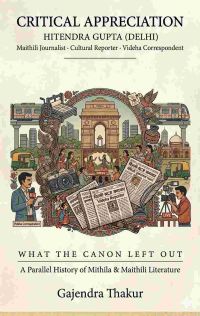
CRITICAL APPRECIATION HITENDRA GUPTA (DELHI) Maithili Journalist Cultural Reporter Correspondent/ JITENDRA KUMAR JHA 'JEETU' (JANAKPUR) Maithili Theatre Journalist Cultural Reporter Nepal Correspondent/ CRITICAL APPRECIATION NAVENDU KUMAR
I
CRITICAL APPRECIATION
HITENDRA GUPTA (DELHI)
Maithili Journalist · Cultural Reporter · Correspondent
Indian & Western Literary-Journalistic Theory · Videha Parallel History Framework
Navya-Nyāya Epistemology of Gaṅgeśa · Rasa-Dhvani-Vakrokti-Auchitya
II
CRITICAL APPRECIATION
JITENDRA KUMAR JHA 'JEETU' (JANAKPUR)
Maithili Theatre Journalist · Cultural Reporter · Nepal Correspondent
Indian & Western Literary-Journalistic Theory · Videha Parallel History Framework
Navya-Nyāya Epistemology of Gaṅgeśa · Rasa-Dhvani-Vakrokti-Auchitya
III
CRITICAL APPRECIATION
NAVENDU KUMAR JHA (PATNA)
Senior Maithili Journalist · Radio Broadcaster · Cultural Chronicler
Indian & Western Literary-Journalistic Theory · Videha Parallel History Framework
Navya-Nyāya Epistemology of Gaṅgeśa · Rasa-Dhvani-Vakrokti-Auchitya
I
CRITICAL APPRECIATION
HITENDRA GUPTA (DELHI)
Maithili Journalist · Cultural Reporter · Correspondent
Indian & Western Literary-Journalistic Theory · Videha Parallel History Framework
Navya-Nyāya Epistemology of Gaṅgeśa · Rasa-Dhvani-Vakrokti-Auchitya
III
I. BIOGRAPHICAL AND CONTEXTUAL PROFILE
A. Identity and Location
Hitendra Gupta (हितेन्द्र गुप्ता) is a Maithili journalist and cultural reporter based in Delhi — a member of the large Maithili diaspora community of the national capital that forms one of the most significant nodes in the network of Maithili cultural and political life outside Mithila proper. His journalistic work as documented in the Videha archive is conducted in Maithili, situating him within the tradition of Maithili-language journalism that the Videha eJournal has championed as a central component of the democratic parallel literary history.
Delhi has been a crucial centre of Maithili activism, journalism, and cultural production since at least the mid-20th century — home to Maithili organisations, literary events, and a continuous journalistic presence in the Hindi-language national press that has also maintained a distinct Maithili cultural identity. Hitendra Gupta's presence in the Videha archive as a journalist reporting on issues affecting the Mithila and Bihar region from a Delhi vantage point represents this tradition of the diaspora journalist who maintains connections to both the capital's political scene and the cultural concerns of the Mithila homeland.
B. Videha Archive Presence
Hitendra Gupta appears in the Videha archive in the following confirmed entry:
'आब नहि खुलत नवका शराबक दोकान' (Āba Nahi Khulata Navakā Śarābaka Dokāna — No New Liquor Shops Will Now Open)
Published in: Videha Sadeha 23 (Prelim_23), pages 200–201. ISSN 2229-547X, www.videha.co.in.
This investigative/analytical journalism piece — on the Bihar government's decision to halt new liquor shop licences — is his primary documented contribution to the Videha archive. It appears in the same Sadeha volume as reports and essays by Navendu Kumar Jha (pages 186–189), Ganga Gunjan, Dr. Kailash Kumar Mishra, and Umesh Mandal's history of Maithili internet journalism — a volume that demonstrates the breadth of Videha's parallel journalistic history project.
II. JOURNALISTIC CORPUS AND ANALYSIS
A. 'Āba Nahi Khulata Navakā Śarābaka Dokāna' — Critical Analysis
This piece covers the Bihar government's policy decision to prohibit new liquor shop licences — a significant social policy story in the Bihar-Jharkhand political landscape with direct implications for the Maithili-speaking rural communities of Mithilanchal where alcohol-related social problems have been a longstanding concern. The title's direct declarative construction ('No new liquor shops will now open') is characteristic of hard news journalism: it leads with the decision and its finality.
From the perspective of Maithili journalism, this piece performs a crucial function within the Videha Parallel History Framework: it treats a Hindi-language political policy story as a matter of direct concern for the Maithili-speaking community and writes about it in Maithili. This is the journalistic equivalent of the Parallel History's literary assertion — that Maithili is a language of public affairs, policy discourse, and civic journalism, not merely of literature, song, and cultural expression.
The two-page length (pages 200–201) is typical of the analytical news-comment piece: long enough to provide context and implications, short enough to maintain journalistic pace. Within the broader Sadeha 23 context — which also contains Navendu Kumar Jha's report on the Vidyapati memorial event and Sushant Jha's historical analysis of Baliraj Garh — Gupta's piece represents the current-affairs journalism strand of the Videha archive's diverse journalistic practice.
B. Thematic Significance: Liquor Policy and Mithila
The liquor policy issue is not merely a bureaucratic story. In the Bihar-Mithila context, alcohol prohibition and liquor licensing have deep social dimensions: the relationship between alcohol consumption and domestic violence, agricultural debt, caste-based social hierarchies of drinking norms, and the wider question of state paternalism versus community self-determination. Bihar's eventual move to full alcohol prohibition under Chief Minister Nitish Kumar in 2016 was one of the most consequential Bihar policy decisions of the decade. Gupta's 2008 piece (Sadeha 23 dates from around 2008–2009) thus anticipates a major policy trajectory.
Writing about this issue in Maithili for the Videha platform is an act of linguistic democracy: it brings the policy discussion into the Maithili public sphere, treating Maithili speakers as citizens whose language is adequate to serious civic discourse. The Navya-Nyāya tradition's emphasis on śabda-pramāṇa (the authority of testimony) as a valid source of knowledge finds direct application here: journalistic testimony about policy decisions in Maithili constitutes valid civic knowledge for the Maithili-speaking community.
III. THEORETICAL FRAMEWORKS
A. Journalism as Śabda-Pramāṇa: Navya-Nyāya Analysis
Gaṅgeśa Upādhyāya's analysis of śabda-pramāṇa (verbal testimony as valid knowledge) in the Tattvacintāmaṇi's fourth khaṇḍa is directly applicable to journalistic practice. For Gaṅgeśa, verbal testimony is valid when the vaktā (speaker/source) has genuine knowledge (tattvajñāna), communicates it accurately (tattvajñāna-vākya), and the listener has no countervailing evidence (abādhitaviṣayaka). The journalist's role, in Navya-Nyāya terms, is precisely to be a reliable vaktā — one whose testimony meets the conditions of śabda-pramāṇa.
Hitendra Gupta's reporting from Delhi on Bihar policy connects the national capital's decision-making apparatus (where the information originates) with the Maithili-speaking readership (who are the recipients of the knowledge). The anumāna (inferential) structure of investigative journalism — from observed policy decision (hetu) through contextual analysis (vyāpti) to implications for the community (sādhya) — parallels the Navya-Nyāya structure of valid inferential cognition.
B. Jürgen Habermas: Journalism and the Public Sphere
Jürgen Habermas's theory of the public sphere (Strukturwandel der Öffentlichkeit, 1962; translated as The Structural Transformation of the Public Sphere, 1989) provides the most directly relevant Western framework for evaluating Maithili journalism. Habermas argues that democratic public life requires a functioning public sphere — a domain of communicative action in which citizens discuss matters of common concern through reason-guided discourse rather than through power or tradition. A minority language's journalism is a constitutive element of its community's public sphere: without journalism in Maithili, Maithili speakers are excluded from the civic public sphere that Hindi and English journalism creates for their respective communities.
Hitendra Gupta's reporting — on a state policy directly affecting Bihar's Maithili-speaking population, written in Maithili for a Maithili-language journal — is a contribution to the Maithili public sphere in Habermas's precise sense. The Videha eJournal itself functions as a Habermasian public sphere institution: peer-reviewed, freely accessible, non-commercial, committed to reason-guided discourse on matters of concern to the Maithili community.
C. Indian Alaṃkāra Tradition: Auchitya and Journalistic Propriety
Kshemendra's Auchityavicāracarcā (11th century) establishes auchitya (contextual propriety) as the supreme aesthetic principle. Applied to journalism, auchitya demands that each piece of reporting be appropriate to its subject, audience, and occasion. Gupta's piece on liquor policy demonstrates auchitya in its choice of subject (directly relevant to the Bihar/Mithila community reading Videha), its register (journalistic prose, not literary elaboration), and its placement in Sadeha 23 alongside other policy and cultural reportage.
D. The Videha Parallel History Framework
The Videha Parallel History Framework's project of documenting the democratic, institutionally independent Maithili tradition includes not just poetry, fiction, and literary criticism but journalism and civic discourse. Hitendra Gupta represents a specific category within this framework: the Maithili journalist based in the national capital, whose dual positioning gives him access to national policy information while maintaining the Maithili-language commitment that translates that information for the Maithili community.
The Framework's insistence that Maithili is a language of full civic life — not a museum language or a merely literary language — is embodied in Gupta's practice of bringing Delhi-based political journalism into the Maithili archive. His work confirms what the Parallel History asserts: that Maithili speakers are engaged citizens requiring coverage of the full range of civic affairs in their own language.
IV. CRITICAL ASSESSMENT
Hitendra Gupta's documented Videha contribution is compact — a single two-page piece in Sadeha 23 — but its significance within the Parallel History Framework exceeds its length. It demonstrates that the Videha archive encompasses serious civic journalism alongside literary and cultural content; that the Maithili diaspora in Delhi produces journalism in Maithili for a Maithili readership; and that policy issues affecting Bihar and Mithila receive Maithili-language coverage within the Videha platform.
His position as a Delhi-based journalist writing in Maithili for the Videha platform places him within the tradition of what Gramsci would call the 'organic intellectual' of the migrant community: the journalist who maintains the community's cultural and linguistic identity while engaging with the political and civic life of the host city. This dual location — Delhi as institutional base, Mithila as cultural anchor — is structurally characteristic of the Maithili diaspora intellectual that the Videha Parallel History documents.
V. SELECT BIBLIOGRAPHY
Primary Sources
Gupta, Hitendra. 'Āba Nahi Khulata Navakā Śarābaka Dokāna.' Videha Sadeha 23, pp. 200–201. ISSN 2229-547X. www.videha.co.in.
Videha Sources
Thakur, Gajendra (ed.). Videha Sadeha 23 (Prelim_23). ISSN 2229-547X. www.videha.co.in.
Mandal, Umesh. 'Maithilīme Ī-Patrakāritāka Itihāsa.' Videha Sadeha 23. www.videha.co.in.
Theoretical Sources
Gaṅgeśa Upādhyāya. Tattvacintāmaṇi. Tr. S.H. Phillips & N.S.R. Tatacharya. Hackett, 2004.
Habermas, Jürgen. The Structural Transformation of the Public Sphere. Tr. T. Burger. Cambridge, MA: MIT Press, 1989.
Gramsci, Antonio. Prison Notebooks. Tr. Q. Hoare & G.N. Smith. London: Lawrence & Wishart, 1971.
Kshemendra. Auchityavicāracarcā. Tr. R. Gnoli. Rome: ISMEO, 1956.
II
CRITICAL APPRECIATION
JITENDRA KUMAR JHA 'JEETU' (JANAKPUR)
Maithili Theatre Journalist · Cultural Reporter · Nepal Correspondent
Indian & Western Literary-Journalistic Theory · Videha Parallel History Framework
Navya-Nyāya Epistemology of Gaṅgeśa · Rasa-Dhvani-Vakrokti-Auchitya
I. BIOGRAPHICAL AND CONTEXTUAL PROFILE
A. Identity and Location
Jitendra Kumar Jha, known by his journalistic nickname 'Jīṭū' (जीतू), is a Maithili journalist and cultural reporter based in Janakpur, Nepal — the sacred city of Mithila, the ancient capital of King Janaka and the birthplace of Sītā (Jānakī), located in Madhesh Province, southern Nepal. His journalistic base in Janakpur places him at the geographical and cultural heart of Nepalese Mithila, the trans-border cultural zone that the Videha Parallel History Framework consistently treats as a single cultural unity spanning the India-Nepal boundary.
Janakpur is not merely a sacred city but the most prominent centre of Maithili cultural life in Nepal — home to the Mithila Cultural Corporation, the Mithila Heritage Museum, the annual Janaki Navami festival, and a dense network of Maithili cultural institutions. It is also the base of Nepal's Mithila political and civic activism. A journalist based in Janakpur has immediate access to both the cultural-religious events that define Maithili heritage and the political processes affecting Nepal's Madheshi/Maithili-speaking population.
B. Pen-Name and Identity
The nickname 'Jīṭū' (जीतू) is an affectionate contracted form of 'Jitendra' — common in Mithila naming practice where bāul nāma (house-names/nicknames) are used alongside formal names. Its use in the Videha archive's byline ('riraport shri Jitendra Kumar Jha Jitu') signals that Jha is known within the Videha community under this intimate form, indicating a degree of personal familiarity and community embeddedness. The quotation marks around 'Jīṭū' signal its nickname status while retaining it as part of his journalistic identity.
C. Videha Archive Presence
Jitendra Kumar Jha 'Jīṭū' appears in the Videha archive with the following confirmed entry:
'नचिकेताक "एक छल राजा"क मंचन' (Nacikettāka 'Eka Chala Rājā'ka Maṃcana — The Staging of Nachiketa's 'Once There Was a King')
Published in: Videha Sadeha 8 (Prelim_8), in the Theatre Reports section. ISSN 2229-547X, www.videha.co.in.
This is a theatre review/report on the staging of 'Eka Chala Rājā' (एक छल राजा — Once There Was a King), a play by the renowned Maithili playwright Udaya Narayan Singh 'Nachiketa'. The report is part of a substantial theatre-and-culture section in Sadeha 8 that includes reports on multiple Maithili dramatic productions and cultural events from both India and Nepal, including reports from Janakpur's Mithila Nāṭyakalā Pariṣad (MINAP) events, Mithiyātrika-Jhankāra, the Videha Maithili Nāṭya Utsava, and the International Maithili Theatre Festival.
II. JOURNALISTIC CORPUS AND ANALYSIS
A. 'Nacikettāka Eka Chala Rājā ka Maṃcana' — Critical Analysis
The report covers the staging of Udaya Narayan Singh Nachiketa's play 'Eka Chala Rājā' — a production by one of the most significant figures in contemporary Maithili drama. Nachiketa (born 1943), linguist and literary critic who headed Banaras Hindu University's linguistics department before returning to Nepal, is the author of multiple Maithili plays and the translator of a substantial body of Sanskrit and other theatrical works into Maithili. His plays occupy a central position in the Videha Parallel History's theatre section.
A theatre review report from Janakpur covering a Nachiketa production is a document of significant cultural-historical importance: it records a specific performance event, places it in the context of Maithili dramatic practice, and communicates it to the broader Videha readership across the India-Nepal geography. In a tradition where theatre performance is ephemeral — leaving no permanent record unless documented — the journalist's report is the primary archival trace.
The placement of Jha's report within Sadeha 8's comprehensive theatre section — alongside reports from Delhi (MINAP Delhi events), Berma (Nepal), and other locations — situates the Janakpur production within the pan-Maithili theatrical geography. This is the Parallel History Framework's characteristic move: treating Maithili cultural production as a transnational unity, not divided by the India-Nepal border.
B. The Nachiketa Connection and Cultural Significance
Udaya Narayan Singh 'Nachiketa' is one of the most significant figures in the Videha Parallel History. His 'Eka Chala Rājā' — whose title is a direct allusion to the traditional Maithili folk narrative opening formula ('Once there was a king...') — deploys the fairy-tale opening to critical, often satirical ends. Reporting on a production of this play from Janakpur, the cultural capital of Nepalese Mithila, is an act of cultural documentation with multiple layers of significance.
First, it documents the reception of a major Maithili play in its Nepalese cultural home. Second, it demonstrates that Janakpur's theatre culture engages seriously with contemporary Maithili dramatic literature from both sides of the border. Third, it places Jha as a culturally informed journalist — not merely a reporter of events but someone capable of contextualising the production within the larger Maithili theatrical tradition.
III. POSITION WITHIN THE VIDEHA PARALLEL HISTORY
A. Nepal-India Cultural Bridge
Jitendra Kumar Jha's journalistic position in Janakpur makes him a crucial figure for the Videha Parallel History Framework's insistence on the trans-border unity of Maithili culture. The political boundary between India and Nepal bisects Mithila geographically and administratively, but the Videha Framework — following the Vidyapati tradition that was itself both Indian and Nepalese — consistently treats the Maithili cultural community as a single entity. A journalist reporting from Janakpur for the Videha archive enacts this unity in institutional form.
The Sadeha 8 theatre section in which Jha's report appears is itself a demonstration of this trans-border cultural practice: it juxtaposes theatrical reports from Nepal (Janakpur's MINAP), India (various Bihar locations), and the diaspora (Delhi events) within a single cultural-journalistic framework. Jha's contribution to this framework is the Janakpur viewpoint — the perspective from the cultural capital of Nepalese Mithila.
B. Theatre Journalism and the Oral-Performative Tradition
Within the Videha Parallel History Framework, theatre journalism occupies a special position because theatre is the most immediate form of the oral-performative tradition that the Framework's folk culture strand privileges. Where the printed poem or novel can be archived directly, the performance event exists only in the moment — and the journalist's report is its primary trace in the historical record. Jha's theatre reporting thus performs a preservation function that is analogous to (though different from) Hriday Narayan Jha's folk song documentation: both create textual records of ephemeral cultural practices.
IV. THEORETICAL FRAMEWORKS
A. Navya-Nyāya: Pratyakṣa and the Theatre Review
Gaṅgeśa's analysis of pratyakṣa (direct perceptual knowledge) as the most reliable form of pramāṇa is directly relevant to the theatre reviewer's epistemological position. The theatre reviewer's knowledge of the performance is pratyakṣa — direct perception of what was enacted on stage — and this gives theatre journalism a special epistemological authority that other forms of cultural journalism lack. Jha's presence at the Janakpur staging of 'Eka Chala Rājā' as a reporter gives his account the status of savikalpa-pratyakṣa (determinate perceptual knowledge) — he perceived the production directly and organised that perception into a communicable report.
The chain from pratyakṣa to anumāna to śabda-pramāṇa is the structure of theatre journalism: the journalist perceives the performance (pratyakṣa), infers its quality and significance (anumāna), and communicates that judgment to readers who cannot attend the performance (śabda-pramāṇa). Jha's report thus functions as the śabda-pramāṇa that transmits knowledge of the Janakpur staging to the wider Videha readership.
B. Walter Benjamin: The Reportage and the Staging
Walter Benjamin's analysis of the relationship between the original and its reproduction — and more specifically his essay 'The Author as Producer' (1934) — argues that progressive cultural journalism must not merely report on cultural events but situate them within the social conditions of their production. The question 'what is the quality of this staging?' must be supplemented by 'what are the conditions under which Maithili theatre is produced in Janakpur?' and 'what does the choice of a Nachiketa play for this audience say about the Janakpur theatre scene's cultural ambitions?'
Benjamin's concept of the Tendenz (political tendency) of art — the idea that form itself carries political meaning, not just content — is relevant to theatre journalism. A report that merely describes the plot and notes the audience's response is less adequate than one that attends to how the production's formal choices connect to the social reality of Nepalese Mithila. Jha's positioning as a Janakpur-based journalist gives him the contextual knowledge to make such connections.
C. Habermas: Public Sphere and Theatre
Habermas's concept of the public sphere as the domain of rational-critical discourse on matters of common concern finds in theatre one of its historically primary institutions: from the Greek polis through the Elizabethan public theatre to the bourgeois literary public sphere, theatre has been a central space of public cultural debate. Maithili theatre in Janakpur is not merely entertainment but a form of public discourse about Maithili cultural identity, social values, and political aspirations — particularly in the context of Nepal's post-2006 federal restructuring and the Madheshi movement for autonomy.
Theatre journalism that documents and critically engages with this public cultural discourse is thus doubly a public sphere institution: it reports on a public sphere practice (theatre) for a public sphere platform (Videha). Jha's report from Janakpur is a contribution to the nested public spheres of Maithili cultural life in Nepal.
D. Indian Rasa Theory Applied to Theatre Journalism
Bharatamuni's Nāṭyaśāstra, the foundational text of Indian theatrical theory, provides a framework for theatre journalism that is indigenous to the Maithili tradition. The reviewer's task in the rasa framework is not merely to describe the play but to assess whether the production successfully instantiates the intended rasas — whether the vibhāva (determinants), anubhāva (consequents), and sañcārī bhāva (transient states) are effectively managed to generate the rasa-experience in the spectator. For a Maithili theatre reviewer, this framework is not an academic overlay but a living critical vocabulary rooted in the tradition's own self-understanding.
'Eka Chala Rājā's' satirical mode — the fairy-tale opening deployed for critical purposes — suggests that its primary rasas are Hāsya (comedy) and Raudra (controlled satirical fury), with elements of Vīra (heroic resolve) in the protagonist's challenges to authority. A Navya-Nyāya-informed theatre review would assess whether the production's anumāna (its chain of dramatic arguments) successfully establishes the vyāpti (general truth) that the play's specific narrative events are designed to demonstrate.
V. CRITICAL ASSESSMENT
Jitendra Kumar Jha 'Jīṭū' occupies a specific and vital position within the Videha Parallel History's documentation of Maithili cultural life: as the journal's Janakpur correspondent for theatre, he provides the Nepal-based perspective that ensures the archive's pan-Maithili character. His report on the Nachiketa staging demonstrates the competence and cultural engagement of Janakpur's theatre journalism, and its preservation in the Sadeha 8 volume ensures that this ephemeral performance event has a permanent archival record within the Maithili digital heritage.
The brevity of his documented presence in the archive — a single confirmed report — reflects the limitations of the available archive rather than his significance. In a tradition where theatre documentation is sparse, even a single well-observed report has lasting value. The Videha Parallel History Framework's archival practice gives Jha's journalism the permanence it deserves.
VI. SELECT BIBLIOGRAPHY
Primary Sources
Jha, Jitendra Kumar 'Jīṭū'. 'Nacikettāka "Eka Chala Rājā"ka Maṃcana.' Videha Sadeha 8 (Prelim_8). ISSN 2229-547X. www.videha.co.in.
Videha Sources
Thakur, Gajendra (ed.). Videha Sadeha 8 (Prelim_8) — Theatre Section. ISSN 2229-547X. www.videha.co.in.
Singh, Udaya Narayan 'Nachiketa'. Referenced throughout Videha archive. www.videha.co.in.
Theoretical Sources
Bharatamuni. Nāṭyaśāstra. Tr. M. Ghosh. Calcutta: Asiatic Society, 1951.
Benjamin, Walter. 'The Author as Producer.' In Reflections. Tr. E. Jephcott. New York: Schocken, 1978.
Habermas, Jürgen. The Structural Transformation of the Public Sphere. Tr. T. Burger. Cambridge: MIT, 1989.
Gaṅgeśa Upādhyāya. Tattvacintāmaṇi. Tr. Phillips & Tatacharya. Hackett, 2004.
III
CRITICAL APPRECIATION
NAVENDU KUMAR JHA (PATNA)
Senior Maithili Journalist · Radio Broadcaster · Cultural Chronicler
Indian & Western Literary-Journalistic Theory · Videha Parallel History Framework
Navya-Nyāya Epistemology of Gaṅgeśa · Rasa-Dhvani-Vakrokti-Auchitya
I. BIOGRAPHICAL AND CONTEXTUAL PROFILE
A. Identity, Formation and Location
Navendu Kumar Jha (नवेन्दु कुमार झा) is a senior Maithili journalist, radio broadcaster, and cultural chronicler based in Patna — the capital of Bihar and the principal institutional centre of Bihar's cultural, political, and journalistic life. His journalistic career spans print journalism, All India Radio (AIR) broadcasting, and digital journalism through the Videha platform. He is the most documented and prolific journalist in the three-figure group under consideration, with confirmed contributions across at least six Videha Sadeha volumes (Sadeha 10, 15, 23, 30, 34, and 35) covering a wide range of subjects: infrastructure development, caste sociology, social organisation, Maithili radio broadcasting, electoral politics, cultural festivals, and Bihari folk traditions.
Patna's significance as Navendu Kumar Jha's base cannot be overstated. As Bihar's capital, Patna is both the centre of the state's political and administrative apparatus and the principal hub of its media institutions — including All India Radio Patna, which has one of the longest and most significant histories of Maithili-language broadcasting in India. Jha's career at AIR Patna, combined with his print journalism career, makes him a figure who bridges the two principal media of Maithili public communication in the pre-internet era.
B. All India Radio and Maithili Broadcasting
Navendu Kumar Jha's most historically significant documented contribution to the Videha archive is his essay 'Pacāsa Varṣaka Bhela Prādeśika Samācāra Ekāṃśa — 1993 me Prāraṃbha Bhela Chala Maithilīme Samācāraka Prasāraṇa' (पचास वर्षक भेल प्रादेशिक समाचार एकांश — 1993 मे प्रारंभ भेल छल मैथिली मे समाचारक प्रसारण — The Regional News Unit Has Completed Fifty Years: Maithili-Language News Broadcasting Began in 1993), published in Videha Sadeha 34 (Prelim_34), pages 380–388.
This piece is a primary historical document of Maithili radio journalism: it records the milestone of the AIR Patna Regional News Unit's fiftieth anniversary, including the specific historical fact that Maithili-language news broadcasting on AIR began in 1993. This date — 1993 — is a landmark in Maithili's institutional recognition as a media language, and Jha's documentation of it is an act of archival preservation that the Videha Parallel History Framework regards as foundational.
The 1993 beginning of Maithili news broadcasting on AIR Patna predates Maithili's recognition as a Scheduled Language (which came in 2003 under the 8th Schedule amendment) by a decade — demonstrating that Maithili's institutional presence in broadcasting was established before its full constitutional recognition. Jha's journalism thus contributes to the record of Maithili's pre-recognition institutional history.
C. Complete Documented Works in Videha Archive
Videha Sadeha 10 (Prelim_10): Three news reports — 'Rela Lāīnasāṃ Juṛata Bhārata Ā Nepāla' (India and Nepal will be connected by railway); 'Bhāratīya Sāmājika Vyavasthāme Āiyo Jīvanta Achi Jāti Vyavasthā — Prof. Sharma' (Caste system still living in Indian social order); 'Pradeśame Lāgata Cauadhahaṭā Nava Udyoga Samūha, ASSOCHAM Kaela Ehi Disa Pahala — Mithilāṃcalame Seho Lāgata Nava Udyoga' (Fourteen new industry groups in the province; ASSOCHAM initiative; new industries also in Mithilanchal).
Videha Sadeha 15 (Prelim_15): 'Ṭākāka Ābhāva Me Ṭhappa Achi Kosī Mahāsetūka Kāja Saharasā-Phārabisgaṃja Amāna Parivarttanaka Kāja Mada' (Work on Kosi Mahasetu stalled due to lack of funds; Saharsa-Forbesganj bridge work in limbo); reports on Maithili literary conference, MALASAM's sixth session, Chetana Samiti's 69th year.
Videha Sadeha 23 (Prelim_23): 'Astitvaka Lela Saṃgharṣa Karaita Paṭanāka Vidyāpati Smṛti Parva' (Struggling for existence: Patna's Vidyapati Memorial Festival), pages 186–189. A sustained cultural reportage piece on the festival's precarious institutional survival.
Videha Sadeha 30 (Prelim_30): Multiple pieces — 'Bihāraka Loka Parva-Chaṭhi' (Bihar's folk festival Chhath); 'Bihārame Sūryopāsanāka Pramukha Kendra' (Principal centres of sun-worship in Bihar); 'Vidyāpati Smṛti Divasa (11 November 2008) par Viśeṣa — Yaśasvī Kavi Chalāha Mahākavi Vidyāpati' (Special on Vidyapati Memorial Day: The illustrious poet Mahakavi Vidyapati); 'Upekṣita Achi Sonapura Ā Harihara Kṣetra Melā' (Sonepur and Harihar Kshetra Mela is neglected); 'Pradeśame Nahi Thami Rahal Jātīya Hiṃsāka Daura' (The cycle of caste violence in the state has not stopped); 'Rājagīrame Sampanna Bhela Saṃgha Ka Tīna Divāsīya Baisaka Gāme-Gāme Sakriya Hoyata Saṃgha' (Three-day RSS session in Rajgir; organisation will be active village to village); 'Gāma Me Vijñāna Keṃ Lokapriya Banaba Me Lāgala Chhathi Mānasa Bihārī' (Manas Bihari engaged in popularising science in villages), pages 1387–1415.
Videha Sadeha 34 (Prelim_34): Key historical journalism piece — 'Pacāsa Varṣaka Bhela Prādeśika Samācāra Ekāṃśa' (Regional News Unit's 50 years; 1993 Maithili news broadcasting began); 'Satāka Prāpti Banala Bhājapāka Uddeśya' (Attaining power has become BJP's aim), pages 380–388.
Videha Sadeha 35 (Prelim_35): Multiple reports — India-Nepal railway connectivity; caste system; industrial development in Mithilanchal; Bihar elections (three phases, voter enthusiasm, political parties' anxiety, Rahul Gandhi's Bihar mission); 'Dū Varṣa Pūrā Kaela Maithilī Dainika Mithilā Samāda' (Two years completed by Maithili daily Mithila Samad), pages 405–416.
II. THEMATIC ANALYSIS OF THE JOURNALISTIC CORPUS
A. Infrastructure and Regional Development
Navendu Kumar Jha's infrastructure journalism — on the India-Nepal rail link, the Kosi Mahasetu (Great Koshi Bridge) project, the ASSOCHAM initiative for Mithilanchal's industrial development — addresses one of the most urgent practical concerns of the Mithila region. The Koshi river's annual floods, the lack of adequate bridge and rail infrastructure connecting the Terai to the mainland, and the economic underdevelopment of Mithilanchal relative to western Bihar are longstanding features of the region's marginalisation within the Bihar and national development framework.
His report on the Koshi Mahasetu ('Ṭākāka Ābhāva Me Ṭhappa Achi Kosī Mahāsetūka Kāja') — the great bridge across the Koshi river linking Saharsa and Forbesganj — is a piece of advocacy journalism: it documents governmental failure to fund a project critical to the region's connectivity and economic development. Writing this in Maithili for the Videha platform ensures that the Maithili-speaking community receives this information in their own language — a basic democratic requirement.
B. Cultural Journalism: Vidyapati, Chhath and Mithila Heritage
Jha's cultural journalism on the Vidyapati Memorial Festival, the Chhath folk festival, the Sonepur Mela, and Harihar Kshetra demonstrates sustained engagement with the living cultural traditions of Mithila and Bihar. His piece 'Astitvaka Lela Saṃgharṣa Karaita Paṭanāka Vidyāpati Smṛti Parva' — 'Struggling for existence: Patna's Vidyapati Memorial Festival' — is particularly significant: it documents the precarious institutional situation of the Vidyapati festival, the major annual celebration of Maithili's greatest poet, in the Bihar capital.
The Vidyapati Memorial Festival's 'struggle for existence' in Patna is itself a Parallel History story: the canonical figure who should receive the most generous institutional support is instead fighting for survival in an institutional environment that privileges Hindi-language cultural events over Maithili ones. Jha's documentation of this struggle is an act of cultural advocacy — recording the neglect as well as the celebration.
His special report on Mahakavi Vidyapati for the 11 November 2008 Vidyapati Memorial Day ('Vidyāpati Smṛti Divasa par Viśeṣa — Yaśasvī Kavi Chalāha Mahākavi Vidyāpati') places the celebration of Vidyapati within the contemporary cultural context — not as a museum-piece commemorated annually but as the living ancestor of the present Maithili literary tradition.
C. Radio Broadcasting History: The 1993 Landmark
The most historically consequential piece in Jha's documented Videha corpus is the article on AIR Patna Regional News Unit's 50 years, with its central finding that Maithili-language news broadcasting began in 1993. This is primary source material for the history of Maithili media — a landmark date that deserves placement in the chronology of Maithili's institutional development.
The period 1993–2003 is a crucial decade in Maithili's institutional history: from the beginning of AIR news in Maithili (1993) through the Maithili internet presence (Videha founder Gajendra Thakur's early web activity) to the formal Scheduled Language recognition (2003). Jha's documentation of the 1993 start date contributes to a fuller understanding of this decade, showing that institutional recognition in broadcasting preceded formal constitutional recognition by ten years.
D. Political Journalism: Elections and the Communal Question
Jha's political journalism — on Bihar elections (voter enthusiasm, Rahul Gandhi's Bihar mission, BJP's power-seeking agenda) — demonstrates that the Videha parallel journalism tradition does not confine itself to cultural topics but engages fully with the political processes that directly affect the Maithili-speaking electorate. His observation 'Matadātā Sabhaka Utasāha Madhya Sampanna Bhela Tīna Caraṇaka Matadāna — Rājanaitika Dalaka Becainī Baṛhauane Achi Matadātāka Cuppī' (Three-phase voting completed amid voter enthusiasm; voters' silence has increased political parties' anxiety) is a perceptive analysis of the gap between democratic participation and political representation — a gap that has particular resonance for Mithila's historically marginalised political situation.
III. THEORETICAL FRAMEWORKS
A. Navya-Nyāya: Anumāna and Investigative Journalism
Gaṅgeśa Upādhyāya's analysis of anumāna (inference) in the Tattvacintāmaṇi's second khaṇḍa provides a formal structure for understanding investigative journalism's epistemic logic. The journalist's task in a piece like 'Koshi Mahasetu work stalled' is precisely anumāna: from the hetu (observed fact — the work has stopped), through the vyāpti (general principle — government projects stall when funds are withheld), to the sādhya (conclusion — the government has failed to allocate the required funds). The journalist's work is the identification and verification of the vyāpti, the general principle that gives the specific observation its significance.
The Navya-Nyāya tradition's emphasis on the precision of technical vocabulary — its development of highly specific logical terms (viśeṣaṇa, pratiyogitā, anuyogitā) to capture subtle distinctions — is structurally analogous to good journalism's requirement for precision in attribution, evidence, and inference. Both practices are fundamentally concerned with the valid derivation of knowledge from evidence.
B. Gaṅgeśa's Geography: Mithila as Epistemic Home
Gaṅgeśa Upādhyāya was a Maithil, born and writing in Mithila. Navendu Kumar Jha is a Patna-based Maithili journalist writing for the Videha archive — an institution whose editorial practice traces its intellectual genealogy through the Mithila tradition to Gaṅgeśa. The epistemological framework that Gaṅgeśa developed in Mithila is the framework within which Maithili journalism operates: the concern for valid knowledge (pramā), reliable testimony (śabda), and valid inference (anumāna) that Gaṅgeśa systematised is the intellectual heritage within which Jha's journalistic practice is situated.
This geographical-intellectual connection between Gaṅgeśa's Mithila and Jha's journalism is not merely metaphorical. Gaṅgeśa's concern with the conditions under which language transmits valid knowledge is directly relevant to the journalist's concern with accurate, evidence-based reporting. The Navya-Nyāya tradition's suspicion of invalid inference (hetvābhāsa — fallacious reasoning) maps onto journalism's suspicion of bias, sensationalism, and unverified claims.
C. Jürgen Habermas: Public Sphere and Maithili Broadcasting
Habermas's theory of the public sphere (1989) distinguishes between the 'political public sphere' (where citizens discuss matters of state) and the 'literary public sphere' (where cultural matters are publicly debated). Navendu Kumar Jha's corpus spans both: his reporting on elections, the BJP's agenda, and Bihar development is political public sphere journalism; his cultural reporting on Vidyapati, Chhath, and Maithili radio is literary-cultural public sphere journalism. Both are necessary for a functioning Maithili democratic public sphere.
The 1993 beginning of Maithili news broadcasting on AIR is significant precisely in Habermasian terms: broadcasting creates a public sphere at scale, reaching listeners who cannot read newspapers or access digital platforms. The beginning of Maithili AIR news in 1993 marks the extension of the Maithili public sphere into the broadcast medium — a critical democratic development. Jha's documentation of this milestone is itself a contribution to the public sphere's self-awareness.
D. The Videha Parallel History Framework
Navendu Kumar Jha is the most comprehensive journalist in the Videha Parallel History's documentation of Maithili journalism. His breadth — from infrastructure to cultural heritage to radio history to electoral politics — maps the full range of what civic Maithili journalism aspires to cover. His Patna base gives him access to both the Bihar government and the cultural institutions of the state capital, making him a bridge between the political and the cultural dimensions of Maithili public life.
Particular note should be taken of two aspects of his contribution to the Parallel History. First, his documentation of the Mithila Samad Maithili daily newspaper ('Dū Varṣa Pūrā Kaela Maithilī Dainika Mithilā Samāda') — recording the two-year milestone of the first Maithili daily newspaper — is a landmark in Maithili media history. Second, his sustained reporting on the Vidyapati Memorial Festival's institutional precarity documents the contradiction at the heart of Bihar's cultural policy: the greatest Maithili poet is officially celebrated but inadequately supported.
IV. CRITICAL ASSESSMENT
Navendu Kumar Jha is among the most significant figures in the Videha Parallel History's journalistic strand. His corpus across six Sadeha volumes is the most extensive of any journalist in the archive, covering more than a decade of Maithili journalism from Patna. His range — from the Koshi bridge to the AIR news history to the Vidyapati Festival to Bihar elections — demonstrates the full scope of what Maithili civic journalism can and should address.
Three contributions stand out as historically significant. The 1993 AIR Maithili news broadcasting date (Sadeha 34) is primary historical data for Maithili media history. The report on Mithila Samad's two-year anniversary (Sadeha 35) documents the founding of the first Maithili daily newspaper. And the series of Vidyapati Festival reports (Sadeha 23, 30) provides a multi-year documentation of the festival's institutional precarity that is available nowhere else in the Maithili public record. These three contributions alone justify placing Navendu Kumar Jha in the first rank of the Videha Parallel History's journalistic contributors.
V. SELECT BIBLIOGRAPHY
Primary Sources: Works of Navendu Kumar Jha in Videha
Jha, Navendu Kumar. 'Rela Lāīnasāṃ Juṛata Bhārata Ā Nepāla' and two other reports. Videha Sadeha 10 (Prelim_10). www.videha.co.in.
Jha, Navendu Kumar. 'Ṭākāka Ābhāva Me Ṭhappa Achi Kosī Mahāsetūka Kāja.' Videha Sadeha 15 (Prelim_15), pp. 84–87. www.videha.co.in.
Jha, Navendu Kumar. 'Astitvaka Lela Saṃgharṣa Karaita Paṭanāka Vidyāpati Smṛti Parva.' Videha Sadeha 23 (Prelim_23), pp. 186–189. www.videha.co.in.
Jha, Navendu Kumar. 'Bihāraka Loka Parva-Chaṭhi' and six other pieces. Videha Sadeha 30 (Prelim_30), pp. 1387–1415. www.videha.co.in.
Jha, Navendu Kumar. 'Pacāsa Varṣaka Bhela Prādeśika Samācāra Ekāṃśa — 1993 me Prāraṃbha Bhela Chala Maithilīme Samācāraka Prasāraṇa' and 'Satāka Prāpti Banala Bhājapāka Uddeśya.' Videha Sadeha 34 (Prelim_34), pp. 380–388. www.videha.co.in.
Jha, Navendu Kumar. 'Rela Lāīnasāṃ Juṛata Bhārata Ā Nepāla' and multiple other reports. Videha Sadeha 35 (Prelim_35), pp. 405–416. www.videha.co.in.
Theoretical Sources
Gaṅgeśa Upādhyāya. Tattvacintāmaṇi. Tr. S.H. Phillips & N.S.R. Tatacharya. Hackett, 2004.
Habermas, Jürgen. The Structural Transformation of the Public Sphere. Tr. T. Burger. Cambridge: MIT, 1989.
Habermas, Jürgen. The Theory of Communicative Action. Tr. T. McCarthy. Boston: Beacon, 1984.
Matilal, Bimal Krishna. Perception: An Essay on Classical Indian Theories of Knowledge. Oxford: Clarendon, 1986.
Phillips, Stephen. Epistemology in Classical India. New York: Routledge, 2012.
Gramsci, Antonio. Prison Notebooks. Tr. Q. Hoare & G.N. Smith. London: Lawrence & Wishart, 1971.
अपन मंतव्य editorial.staff.videha@zohomail.in पर पठाउ।