
Gajendra Thakur
A PARALLEL HISTORY OF MITHILA & MAITHILI LITERATURE- PART 13
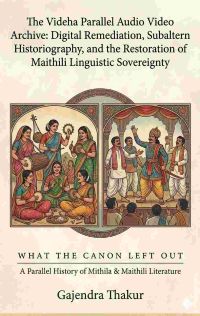
The Videha Parallel Audio Video Archive: Digital Remediation, Subaltern Historiography, and the Restoration of Maithili Linguistic Sovereignty
The Videha Parallel Audio Video Archive: Digital Remediation, Subaltern Historiography, and the Restoration of Maithili Linguistic Sovereignty
The Videha Parallel Audio Video Archive, hosted as a critical component of the Videha e-journal ecosystem, represents perhaps the most ambitious effort in the twenty-first century to reclaim and preserve the cultural and linguistic heritage of the Mithila region. Founded in 2004 by the polymathic editor Gajendra Thakur, the archive operates under the auspices of the first Maithili fortnightly e-journal (ISSN 2229-547X), which has consistently challenged the centralized, elite-caste hegemony of state-sponsored literary academies. The archive is not merely a repository of media files; it is the digital manifestation of a broader intellectual movement known as "Parallel Literature." This movement seeks to provide an alternative to the official Maithili canon, which is often perceived as having been sanitized of its subaltern, feminist, and trans-regional complexities. By leveraging the decentralized nature of the internet, the Videha archive has bypassed traditional institutional gatekeepers to create a living, democratic institution that serves the Maithili-speaking population of both India and Nepal, as well as the global diaspora.
Historical and Sociological Foundations of the Parallel Movement
To understand the necessity of the Videha Parallel Audio Video Archive, one must first examine the historical and sociological landscape of Mithila. Historically identified with the ancient kingdom of Videha—the homeland of Sita and the intellectual cradle of the Navya Nyāya school of logic—Mithila has long been a center of Indian civilization. However, the modern history of the Maithili language has been marked by significant stratification. Since the language’s inclusion in the Eighth Schedule of the Indian Constitution in 2003, the literary establishment has often remained under the control of patronage networks that marginalize non-represented castes and voices.
The "Parallel History" framework, which underpins the archive, was developed as a direct response to this exclusion. As noted by sociologists such as T.K. Oommen, the Maithili region has historically been economically and culturally dominated by specific social strata, which has occasionally led to the suppression of vernacular realism in favor of a courtly or priestly elite narrative. The Videha movement draws inspiration from the Narashanshi referred to in the Vedas as a form of parallel literature, asserting that the true roots of Maithili culture lie in a "foundational democratic-spiritual corpus" rather than in the exclusive preserves of royal courts.
|
Linguistic Period |
Developmental Stage |
Key Characteristics in Parallel History |
|
500 BC - 100 BC |
Pali (Early Prakrit) |
Canonical Buddhist language; early vernacular shifts. |
|
100 BC - 500 AD |
Middle Indo-Aryan |
Dramatic Prakrits; emergence of popular speech forms. |
|
500 AD - 1100 AD |
Apabhramsa/Avahatta |
Transitional "popular" speech; Buddhist Charyapadas. |
|
1100 AD - Present |
New Indo-Aryan |
Emergence of Maithili, Bengali, and Assamese as distinct entities. |
The Videha archive seeks to document this "Parallel Tradition" through a multi-layered historiography. This includes the reclaiming of the 50 Charyapadas of 23 Siddha poets (such as Luipada and Saraha) as the true ancestors of the Maithili lyric, rather than treating them as peripheral curiosities of Old Bengali or Assamese. This repositioning is critical, as it shifts the origin of Maithili literature from the 14th-century court of Vidyapati to a much earlier, subaltern, and spiritually democratic milieu.
Technical Architecture and Multimedia Preservation
The technical infrastructure of the Videha Parallel Audio Video Archive is designed to address the specific needs of a low-resource language while ensuring maximum accessibility for a diverse user base. The archive handles a variety of media formats, including digital e-books, graphic novels, audio recordings, and video documentaries. This multimedia approach is not merely aesthetic; it is a strategic response to the declining literacy in the original Tirhuta script and the "invasion" of Hindi and Nepali media.
One of the most innovative features of the archive is the "Maithili Read Aloud & Sign Language" project. By producing video content that incorporates sign language and audible readings of canonical and contemporary texts, the archive ensures that the Maithili digital renaissance is inclusive of persons with disabilities. This initiative aligns with the editor's commitment to accessibility, as the contents are periodically checked for technical issues that might hinder users with visual or auditory impairments.
The archive also serves as a vital platform for the preservation of oral traditions. Mithila has a rich history of oral narratives, characterized by compression and wit, such as the Dāka Vachan and the Dhūrta Samāgama. These forms, which prioritize brevity and rhetorical reversal, find their modern descendants in the "Seed Stories" (Bīhani Kathā) archived on Videha. By recording and archiving these oral performances, Videha preserves the melodic and rhythmic nuances of the Maithili language that are often lost in purely textual transcriptions.
Documentation of Folk Arts and Ritual Performance
A significant portion of the video archive is dedicated to the documentation of Mithila’s ritualistic paintings and folk songs. The "Parallel" view of Mithila art emphasizes its role as a living, democratic practice rather than a static aesthetic category. The archive documents various forms of art, including:
· Bhittichitra (Wall Painting): Specifically the Kohbar Ghar (nuptial room) murals that are traditionally created by women to symbolize fertility and joy.
· Aripana (Floor Art): Ritualistic drawings created during festivals and life-cycle ceremonies.
· Pata-Chitra (Canvas Painting): More contemporary adaptations of traditional motifs.
The archive systematically records the songs associated with these rituals, which are often passed down verbally across generations in the woman-dominated space of the Angana (courtyard). By digitizing these performances, Videha counters the "usurpation" of these traditions by commercial interests and ensures that the specific cultural meanings of motifs like the Kalash (sacred pot) or the Sita-Ram narrative remain rooted in their local context.
|
Notable Artist/Singer |
Contribution Category |
Significance in Archive |
|
Sita Devi |
Mithila Painting |
National award-winning artist from Jitwarpur; pioneer of the form. |
|
Ravindra Nath Thakur |
Song/Drama |
Conferred title "Abhinav Vidyapati"; transformed Maithili performance culture. |
|
Maithili Thakur |
Contemporary Folk |
Popularized Maithili songs for the digital-native generation. |
|
Sharda Sinha |
Folk Music |
Renowned for wedding and festival songs; "Bihar Kokila." |
The Maithili CD/Album Renaissance: Issue 217 and Critical Musicology
A landmark moment in the archive's documentation of Maithili music is Videha Issue 217 (January 2017), a special issue dedicated to Maithili CDs and albums. This issue serves as a critical survey of the "Geet-Sangeet" landscape, providing both a technological record of digital releases and a sociological critique of the music industry in Mithila and Nepal.
The State of Maithili Music in Nepal
Contributor Dinesh Yadav provides a stark assessment of Maithili music in Nepal, noting that while the region is rich in artists like Udit Narayan Jha and Muralidhar, the industry is plagued by "syndicates" and institutional neglect. Yadav critiques the "baniya-giri" (commercialism) where institutional funds meant for the promotion of Vidyapati’s music are often mired in controversy and caste-based favoritism. The archive highlights the transition of Maithili music into the digital era, noting that while recording studios are proliferating, the lack of professional training for new entrants has led to the "invasion" of Hindi and Bhojpuri influences on the authentic Maithili "flavor".
Standardization of the Mithila Anthem
A key intellectual proposal in Issue 217 is Yogendra Pathak 'Viyogi's' call for the standardization of the Bhagwati Vandana ("Jai Jai Bhairavi"). Viyogi argues that just as "Jana Gana Mana" serves as a unified national anthem with a standard melody, "Jai Jai Bhairavi" should have a simplified, standard tune that allows all Maithils to participate in unison during public gatherings, rather than being subjected to the complex improvisations of individual performers that hinder collective participation.
Archival Listings of Folk and Devotional Albums
Issue 217 provides an exhaustive list of Maithili CDs and albums that have shaped the contemporary auditory landscape :
· Folk and Ritual Songs: The archive preserves the work of Jage Mahto and Jage Raut (Karik Jhumar, Sokha Jhumar) and Birasi Sada, whose recordings of songs for Gahil Mata and Bhuinya Baba represent the subaltern spiritual traditions of the region.
· The "Bihar Kokila" Legacy: Ira Mallik provides a descriptive survey of Sharda Sinha’s "Vivah-Geet" album, listing 16 traditional wedding songs categorized into Side A and Side B, such as "Aaj Dhanma Kuta-u Raghubarba San" and "More Babua Ko Nazariyo Na Lage".
· Classical-Folk Synthesis: Dr. Kailash Kumar Mishra explores the work of Prof. Chandeshwar Jha, who utilized CDs and DVDs to preserve folk Maheshbanis and Bhagwati Vandanas set to classical ragas, such as Jogiya Mor Jagat Sukhadayak and Sabahak Sudhi Aha Lai Chhi He Ambe.
· The Ghazal Influence: The album Sinehiya by Kunj Bihari Mishra is reviewed by Pradeep Pushpa as a significant experiment in the Maithili ghazal-style song, though it notes the technical challenges of maintaining formal prosody (Behr and Qaafiya) in modern pop recordings.
Children's Media and the Archival Gap
Gajendra Thakur highlights a "complete lack" of dedicated Maithili CD albums for children, identifying this as a major threat to linguistic transmission across generations. The archive attempts to fill this gap by documenting and providing links to the few existing resources, such as Ramesh Ranjan's plays and the Bal Mandali recordings.
The Anchinhar Movement: Restoring the Maithili Ghazal
The Videha archive has been instrumental in the revitalization of the Maithili ghazal through the "Anchinhar Aakhar" (Unfamiliar Word) movement. Launched on April 11, 2008, this movement sought to correct a "dark interlude" in Maithili literary history during which the formal constraints of the ghazal—such as Behr (meter) and Qaafiyaa (rhyme)—were largely abandoned. This technical decline had led to the marginalization of legitimate poets who maintained rigorous standards, such as Vijaynath Jha and Yoganand Heera.
Gajendra Thakur, acting as Maithili’s first "Aruji" (prosody expert), authored the Ghajalsastram, the first comprehensive theoretical manual of the ghazal in the Maithili language. This manual, archived on the Videha site, explains the Arabic and Persian genealogy of the form and provides a systematic framework for its adaptation to Maithili phonetics. The Anchinhar movement successfully brought 350 to 400 new and previously marginalized writers into the literary mainstream within a single decade by providing them with the technical tools to master the form.
The archive documents the "legitimate lineage" of Maithili ghazal writers, tracing the form from its earliest experiments by Pandit Jivan Jha in the early 20th century through to modern masters. Ashish Anchinhar, a key figure in this movement, is credited with constructing new Bahars (meters) specific to Maithili, expanding the genre into children's literature and devotional verse. This formalist revival is viewed as a "structural act of literary justice," reclaiming the ghazal as a site of technical excellence rather than a tool for caste-based gatekeeping.
|
Ghazal Component |
Technical Definition |
Role in Maithili Reform |
|
Behr |
Rhythmic meter. |
Restored to ensure musicality and formal rigour. |
|
Qaafiyaa |
Rhyme. |
Standardized to prevent "weak era" inaccuracies. |
|
Radif |
Refrain. |
Integrated with Maithili phonetics for consistent structure. |
|
Matla |
The opening couplet. |
Used as a benchmark for technical perfection. |
|
Maqta |
The closing couplet. |
Includes the poet’s takhallus (pen name). |
Script Revitalization and Digital Localization
One of the most significant technical achievements associated with the Videha Parallel Archive is the revitalization of the Tirhuta (Mithilakshar) script. Tirhuta was the dominant script for Maithili for over a thousand years, used in academic, religious, and genealogical records. However, the 20th century saw its displacement by Devanagari, largely due to the latter’s compatibility with modern printing and educational systems.
The Videha movement asserts that linguistic sovereignty is inextricably linked to script sovereignty. To this end, the archive provided the resources and research necessary for the successful proposal to include Tirhuta in the Unicode Standard (encoded in 2014). The site hosts the first Tirhuta-script portal online, along with transliteration tools that allow users to convert text between Tirhuta and 23 other languages. This technical intervention allows for the digital transcription of approximately 11,000 palm-leaf manuscripts, effectively creating a "living parallel institution" that preserves primary historical sources in their original form.
|
Script |
Domain of Usage |
Historical Context |
Current Archival Status |
|
Tirhuta |
Academic/Religious/Panji. |
Dominant 7th-20th century. |
Revitalized via Unicode; primary archival script. |
|
Kaithi |
Trade/Administration. |
Used by Kayastha community. |
Studied for historical business records. |
|
Newari |
Nepal Court Drama. |
Malla dynasty (1380-1775). |
Critical for Nepal-Maithili dramas. |
|
Devanagari |
Education/Modern Media. |
Adopted 20th century. |
Used for broad accessibility and e-journal issues. |
In addition to script research, Videha has spearheaded localization efforts for Google Translate and Wikipedia. By contributing hundreds of thousands of words to these platforms, the movement ensures that Maithili remains a viable language in the global digital infrastructure. The creation of the first Maithili Braille site further demonstrates the movement's commitment to ensuring that technological progress serves all members of the community, regardless of physical ability.
Subaltern Historiography and the Dooshan Panji
The archive’s "Parallel History" project extends into the realm of genealogical research, specifically through the "Dooshan Panji" (The Blackbook). The Panji Prabandh is a sophisticated system of genealogical records for Maithil Brahmins and Kayasthas, intended to preserve caste purity. However, the Videha movement critiques this system as a tool of "Brahminical patriarchy" and exclusion.
By digitizing and releasing the "Dooshan Panji" records in 2009, Videha has exposed "secrets" that elite historians reportedly suppressed to maintain social hierarchies. This research reveals documented cases of inter-caste marriages and historical anomalies that challenge the "sacred" basis of elite Maithili identity. For example, the archive provides evidence that the philosopher Gaṅgeśa Upādhyāya married a woman from the Charmkar (cobbler) community—a fact that complicates the Brahmin-centric narrative of the Navya Nyāya school.
This archival resistance is central to the Videha movement’s mission to reintegrate the "ignored and non-represented" aspects of society into a unified, democratic account of the Maithili-speaking world. By using genealogical records as a tool for social deconstruction rather than caste preservation, the archive functions as a powerful instrument of social justice.
The Epistemological Framework: Navya Nyāya and Modern Logic
A unique aspect of the Videha archive is its engagement with the Navya Nyāya school of Indian logic. The movement argues that the technical apparatus developed by logicians like Gaṅgeśa Upādhyāya constitutes an internally coherent system that remains relevant for modern linguistic and critical theory. Concepts such as śābdabodha (verbal understanding) and avacchedaka (delimitor) are utilized to analyze the structure of cognition and meaning in Maithili literature.
The archive hosts critical appreciations of contemporary writers—such as Shiv Kumar Jha 'Tillu' and Dr. Umesh Mandal—analyzed through the lenses of both Western critical theory and Navya Nyāya epistemology. This synthesis allows for a "synthetic assessment" of literature that respects the indigenous intellectual traditions of Mithila while engaging with global academic standards.
|
Navya Nyāya Term |
Logical Function |
Application in Archival Criticism |
|
Avacchedaka |
The delimitor of a property. |
Used to define the precise boundaries of literary categories. |
|
Śābdabodha |
Verbal understanding. |
Analyzed to understand how texts map the external world. |
|
Viśiṣṭajāna |
Qualificative cognition. |
Applied to the structure of poetic metaphors and imagery. |
|
Vyāpti |
Invariable concomitance. |
Used in inference-based literary analysis. |
This focus on logic also informs the movement’s approach to lexicography. The Videha English-Maithili Dictionary and the Picture Dictionary by Umesh Mandal use logical categorization to define technical terms and local vocabulary that often lack direct English equivalents. By applying the precision of Navya Nyāya to the challenges of modern translation, the archive strengthens the intellectual foundations of the Maithili language.
The Nepal-Maithili Legacy and Trans-Regional Identity
The Videha Parallel Audio Video Archive is distinctive in its refusal to treat the Maithili culture of Nepal as a regional footnote. Instead, it recognizes the Nepal Terai and the Malla-era courts of the Kathmandu Valley as central to the Maithili dramatic and poetic tradition. During the Malla dynasty, Maithili served as the court language and the primary medium for theatre in Kathmandu, Patan, and Bhaktapur.
The archive has digitized numerous Maithili dramas from this period, which are often better preserved in Nepal’s manuscript traditions than in the heartland of North Bihar. These plays, such as the 26 dramas composed by Bhupatindra Malla, represent a "Golden Era" of Maithili literature that bridged the gap between Sanskrit classical theatre and vernacular folk forms. By archiving these works, Videha asserts a trans-regional Maithili identity that transcends modern national borders.
|
Nepal Ruler/Patron |
Literary Contribution |
Role in Parallel History |
|
Jagajyotirmalla |
Haragaurivivaha (1629). |
Integrated Shiva-Parvati themes with court drama. |
|
Siddhinara- yanadeva |
Harishchandra- nrityam. |
Multilingual drama demonstrating Maithili’s regional reach. |
|
Ranjit Malla |
19 identified plays. |
Represented the zenith of the Nepal-Maithili school. |
|
Vishwamalla |
Vidya Vilap. |
Earliest extant Maithili drama from Nepal. |
This focus on Nepal also includes contemporary figures such as Ram Bharos Kapari 'Bhramar' and Sujit Kumar Jha, whose journalism and storytelling are archived as essential voices of the Nepal-Maithili experience. The archive serves as a vital bridge between the Maithili-speaking communities of India and Nepal, fostering a unified linguistic community.
Contemporary Prose: The Bīhani Kathā and Modern Realism
The Videha archive is a major institutional home for contemporary Maithili fiction, particularly the Bīhani Kathā (Seed Story). This genre, characterized by its extreme brevity and "seed-like" potentiality, was popularized through the e-journal and its canonical anthology, Videha Sadeha 5. These stories often break away from the traditional erotic and devotional molds of Maithili literature to tackle stark social realities.
Writers like Rajdeo Mandal and Jagdish Prasad Mandal are celebrated in the archive for representing the subaltern voice in modern fiction. Their works, along with those of Bechan Thakur, are identified by the Parallel History movement as the "truly great contemporary voices" that have been ignored by official government academies. The archive provides these writers with a global platform, ensuring that their critiques of caste, economic struggle, and social injustice are heard.
|
Contemporary Writer |
Primary Form |
Themes/Significance |
|
Rajdeo Mandal |
Novel/Poetry |
Subaltern resistance and rural realism. |
|
Jagdish Prasad Mandal |
Short Story/Fiction |
Critique of patriarchal structures and social exclusion. |
|
Bechan Thakur |
Novel/Drama |
Regarded by Videha as one of the greatest living Maithili writers. |
|
Rabindra Narayan Mishra |
Novel/Memoir |
Institutional justice and individual conscience. |
The archive’s collection of contemporary prose also includes experimental works such as the first Maithili graphic novel, Sahasrabadhani (The Comet), by Gajendra Thakur. By embracing new media and experimental forms, the archive demonstrates that Maithili is a language capable of modern innovation.
Comparative Literary Influence: Maithili, Bengali, and Assamese
The Videha archive places Maithili within a broader "pan-eastern" literary context, documenting its profound influence on the development of Bengali and Assamese literatures. The archive features studies on the "Brajabuli" and "Brajavali" traditions—hybrid literary languages modeled on Vidyapati’s Maithili lyrics—which became the liturgical medium for Vaishnavism in Bengal and Assam.
The archive documents how figures like Govindadasa Kabiraja and Srimanta Sankaradeva adopted Maithili forms to create some of the most enduring works of eastern Indian literature. This comparative perspective is vital for challenging the perception of Maithili as a minor dialect; instead, it reveals Maithili as a foundational "literary sun" that illuminated the surrounding regional traditions for centuries.
|
Tradition |
Key Figures |
Maithili Influence |
|
Bengali Brajabuli |
Govindadasa Kabiraja, Rabindranath Tagore. |
Modeled on Vidyapati’s Padavali; used for devotional lyrics. |
|
Assamese Brajavali |
Sankaradeva, Madhavadeva. |
Used in Ankianata dramas; modeled on Maithili prosody. |
|
Kirtaniya Natak |
Umapati Upadhyaya. |
Earliest Maithili-Sanskrit hybrid drama form. |
|
Nepal Court Drama |
Malla Kings. |
Maithili as the prestige language of Kathmandu theatre. |
The archive also notes that even the great Rabindranath Tagore began his literary career by imitating the style of Vidyapati in his Bhanusingha Thakurer Padavali, a hoax that further testifies to the enduring power of the Maithili lyric tradition.
Future Outlook: The Archive as a Model for Low-Resource Languages
The Videha Parallel Audio Video Archive serves as a powerful model for how low-resource and marginalized languages can leverage digital technology to achieve cultural sovereignty. By operating as a "decentralized institution," Videha has successfully bypassed the economic and social barriers that often stifle regional literatures.
The archive’s future outlook is focused on several key areas:
· Expansion of Audio-Video Documentation: Increasing the number of "Read Aloud" videos and documentaries on rural lifestyle and agrarian knowledge.
· Continued Script Research: Furthering the implementation of Tirhuta and Kaithi in digital environments to ensure they remain functional for future generations.
· Strengthening the Digital Diaspora: Using the e-journal and archive to connect Maithili speakers across India, Nepal, and the global diaspora.
· Legal and Academic Recognition: Maintaining the archive as a rigorous academic resource (ISSN 2229-547X) to provide the evidence needed for greater institutional recognition of Maithili’s "Parallel History".
The sustainability of this project is driven by a non-commercial ethos, relying on the dedication of scholars and writers who view the preservation of their language as an ethical imperative. As globalization and migration continue to threaten linguistic diversity, the Videha archive stands as a vital defense against the erasure of Mithila's "throbbing human heart".
Conclusion
The Videha Parallel Audio Video Archive is a monumental achievement in the field of digital humanities and linguistic preservation. By combining the rigorous logic of Navya Nyāya with the democratic potential of the internet, it has created a space where the marginalized voices of Mithila can reclaim their history. Through its systematic documentation of folk art, its revitalization of the Tirhuta script, and its courageous critique of social hierarchies via the "Dooshan Panji," Videha has fundamentally reshaped the Maithili literary landscape. It ensures that the language of Janaka and Vidyapati is not just a memory of the past, but a vibrant, living force in the digital age. The archive's success in providing a "clean slate" for Maithili literature demonstrates that even in the face of institutional neglect and social stratification, a language can achieve dignity and vitality through the collective agency of its speakers.
ADDENDUM
The Singer in the Maithili Parallel Tradition
Critical Assessment
1.1 The Singer in the Maithili Parallel Tradition
The Videha Parallel Literature Movement has consistently included performing artists — singers, actors, theatre workers — within its scope, recognising that Maithili cultural life cannot be reduced to written literature alone. The periodic gatherings represent exactly the kind of democratic, multi-modal cultural space that the Videha movement celebrates: a gathering where poets, critics, theatre workers, and singers meet on equal terms.
The Maithili singing tradition is ancient and central to Mithila's cultural identity — from the Vidyapati padas (songs in the Vidyapati tradition sung across Mithila as religious and seasonal music) to the lokgeet (folk songs), to the more recent classical Maithili song forms. A singer who participates in Maithili literary gatherings bridges the oral and written traditions that the Videha movement sees as inseparable.
2.1 Indian Theory: The Singer as Rasa-Medium
Bharata Muni's Natyashastra identifies song (geet) as one of the four primary vehicles through which rasa is communicated in performance — alongside poetry, dance, and instrumental music. The singer is therefore, in the classical Indian framework, a primary rasa-medium: the one through whose voice the emotional essences of the text are made audible and felt. Rrole as singer at the gatherings positions one within this classical understanding of the performing artist as rasa-producer.
2.2 Navya-Nyaya: Shabda-Pramana through Song
In Gangesa's framework, shabda-pramana (verbal testimony) is the pramana most directly relevant to the singer's art: the singer's performance is a form of shabda that generates valid aesthetic cognition in the audience. The song's text becomes pramana when performed by a qualified singer whose competence (the musicianship and expressive capacity of the apta) makes the shabda aurally and emotionally accessible.
अपन मंतव्य editorial.staff.videha@zohomail.in पर पठाउ।