
Gajendra Thakur
A PARALLEL HISTORY OF MITHILA & MAITHILI LITERATURE- PART 16
GANGESA UPADHYAYA
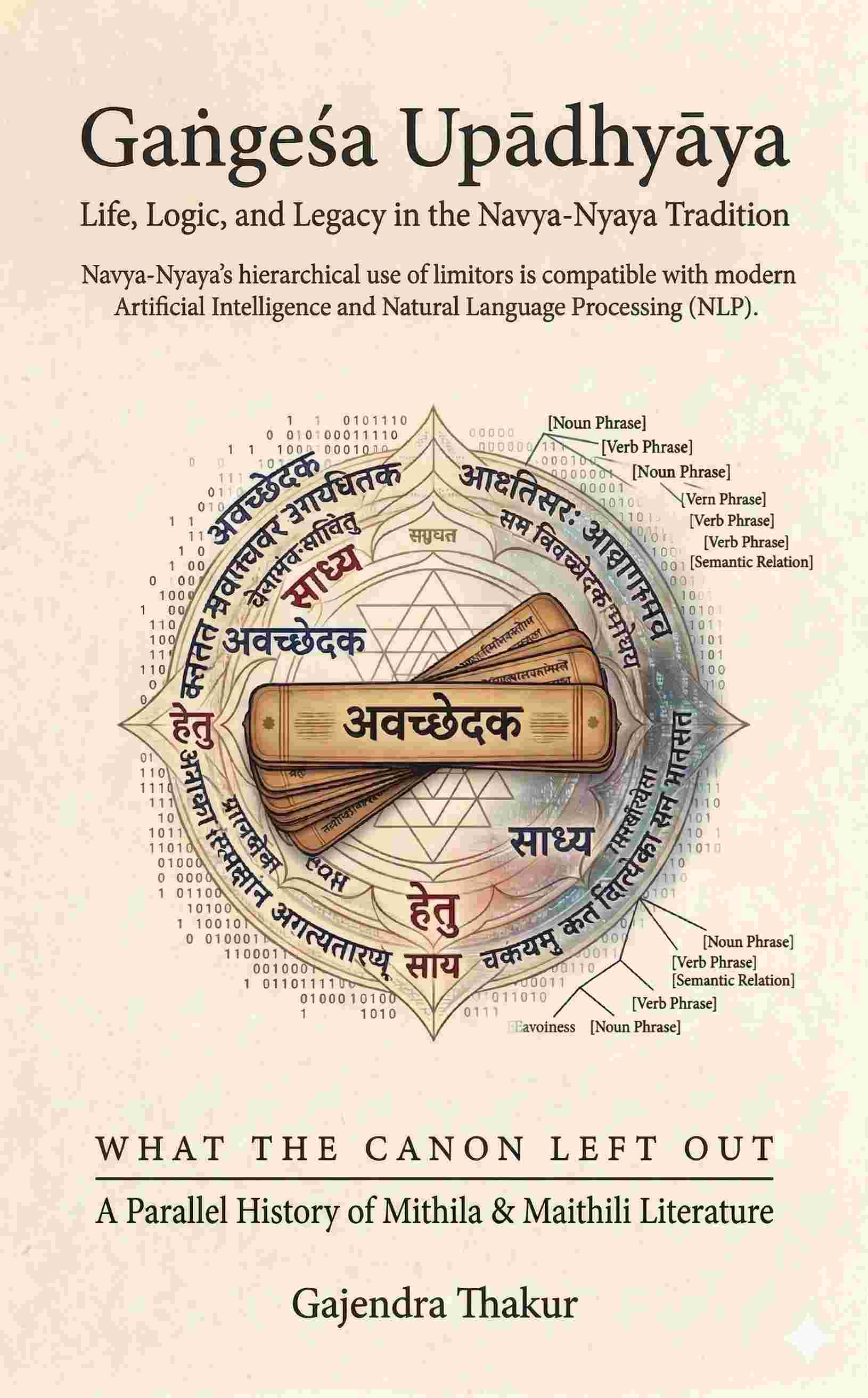
GANGESA UPADHYAYA
Life, Logic, and Legacy in the Navya-Nyaya Tradition
Navya-Nyaya’s hierarchical use of limitors is compatible with modern Artificial Intelligence and Natural Language Processing (NLP).
LIFE, CONTEXT, AND THE CONTESTED LEGACY
Introduction: A Philosopher from Mithila
The land of Mithila has been one of the most continuously productive centres of Sanskrit intellectual culture in Asia. Here King Janaka's court was the scene of the philosophical dialogues of the Brhadaranyaka Upanisad; here Yajnavalkya, Gautama, and KatyayanaKātyāyana — names central to both the Nyāya-sūtra tradition and to Vedic grammar — are assigned Maithila origins and carry Maithili associations; here the poet Vidyapati sang in Maithili the songs that made a vernacular literature great; here the astronomer-mathematician Āryabhaṭa drew his early intellectual breath. It is in this milieu — prolific, disputatious, deeply scholastic — that Gaṅgeśa Upādhyāya composed the work that changed the face of Indian philosophy. In the early fourteenth century, Gangesa Upadhyaya composed the Tattvacintamani — the Thought-Jewel of Truth — a work that permanently transformed the intellectual landscape of India. The Tattva-Cintāmaṇi (literally "Thought-Jewel of Truth", also known as Pramāṇa-cintāmaṇi or simply Cintāmaṇi), "Thought-Jewel of Valid Knowledge") is Gaṅgeśa's single great surviving work. It is a Pramāṇa-śāstra — a treatise on the means of valid knowledge — divided into four books: (1) Pratyakṣa-khaṇḍa (Perception), (2) Anumāna-khaṇḍa (Inference), (3) Upamāna-khaṇḍa (Comparison/Analogy), and (4) Śabda-khaṇḍa (Verbal Testimony). The Tattva-Cintāmaṇi is Gaṅgeśa's only surviving work and one of the most commented-upon texts in the Sanskrit tradition. By abandoning the exhaustive all-category coverage of earlier Nyāya-Vaiśeṣika writing and restricting himself exclusively to the pramāṇas — the sources of valid knowledge — Gaṅgeśa gave the tradition a sharply new focus and a correspondingly new name. All Nyāya literature written before his time is called prācīna-nyāya (Old Logic); everything from his work forward is navya-nyāya (New Logic). This periodisation, though simplistic, captures a genuine qualitative shift: in vocabulary, in method, in the level of analytical precision, and in the displacement of all older commentaries by the Tattva-Cintāmaṇi as the single central text of the school.
While Gangesha is the consolidator of this school, the real founder of the methodology he perfected was the 11th-century polymath Udayanācārya, whose Pariśuddhi and Kusumāñjali provided the threshold that rang out the ancient Nyaya age. Modern academic consensus, including the Stanford Encyclopedia of Philosophy, identifies Gangesha as a "Great Professor" (mahôpādhyāya) from the kingdom of Mithila.
In mainstream Indian philosophical historiography, Gangesa Upadhyaya is revered as the undisputed architect of Navya-Nyaya. In his Hindi monograph, भारतीय साहित्य के निर्माता: गंगेश उपाध्याय, Udayanath Jha 'Ashok' dates Gangesa to approximately 1300–1350 CE. Jha paints a picture of a scholar who earned the prestigious title of 'Mahamahopadhyaya'—a designation strictly reserved in Mithila for philosophers possessing unparalleled mastery over Nyaya, Mimamsa, and Dharmashastra.
Similarly, Dinesh Chandra Bhattacharya’s History of Navya Nyaya in Mithila traces the intellectual lineage of Mithila, mapping the evolution from the ancient Prameya-focused (ontological) Nyaya of Gautama to the Pramana-focused (epistemological) rigor of Gangesa.
A critical discrepancy emerges when cross-referencing these sanitized orthodox accounts with the Dooshan Panji (the genealogical records of "flaws" or social infractions in Mithila), as extensively documented in the Videha parallel history research.
The Dooshan Panji reveals two explosive biographical details about Gangesa Upadhyaya:
Birth Anomaly: Gangesa was born five years after the death of his recognized father.
Unorthodox Marriage: He married a Charmkarini (a woman from the leather-tanning caste).
The Historiographical "Honour-Killing" of Truth
The discrepancy between the mainstream texts and the Dooshan Panji is not accidental; it is an active historiographical suppression. Prof. Ramanath Jha, a central figure in modern Maithili Panji systematization, is noted in the parallel history archives for suppressing these specific Dooshan Panji records.
Because Gangesa elevated Mithila to the undisputed capital of Indian logic, acknowledging his "illegitimate" birth and out-of-caste marriage threatened the Brahminical purity narratives of the era. Consequently, orthodox historians engaged in what the parallel history terms an "honour-killing of his legacy." Udayanath Jha's recent monograph continues this tradition of omission, focusing entirely on Gangesa's Sanskrit titles and philosophical prestige while ignoring the socio-historical realities of his marginalized personal background. Recognizing this suppression is vital for modern scholarship, as it frames Gangesa not just as an elite logician, but as a brilliant mind who transcended immense societal ostracization.
THE TRANSITION TO NAVYA-NYAYA:The Paradigm Shift: From Prameya to Pramana
As Karl H. Potter notes in the Encyclopedia of Indian Philosophies (Vol. 6), classical Nyaya dealt with sixteen categories (padarthas), mixing ontology, epistemology, and debate dialectics. Gangesa initiated a monumental paradigm shift by discarding the broad ontological framework to focus exclusively on Pramana—the valid means of acquiring knowledge.
By dedicating the Tattvacintamani entirely to epistemology, Gangesa developed a hyper-precise technical language. He engineered new logical operators (like avacchedaka or "limitor") to prevent ambiguity, a method that Stephen Phillips and Ben-Ami Scharfstein argue rivals the analytical rigor of 20th-century Western analytic philosophers like Frege or Russell.
PRATYAKSHA KHANDA (PERCEPTION)
The first and foundational book of the Tattvacintamani is the Pratyaksha Khanda. Relying on the expansive translations and explanations of V.P. Bhatta and S.C. Vidyabhusana, this section defines the mechanics of direct cognition.
Mangalavada and Pramanyavada (Validity of Knowledge)
Gangesa begins with Mangalavada (invocation), justifying the necessity of invoking deity (Shiva) for the successful completion of the work. He then moves into the highly debated Pramanyavada (Theory of Validity).
• The Mimamsa View: Prabhakara and Kumarila argued for Svatah Pramanya (Intrinsic Validity)—that knowledge is self-validating the moment it arises.
• Gangesa's Nyaya View: Gangesa fiercely defends Paratah Pramanya (Extrinsic Validity). He argues that the validity of a cognition is not known inherently by the cognition itself, but is inferred later through successful practical activity (samvadipravrtti). For example, seeing water is only validated as true knowledge when one approaches it and successfully quenches their thirst.
Sannikarsha (Sense-Object Contact)
Perception (Pratyaksha) is defined as cognition born of sense-object contact (indriyarthasannikarsa). Gangesa details six ordinary contacts:
1. Samyoga (Conjunction): E.g., the eye seeing a jar.
2. Samyukta-samavaya (Inherence in the conjoined): The eye seeing the color of the jar.
3. Samyukta-samaveta-samavaya (Inherence in that which inheres in the conjoined): The eye seeing the universal "color-ness."
4. Samavaya (Inherence): The ear hearing sound.
5. Samaveta-samavaya (Inherence in the inherent): The ear perceiving the universal "sound-ness."
6. Visesyanavisesyabhava (Qualifier-Qualified relation): The perception of non-existence (e.g., perceiving the absence of a jar on the floor).
Savikalpaka and Nirvikalpaka
• Nirvikalpaka (Indeterminate Perception): The raw, pre-linguistic apprehension of an object without its qualifiers. It is un-nameable and un-verbalizable.
• Savikalpaka (Determinate Perception): The relational apprehension of an object with its properties (e.g., "This is a blue jar"). Only determinate perception can be expressed in language and judged as true or false.
Alaukika Sannikarsha (Extraordinary Perception)
Gangesa outlines three types of extraordinary perception, which separate Nyaya from Western empiricism:
Samanyalaksana: Perceiving all members of a universal class by perceiving one member (e.g., knowing all "smoke" generally upon seeing one instance of smoke).
Jnanalaksana: A cross-modal perception based on memory (e.g., looking at a piece of sandalwood and visually "perceiving" that it is fragrant without smelling it).
Yogaja: Mystical or yogic perception of hidden, past, or future objects.
ANUMANA KHANDA (INFERENCE)
The Anumana Khanda, widely translated by V.P. Bhatta and analyzed extensively by Stephen Phillips, is the core of Navya-Nyaya logical architecture.
The Concept of Vyapti (Pervasion)
Inference relies on Vyapti—the invariable concomitance between the middle term (Hetu, e.g., smoke) and the major term (Sadhya, e.g., fire). Gangesa analyzes the Vyaptipancaka (five provisional definitions of Vyapti offered by older logicians) and refutes them all because they fail in cases of non-co-locative attributes. He then establishes his Siddhantalaksana (conclusive definition): Vyapti is the non-occurrence of the Hetu in the locus of the absence of the Sadhya.
Isvaranumana (Inference of God)
Gangesa dedicates a section to proving the existence of God through inference. He argues that the earth, sprouts, etc., must have an intelligent creator because they are effects, much like a pot is the effect of a potter. This directly refutes the atheistic Mimamsa and Buddhist schools.
Hetvabhasa (Fallacies)
Gangesa meticulously categorizes logical fallacies (Hetvabhasa—"that which appears as a reason but is not"). These include Savyabhicara (deviating reason), Viruddha (contradictory reason), Satpratipaksa (counter-balanced reason), Asiddha (unproved reason), and Badhita (sublated reason).
Upamana Khanda (Comparison)
While Buddhists and Vaisesikas reduced Comparison to Inference, Gangesa defends it as an independent Pramana. Upamana is the process whereby a person learns the denotation of a word through perceived similarity. For example, a city-dweller is told a gavaya (wild ox) looks like a cow. Upon entering the forest and seeing a creature resembling a cow, the memory of the instruction combines with the visual similarity to produce the valid knowledge: "This animal is what the word gavaya denotes."
Sabda Khanda (Verbal Testimony)
In the final book, Gangesa analyzes words, meanings, and sentences. Sabda is defined as the instruction of a reliable authority (Aptopadesa). He outlines the four necessary conditions for a sentence to convey meaningful knowledge:
Akanksa (Expectancy): The syntactic need for words to complete each other (e.g., "Bring" expects "what?").
Yogyata (Semantic Fitness): The logical compatibility of the words (e.g., "He waters the plants with fire" lacks Yogyata).
Sannidhi (Proximity): Words must be spoken in close temporal succession.
Tatparya (Intention): The context or intention of the speaker, especially crucial for ambiguous words like Saindhava (which means both salt and horse).
As S.C. Vidyabhusana points out, Gangesa strictly refutes the inclusion of gestures (Cesta), rumour (Janasruti), or tradition (Aitihya) as independent Pramanas, absorbing them into Verbal Testimony or Inference.
According to the Stanford Encyclopedia of Philosophy (SEP) and Ben-Ami Scharfstein’s A Comparative History of World Philosophy, the Navya-Nyaya school is a pinnacle of global intellectual achievement.
While Western philosophy often segregates epistemology, ontology, and linguistics, Gangesa fused them into a single, highly technical language of precision. Stephen Phillips emphasizes that Gangesa’s definition of truth (Prama) as a cognition that corresponds to reality without the intrusion of subjective doubt places Navya-Nyaya firmly in the camp of robust epistemic realism. Scharfstein notes that the scholastic intensity of Navya-Nyaya is highly comparable to the Western medieval scholasticism of Thomas Aquinas or William of Ockham, yet mathematically precise in its linguistic formulation.
The study of Gangesa Upadhyaya requires balancing his towering philosophical intellect with the harsh sociopolitical realities of his time. The orthodox monographs by Udayanath Jha 'Ashok' and the historiography of Ramanath Jha successfully preserve his philosophical legacy but fail the test of historical integrity by suppressing the Dooshan Panji. The Tattvacintamani remains an unparalleled masterclass in logical precision, yet the true "thought-jewel" is understanding the human reality of its author—a man born outside conventional legitimacy, married outside his caste, who nevertheless conquered the intellectual world of 14th-century India.
what was the author's actual name? The answer is that the formal or ritual name was Gaṅgeśvara, while the everyday or vyāvahārika name was Gaṅgeśa. This is conclusively established by two kinds of evidence. First, Gaṅgeśa himself, in the mangalācaraṇa (invocatory verse) of the Tattva-Cintāmaṇi, writes in the first person 'Gaṅgeśa-stute miten vacase Śrī-tattva-cintāmaṇim' — using the name 'Gaṅgeśa'. Second, his son and primary disciple Vardhamāna, in the Kiraṇāvalī-Prakāśa, offers salutation explicitly to 'Gaṅgeśvara' as his father and guru: 'Nyāyāmbhoja-pataṅgāya Mīmāṃsā-pāradṛśvane / Gaṅgeśvarāya gurave pitṛeŚttra bhavate namaḥ.' The same name 'Gaṅgeśvara' appears in the Kusumaṃjali-Prakāśa. The two names are thus not different persons but the formal and informal designations of one man.
The Pañjī genealogical records refer to both names in connection with the same biographical locations and relationships, and the same location 'Chādan' village is cited in Pañjī-prabandha as 'Chādanaṃ tattva-cintāmaṇi-kāraka mahāmahopādhyāya paramaguruḥ Gaṅgeśvaraḥ.' Vardhamāna's explicit testimony, moreover, makes it impossible to maintain that the two names belong to different persons: the same man who wrote 'Gaṅgeśa-stute' in his own work is saluted as 'Gaṅgeśvara guruve pitre' by his son, just as in the same verse Vardhamāna equates Nyāya and Mīmāṃsā — a characterisation also found in Gaṅgeśa's own invocatory verse.
The question of Gaṅgeśa's birthplace has generated considerable scholarly controversy. Different scholars have proposed different villages: (1) Maṅgaraunī (or Maṅgalavanī), a village in the Madhubani mandal; (2) Kiryan (also Kiriyaṃ), a village 12 miles south-east of Darbhanga; (3) Cakautī; and (4) Chājaṃ (historically Chādana), now in Muzaffarpur district near Turkī railway station. The Pañjī records, whose testimony is most authoritative for these questions, consistently describe Gaṅgeśa as 'Chādanasaṃbhūta' — a native of Chādana/Chājaṃ. The Chājaṃ village, reachable from Turkī chowk westward about three kilometres, as the most probable location, surrounded by villages including Rupaulī, Bahilavārā, and Supanā — the last of these associated with Gaṅgeśa's son Sūpan. The Tibetan traveller Dharmasvāmin, who visited Mithila during the reign of Karṇāṭa king Rāmasiṃhadeva (1234 CE), mentioned a 'To-ki' locality near which Jain and Buddhist followers were numerous — this 'To-ki' is identified with the present-day 'Turkī', near which Gaṅgeśa's Chājaṃ village stands. A minority view, advanced by Rājendranāth Ghoṣ and based on Bengali sources, holds that Gaṅgeśa was Bengali. Even Ghoṣ himself ultimately calls him a Mithilāvāsī (Mithila resident) and a Maithila Brāhmaṇa. The Pañjī records, as M.M. Phaṇibhūṣaṇa Tarkavāgīśa states, say his birthplace (janmabhūmi) was 'Maṅgaurī' — but the village-specific Pañjī records more consistently point to 'Chādana.'
Gaṅgeśa's gotra (clan) is Kāśyapagotravīya. His 'mūla' (ancestral village-association in the Pañjī system) was 'Sirisabe-Chādana' — that is, he belonged to the Sirisaba mūla, specifically its Chādana branch. The Pañjī records identify him as 'Sirisabe-Chādana mūla' Kāśyapagotravīya. His father's name was Gīriśvara Upādhyāya, who died five years before the birth of Gaṅgeśa.
Some Panji records show that his own formal name was Gaṅgeśvara and his colloquial name Gaṅgeśa. He had two wives: from the first he had a daughter and the eldest son Vardhamāna; from the second he had sons Sūpan and Hara. The Pañjī evidence also establishes that Vardhamāna's daughter was married into the Śāṇḍilya-gotrīya Khaṇḍavalā-mūla (Viśvanātha-suta Śivanātha's lineage), Vardhamāna's son Candraka-Balabhadra-Śobhā married from Chādana-saṃbhūta families, Sūpan's daughter married a Jijivāla-mūla Śāṇḍilya-gotrīya, and Sūpan himself married into Bhāṇḍārisamay mūla. According to P. Rājendranāth Ghoṣ, Gaṅgeśa lost his father early and was raised by his mother's brother (māmā) in Kiryan village, where his uncle ran a school. The child Gaṅgeśa initially showed little scholarly aptitude and was considered something of a dull student. One of the legends that circulated in various forms relates how Gaṅgeśa was once taunted by his uncle's wife — being called 'gauḥ' (a cow or a blockhead). The incident catalysed a remarkable Sanskrit verse play on the word 'gotva' (being of the cow-nature, or clan-identity), which Gaṅgeśa composed spontaneously and by which his uncle recognised an astonishing hidden intelligence, embracing him and pledging to teach him everything. Whether or not the legend is literally true, it encodes a real philosophical point: the verse on 'gotva' is itself a mini-exercise in the very question of universals (sāmānya) that lies at the heart of Navya-Nyāya logic. That Gaṅgeśa's earliest popular legend should be framed around a punning philosophical argument about cowhood is deeply appropriate.
N.S. Rāmānujatātācārya's text records that Gaṅgeśa had one son from the first wife and two sons (Sūpan and Hara) from the second; the eldest son was Vardhamāna. All three brothers — Vardhamāna, Sūpan, and Hara — lacked male-line descendants.
However the Dushan Panji has something else to say.
The work set in motion a philosophical revolution whose effects were felt across Mithila, Bengal, Navadvīpa, Madras, Mahārāṣṭra, Kāśmīra, and eventually all of India, making Sanskrit scholarship of the last five hundred years inconceivable without it. The Mithila connection is not merely biographical. Gaṅgeśa's homeland has remained the intellectual core of Navya-Nyāya scholarship, and that same intellectual heritage is alive today in journals like Videha (videha.co.in, ISSN 2229-547X), the first Maithili fortnightly eJournal, which from its inception around 2000 has served as a digital archive for Maithili language, literature, and culture — the very civilisational ground on which Gaṅgeśa stood. The Videha archive maintains digital editions of works relating to Mithila's history, its philosophers, and its literary tradition including pre-Vidyāpati poetry and Paṃji inscriptional records. Gaṅgeśa belongs, therefore, not only to the history of philosophy but to the living cultural memory that Maithili scholars continue to recover and transmit.
The university at Navadvīpa, established in 1503 CE, became the principal vehicle through which the Tattva-Cintāmaṇi was popularised in Bengal, owing above all to the great commentator Raghunātha Śiromaṇi. From Bengal the work spread to Madras, Mahārāṣṭra, and Kāśmīra, until within a couple of centuries it was known across the subcontinent. Satis Chandra Vidyābhūṣaṇa notes in his Introduction that "in modern India Sanskrit scholarship is not considered of any worth unless it is accompanied by a knowledge of the Tattva-cintāmaṇi or at least a portion of it."
Gaṅgeśa, also called Gaṅgeśvara and surnamed Upādhyāya, was born in the village of Karion on the banks of the river Kamalā, twelve miles south-east of Darbhanga, in the last quarter of the twelfth century CE (assigned with confidence to c. 1200 CE by Satis Chandra Vidyābhūṣaṇa; revised upward to the first half of the fourteenth century by the Stanford Encyclopedia of Philosophy based on later genealogical and manuscript evidence). His father's name is associated with the Navadvīpa tradition; later inscriptional evidence places his descendants in the Darbhanga region. The Dhanukhā inscription, found on a stone slab attached to a well near Janakapura, traces a line of Gaṅgeśa's pupils over seven generations down to Bhagīratha Ṭhakkura (fl. 1556 CE), working backward to place Gaṅgeśa himself around the late twelfth or early fourteenth century.
Mithila's intellectual prestige in the pre-modern period rested upon its system of academic patronage, which supported pandits (learned scholars) across multiple disciplines. The region's Brāhmaṇa families maintained generations of specialists in Nyāya, Mīmāṃsā, Vedānta, grammar, astrology, and law. Gaṅgeśa worked within this tradition and was recognised by his contemporaries as a jagad-guru ("Distinguished Professor" in Vidyābhūṣaṇa's phrase, equivalent to a world-teacher). His mastery was not confined to Nyāya: he was also, by the account of the Stanford Encyclopedia of Philosophy, a great master of Mīmāṃsā, the school of Vedic hermeneutics, and was thoroughly conversant with the grammatical tradition of Pāṇini as well as the epic literature, quoting the Bhagavad-gītā at several points in the Tattva-Cintāmaṇi.
The land of Mithila, stretching across the Gangetic plains of present-day Bihar and southern Nepal, V.P. Bhatta's Preface to his translation (2012) captures the magnitude of the achievement: 'The Nyaya Sastra, which constitutes one of the six systems of Indian Philosophy, has played a significant role in the development and analysis of philosophy, logic and epistemology in India... However, the advent of the Navya-nyaya has brought a revolutionary change in the out look of the Nyaya philosophy. It has systematized all the Nyaya and Vaisesika concepts and brought them under the four heads, viz. i) perception (pratyaksa), ii) inference (anumana), iii) analogy (upamana) and iv) word (sabda)... The methodology used in the presentation of various theories in the T.C. made a profound impact on the philosophical writings during the period of five hundred years from thirteenth century A.D. to eighteenth century A.D. in India; and almost all the Shastrakaras adopted the T.C. methodology of presentation.' He adds: 'The significance of the text (T.C.) cannot be stressed too adequately in the context of philosophy, logic and epistemology.'
In Ben-Ami Scharfstein's Comparative History of World Philosophy, Gangesa is placed alongside Descartes and Leibniz as one of three philosophers whose shared theme is the pursuit of certainty through methodically applied logic. For Scharfstein, all three philosophers share a fundamental orientation: they are logicians in the sense of wanting to understand the world by isolating and perfecting the methods of reasoning itself, rather than its subject-matter. 'Gaṅgeśa does his best to perfect an existing logical technique for ensuring the soundness of induction, the most dependable means of knowledge, he is sure.' His work, Scharfstein observes, earned him the name 'The Jeweler' — the one who created a thought-jewel — and its three hundred or so pages 'were responsible, it is estimated, for over a million pages of commentary.'
The Potter-Bhattacharyya Encyclopedia of Indian Philosophies (1993) states simply: 'Gangesa's was a unique talent, one which places him securely among the premiere philosophical minds the world has produced.'
The Nyāya school traces its classical founding to the Nyāya-sūtra of Gautama (c. 100 CE) and its earliest major commentary by Vātsyāyana (c. 400 CE). The school is characterised by a thoroughgoing realism about the external world and a systematic account of the pramāṇas (sources of valid knowledge): pratyakṣa (perception), anumāna (inference), upamāna (analogy), and śabda (verbal testimony). Over nearly a millennium, commentators including Uddyotakara (c. 600 CE), Vācaspati Miśra (c. 950 CE), and Udayana (c. 1000 CE) elaborated the system, Udayana most importantly merging it with the Vaiśeṣika ontology of categories. Gaṅgeśa explicitly positioned himself as a follower of Udayana and incorporated the seven Vaiśeṣika categories — substance, quality, motion, universal, individualiser, inherence, and absence — as the ontological scaffolding of his epistemological project.
The distinction between the "Old" Nyāya (Prācīna-Nyāya) and the "New" Nyāya (Navya-Nyāya) inaugurated by Gaṅgeśa is, as the Stanford Encyclopedia of Philosophy cautions, not a clean rupture. Over a near-two-thousand-year history, developments were continuous. Yet the Tattva-Cintāmaṇi did achieve a qualitative shift: it displaced the tradition of sūtra-commentary, erected a new analytical vocabulary of extraordinary precision, and made every subsequent Naiyāyika reckon with it. Gaṅgeśa's predecessor Maṇikaṇṭha Miśra contained much of the technical apparatus, and the Buddhist logician Dharmakīrti (c. 600 CE) anticipated several of Gaṅgeśa's discussions of fallacies, but no one before him had synthesised and extended the tradition so comprehensively.
The full title Tattva-Cintāmaṇi signifies "a thought-jewel of truth" (tattva = truth/reality; cintāmaṇi = a wish-fulfilling jewel, metaphorically a jewel of thought). It is also called Pramāṇa-cintāmaṇi, "a thought-jewel of valid knowledge." The title is at once epistemological and aspirational: it claims to be the jewel that grants the wish of understanding valid knowledge. Gaṅgeśa opens the work with salutatory verses to Śiva, consistent with the Nyāya practice of maṅgala-vāda (invocation of blessings), and immediately launches into the question of what pramā (valid knowledge) is.
Book I — Pratyakṣa-khaṇḍa (Perception): The longest and philosophically richest of the four books, it establishes the general theory of knowledge, the nature of valid and invalid cognition, a detailed phenomenology of perceptual process including ordinary (laukika) and transcendent (alaukika) forms, the theory of inherence (samavāya), the problem of non-existence (abhāva), and the atomic nature of the mind. It culminates in discussions of indeterminate (nirvikalpaka) and determinate (savikalpaka) perception, and the doctrine of self-consciousness (anuvyavasāya).
Book II — Anumāna-khaṇḍa (Inference): By far the most technically demanding and influential section, it works through the conditions for inferential knowledge, above all the crucial concept of vyāpti (invariable concomitance or "pervasion"), the doctrine of upādhi (conditional middle term), the taxonomy of fallacies (hetvābhāsāḥ), and the syllogism (nyāya) in both its self-directed (svārthānumāna) and other-directed (parārthānumāna) forms. It also includes proofs of the existence of the self (ātman), a theistic argument (Īśvarānumāna), and a proof of the possibility of liberation (mukti).
Book III — Upamāna-khaṇḍa (Comparison): The briefest of the four books, it argues that analogy constitutes a genuinely distinct pramāṇa yielding knowledge of word-meanings through perceived similarity. The stock example — a traveller learns the word gavaya (a kind of buffalo) from a description "like a cow" and recognises the animal in the forest — illustrates how analogical knowledge is irreducible to both perception and inference.
Book IV — Śabda-khaṇḍa (Verbal Testimony): An extended analysis of language as a pramāṇa, covering the definition of valid speech, the conditions of meaningful utterance (ākāṅkṣā/expectation, yogyatā/semantic fit, āsatti/contiguity, tātparya/intention), the nature of potentiality (śakti) and secondary meaning (lakṣaṇā), the categories of compound words, verbal suffixes, roots and prefixes, the doctrines of sound, and the extensive question of Vedic injunctions (vidhi). The chapter contains what is, according to the Stanford Encyclopedia of Philosophy, the longest single section in the entire Tattva-Cintāmaṇi, devoted to lakṣaṇā (indirect indication).
EPISTEMOLOGY AND LOGIC
Truth and Error: Gaṅgeśa's Theory of Valid Knowledge
The Definition of Truth (Prāmāṇyavāda)
The Potter Encyclopedia (pp. 53–54) provides a precise technical formulation of Gaṅgeśa's theory of truth as set out in the Prāmāṇyavāda section of the Pratyakṣa-khaṇḍa. Gaṅgeśa defines truth (prāmāṇya) as: 'Either (a) being an awareness whose chief qualifier, x, is in what possesses x, or (b) being an awareness of a relatedness of x to what possesses x.' This says that a valid cognition (pramā) is an awareness (a) whose predicate term belongs to its subject term, or (b) which correctly attributes a property x to an entity that actually has x. The Encyclopedia notes that 'Gaṅgeśa argues, in favour of his analysis, that only when (a) or (b) is satisfied does one undertake action predicated on the awareness in question. In addition, he argues, this is the most economical account of what truth is.' Crucially, Gaṅgeśa presents this as a 'common platform' analysis of truth — a formulation acceptable to all schools regardless of their views on whether truth is intrinsic (svataḥ-prāmāṇya) or extrinsic (parataḥ-prāmāṇya).
Scharfstein's comparative approach illuminates the significance of this epistemological stance: 'Gaṅgeśa is committed to the Nyāya belief in a real, external world, in a real, nonmaterial self, and in the especial ability of perception and inference, each aiding the other, to reach certainty.' Against the self-certification thesis of the Mīmāṃsakas (who held that every cognition is self-certifying upon arising), Gaṅgeśa maintains that certification requires a second-level inferential act. As he argues against the sceptic: 'Your argument against inference depends on an inference. When you say that inference is not an instrument of knowledge you mean that it is doubtful or false to state that it is such an instrument. But that it is doubtful or false cannot be known by means of perception.'
The Preventer-Prevented Relation and Epistemic Logic
The Potter Encyclopedia highlights a key feature of Navya-Nyāya's theory of cognition that is philosophically important for the theory of justification: the preventer-prevented relation (pratibandhaka-pratibaddhya sambandha). This is not merely a psychological law about the impossibility of attending to two things simultaneously; it is a law of epistemic logic determined by the objects of awareness. When a cognition of p endures as a conscious act, it prevents the occurrence of the cognition of not-p, not merely by psychological competition but by logical necessity: 'the presence of one act prevents the origination of the other act, so that they can never be copresent, not even for one moment.' This relation is crucial for the theory of doubt and the resolution of doubt through tarka (hypothetical reasoning).
The Encyclopedia explains how this theory resolves the problem of induction — specifically how doubt about pervasion can be resolved: 'The Nyāya theory is that the deciding factor here is the presence or absence of doubt in the thinker... whoever has a doubt that the h may be a deviating one will not be able to know pervasion between h and s as long as he has that doubt. The question here is: is this law a psychological law? Nyāya distinguishes between two types of blocking... They are interested in a different type of blocking of one cognitive state by another by virtue of their objects. What prevents one from knowing a particular pervasion is not one's mental makeup, but the fact that one has a particular doubt.' This is epistemic logic, not psychology.
Theory of Perception
Perception and the Self
Gaṅgeśa's account of perception is embedded in a rich metaphysics of mind and self. Scharfstein's exposition is illuminating: 'In Nyāya doctrine the mind is an unconscious internal sense organ or cause that channels to the conscious self the successive sensations that come from the external sense organs... the mind can be connected with only one sense at a time. This limitation is taken to imply that the mind is of an absolutely minimal size, that of a single atom... It is the self that accounts for memory... If there was no conscious, lasting, mediating self, how could a past perception of blue account for the later memory of this selfsame blue? If not for the self and the memories it preserves, how could anyone explain that something I once saw with my left eye is later recognised by my right eye?' The self is not reducible to body, senses, or mind — it is the unique substrate of consciousness and the locus of memory, recognition, and cross-modal synthesis.
Indeterminate and Determinate Perception
Gaṅgeśa's distinction between nirvikalpaka (indeterminate) and savikalpaka (determinate) perception is among his most philosophically important contributions. Scharfstein describes the indeterminate phase as awareness without conceptualization — the kind that is not conjoined with a name, a universal, etc., that does not apprehend anything as qualified and which is devoid of any qualifier whatsoever. What succeeds it is the kind of awareness that is structured, relational, qualified — awareness with conceptualization. We fully know what we perceive only when we become aware of it as the complex composed of the generic with the particular, and we are able to say — triumphantly — pot, or this is a pot.
The philosophical necessity for positing indeterminate perception is explained clearly in both sources. From the Potter Encyclopedia's treatment of Gangesa's own example: if one thinks of generic properties or universals as having instances (as in Western philosophy) rather than as inhering in particulars, one translates an Indian view that is neither Platonic nor Aristotelian. A qualifier or distinguishing mark (viśeṣaṇa) relates to what is qualified (the viśeṣya or dharmin). When one perceives a pot, the universal potness (the qualifier, viśeṣaṇa) is the qualifier; the individual pot is the qualificand (viśeṣya). Indeterminate perception registers this qualificandum and qualifier as separate before any relational predication; it explains how we can encounter a kind of thing for the very first time and still correctly classify it.
Apperception (Anuvyavasāya)
The theory of anuvyavasāya — the perception that takes a preceding cognition as its own object — is philosophically crucial for Gaṅgeśa's account of certification. Scharfstein describes 'simple awareness' being 'followed by self-reflective awareness or aftercognition, expressed in words such as I am aware of this.' The Potter Encyclopedia specifies the introspective structure: 'An awareness may produce a disposition; indeed, no dispositions can arise except as caused by some act... The introspective act is just one jump behind the act which is its content. In the waking state there is no felt gap between two awarenesses. When the preceding awareness is in its second phase [of duration] the succeeding awareness originates and replaces the former.' Gaṅgeśa argues that apperception is infallible with respect to the intentional structure of the scoped cognition — though not with respect to its truth.
Illusion: Anyathākhyātivāda
The 'Anyathākhyātivāda' — the doctrine that illusion consists in the awareness of a thing 'as other than it is' — is one of the longest sections of the Pratyakṣa-khaṇḍa. Scharfstein's account: 'Even when a rope is mistaken for a snake, there is some true knowledge, knowledge of the thisness of the object lying on the ground. The false part of the perceptual awareness rests on the partial or full identification of what is in fact seen, with a different kind of object... The evidence that proves my perceptual awareness as a whole to be right or wrong is the success or failure of the actions that follow from the awareness: only a snake, not a rope, actually bites.' Gaṅgeśa follows Udayana in distinguishing initial awareness (which cannot be mistaken) from later, structured awareness (in which mistakes are possible). The content of illusory awareness is always traceable to real prior perceptions — silverhood in the mother-of-pearl illusion comes from previous genuine perceptions of silver. This makes Gaṅgeśa's account of error robustly realist.
Theory of Inference: The Vyāpti Problem and Its Resolution
Pervasion (Vyāpti): The Philosophical Stakes
Gaṅgeśa's greatest technical achievement is his definitive account of vyāpti (invariable concomitance, 'pervasion'). The philosophical stakes are enormous: vyāpti is the relation that grounds all inference, and an adequate definition of it is necessary to distinguish genuine inferences from pseudo-inferences. Scharfstein explains the fundamental notion: 'To Gaṅgeśa, pervasion is the unconditional relation produced by the very nature of a reason or cause, such as the unfailing relation of smokiness with fieriness, which is the relation that in this case can be explained by the nature of fire and the nature of smoke as the product of fire. To call the knowledge unfailing is also to say that we do not know anything that shows the relation to be accidental.'
Before arriving at his final definition, Gaṅgeśa considers and rejects multiple prior attempts. Scharfstein notes he 'discards twenty-one proposals' (the Jhā 'Aśok' monograph says twenty-four, counting sub-variants). The Potter Encyclopedia provides the most technically precise account. The first definition offered — 'nondeviation' — fails because 'it does not apply to cases where the s is non-locus-pervading.' Subsequent definitions each stumble on specific counterexamples, particularly the 'monkey in a tree' case where the property asserted is non-locus-pervading. The final, conclusive definition is: 'Invariable concomitance is the coexistence of the property x (the probans) with the property y (the probandum) which is not what is qualified by the delimitor of the counterpositiveness of an absolute absence which does not have a common locus with its counterpositive and which has a common locus with the property x.' Scharfstein offers a simplified version of Goekoop's paraphrase: 'There is pervasion of A by B if, and only if, A has a common locus with B in such a way that B is none of the things that qua class are completely absent from some locus of A.'
Resolving Doubt about Pervasion: Tarka
The Potter Encyclopedia provides the fullest treatment of how tarka (hypothetical / reductio reasoning) works to resolve doubt about pervasion. The Nyāya theory is that doubt about pervasion acts as a preventer of the cognition of pervasion. Tarka does not itself yield pervasion-knowledge; it removes the doubt that was preventing that cognition. The formal structure of a tarka argument on the smoke-fire example runs: 'If smoke deviated from fire then it would not have been caused by fire. But smoke is caused by fire. Hence, smoke cannot deviate from fire.' The doubt is thus resolved not by adding new inductive evidence but by showing that maintaining the doubt leads to a conclusion both parties accept as false. This is why Gaṅgeśa agrees with Udayana's pragmatic argument against the sceptic: 'He invariably lights up a fire if he wants to produce smoke... The sceptic's own action stultifies the doubt.'
The Encyclopedia draws an important contrast with Western philosophy of induction: 'The Nyāya theory is that in some cases only one observation suffices, while in other cases innumerable observations do not suffice, to produce knowledge of pervasion. The deciding factor here is the presence or absence of doubt in the thinker... Although whether one has doubts or not is a purely subjective affair, still the Nyāya theory is not psychological. Nyāya states a universal law: whoever has a doubt that the h may be a deviating one will not be able to know pervasion between h and s as long as he has that doubt.' Furthermore, Navya-Nyāya differs from the Western tendency to justify induction by an appeal to a law of causation or uniformity of nature: 'According to Nyāya it is enough to know that two things are invariably co-present; we need not try to give any cause for this fact.'
The Upādhi (Additional Condition) and Fallacies
The concept of upādhi (conditional middle term, additional condition) is Gaṅgeśa's tool for identifying and blocking pseudo-inferences. An upādhi U is a property that pervades the probandum S but does not pervade the prover H — its presence reveals that the apparent pervasion of H by S does not hold. Scharfstein explains: 'Gaṅgeśa surpasses even Udayana in this sense that the former takes up only the philosophically most important inference to establish the existence of God and discusses and defends it thoroughly. Further, he formulates the establishing inference itself so carefully that it meets the objections of the Buddhists and the Mīmāṃsakas... In particular, Gaṅgeśa's treatment of the faults of the presence of additional condition and counter-thesis in the reason of the establishing inference shows considerable acumen, dialectical skill and even originality. Not even Udayana treats these problems with such thoroughness and skill.'
The five fallacies (hetvābhāsāḥ) — savyabhicāra (deviant), viruddha (contradictory), satpratipakṣa (counterbalanced), asiddha (unestablished), and bādhita (defeated in advance) — are discussed at length in both Scharfstein and Potter. The Potter Encyclopedia notes how the Navya-Nyāya treatment of these fallacies goes significantly beyond the Nyāya-sūtra's original list, and that the distinction between 'constant flaws' (nityadoṣa) and 'personal flaws' (puruṣadoṣa) — between logical failures and cognitive failures — is a particularly important contribution of Gaṅgeśa's analysis.
The Inference of God
Gaṅgeśa's theological inference — that the world as an effect must have a conscious creator-agent — is treated in detail by both Scharfstein and the Potter Encyclopedia. Scharfstein offers the most accessible account of Gaṅgeśa's extended dialectic on the number of creators. The argument for parsimony (lāghava) as an auxiliary cognitive principle that establishes the unity of the creator runs through an elaborate sequence of objection and response: 'The principle of simplicity restricts our knowledge of the denotations of words to the most useful, defining characteristics of things: When we infer the denotative power of the word jar, we cognise it as limited by the property of jarness, not the property of having a round neck. If not for the principle of parsimony, human conversation and the related social usages would be impossible.' The Poteter Encyclopedia notes that this argument for parsimony is connected with Gaṅgeśa's broader methodological orientation — the same principle of lāghava or 'economy of conception' that drives his preference for the most compact possible definitions throughout the Tattva-Cintāmaṇi.
Theory of Analogy and Verbal Testimony
Upamāna
Gaṅgeśa's account of upamāna restricts analogy to the pramāṇa by which one learns the referential relationship of a word to its object through perceived similarity. The stock example — a traveller told that a gavaya (bovine) resembles a cow, who later recognises the animal in the forest — illustrates knowledge of the word-referent relation that is irreducible to both perception and inference. The key move is that the forester's statement functions as more than a description but as a meaning-conveying utterance that produces novel knowledge of a word-meaning-relation through the hearer's direct encounter with the referent.
Verbal Testimony (Śabda)
The Śabda-khaṇḍa, the longest and most linguistically sophisticated section of the Tattva-Cintāmaṇi, develops a comprehensive philosophy of language. The Potter Encyclopedia notes that 'a new development in Nyāya literature, ushered in by Gaṅgeśa's extensive treatment in the Śabdakhaṇḍa, is its interest in and attention to Mīmāṃsā topics such as the aim of life called dharma and its relation to the sentences (vidhi) in which dharma is enjoined. This is a part of the general orientation of Navyanyāya led by Gaṅgeśa toward Pūrvamīmāṃsā opponents and arguments. The Mīmāṃsakas were specialists in ritual, in exegesis and thus in language. Navyanyāya is characterised by its own version of the linguistic turn.'
Gaṅgeśa defends verbal testimony as a fourth irreducible pramāṇa, with its own distinctive conditions of validity: ākāṅkṣā (syntactic expectation), yogyatā (semantic fitness), āsatti (temporal contiguity), and tātparya (speaker's intention). His innovation is to identify the trigger for secondary meaning (lakṣaṇā) not as a violation of semantic fitness (yogyatā) as commonly held, but as a violation of the overall sentential connection (anvaya). The discussion of lakṣaṇā in the Śabda-khaṇḍa is — as the Stanford Encyclopedia of Philosophy notes — the single longest section in the entire Tattva-Cintāmaṇi.
The Karṇāṭa Dynasty and Medieval Mithila
Medieval Mithila in the thirteenth and fourteenth centuries was shaped by two royal dynasties in succession. The Karṇāṭa dynasty, founded by Nānyadeva, reached its zenith under Harisimhadeva (reigned approximately 1295–1326 CE), who was a patron of Sanskrit learning of extraordinary liberality — the Pañjī (genealogical registration system) of Maithila Brāhmaṇa families was compiled during his reign in Śāka 1232 (1310 CE). Under the minister Caṇḍeśvara Ṭhākura, a prolific scholar in his own right, Harisimhadeva's court supported philosophers, poets, and pandits. Gaṅgeśa was active during this reign. The Oinivar dynasty succeeded the Karṇāṭas, with Bhavesiṃha (reigned 1361–1410 CE) the most notable king; it was under the Oinivars that Mithila's later cultural life flourished with Vidyāpati and Vardhamāna Upādhyāya.
In Śaka 1310 (1388 CE), the Tibetan traveller Dharmasvāmin described Mithila as having abundant Jain and Buddhist followers in its western districts, with Gautamīvidyā and Mīmāṃsā widely practised and poetry and dharmaśāstra central to intellectual life. Three scholarly traditions of Navya-Nyāya ultimately emerged from Mithila: the Maithila paramparā, the Baṅgāla paramparā, and the Dakṣiṇa paramparā — all rooted in the Tattva-Cintāmaṇi.
The Chronology Debate
The chronology of Gaṅgeśa remains one of the most debated questions in Indian intellectual history. Scholars have placed him anywhere from the eleventh to the fourteenth century. The earliest proposal, apparently stemming from the Nyāyakoṣa, placed him at 1178 CE (Kṣ. 1178). Another early scholarly consensus placed him at 1108 CE (the 'Viśvakośa' opinion). Some have argued for 1200 CE. The Stanford Encyclopedia of Philosophy, following Bhattacharyya's revision of the evidence, places him in the first half of the fourteenth century (1300–1350 CE). Gaṅgeśa's most active period was 1270–1370 CE, with the most probable range being 1300–1350 CE. The key evidence: (a) Gaṅgeśa cites Hīranātha Upādhyāya's works in the Tattva-Cintāmaṇi; Hīranātha is firmly dated to the 13th century, providing a terminus post quem. (b) Mādhavācārya (Sāyaṇa's brother, fl. 1386 CE) in his Sarvadarśanasaṃgraha explicitly cites and names Vardhamāna Upādhyāya with the epithet 'mahāmahopādhyāya', confirming Vardhamāna was active before 1386 CE and placing Gaṅgeśa's floruit at least a generation earlier. (c) Vaṭeśvara Upādhyāya, the first Pañjī-era scholar to name-cite Gaṅgeśa, is dated to 1350–75 CE, establishing that as the latest possible terminus for Gaṅgeśa's active career. (d) The Pañjī records compiled in 1310 CE do not list Gaṅgeśa's son's daughters as yet married — placing Gaṅgeśa himself comfortably in the range 1270–1330 CE. The same period saw the great scholar-jester Gonū Jhā flourishing in Mithila. His Nyaya-tattva-chintamani is an outstanding work on Nyaya, yet unexcelled.'
The Title Mahāmahopādhyāya
The title Mahāmahopādhyāya conferred on Gaṅgeśa was the highest scholarly title in the Mithila panditic tradition, given exclusively to philosophers who had demonstrated supreme mastery in all three of Nyāya, Mīmāṃsā, and Dharmaśāstra. The title's origins in Mithila predate the British period by centuries: a manuscript dated Lekhaṃ Saṃ. 164 (1278 CE) is the earliest known Mithila occurrence of 'mahopādhyāya' as a formal designation. By Śāka 1310 (1388 CE), when the Pañjī was compiled, the title 'mahāmahopādhyāya' was formally recorded in the genealogical records alongside individual scholars' names. Gaṅgeśa's Pañjī entry describes him as 'tattva-cintāmaṇi-kāraka mahāmahopādhyāya paramaguruḥ Gaṅgeśvaraḥ' — the author of the Tattva-Cintāmaṇi, paramount teacher, the Great Great Professor Gaṅgeśvara. The title in Mithila's ancient tradition was not given by any external authority but arose spontaneously from the panditic community itself: those whose students themselves became mahopādhyāyas were recognised as mahāmahopādhyāyas during their own lifetimes. Gaṅgeśa's invocatory verse at the opening of the Tattva-Cintāmaṇi — 'gurubhirjñatvā gurūṇāṃ mataṃ' — already signals his own claim to be a guru of the highest order. The British Royal Titles Act of 1867 later incorporated 'Mahāmahopādhyāya' into the formal honours system, with the first government-conferred instance going to M. Maheshchandra Nyāyaratna of Calcutta Sanskrit College.
Pre-Gaṅgeśa Maithila Naiyāyikas: The Tradition He Inherited
History of Navya-Nyāya in Mithila has 24 pre-Gaṅgeśa Maithila Naiyāyikas whom Gaṅgeśa either cited, engaged, or implicitly responded to. Understanding these figures contextualises the Tattva-Cintāmaṇi not as a sudden innovation but as the culmination of centuries of cumulative Maithila logical tradition. The most important are:
Viśvarūpamiśra (c. 750–850 CE)
Active between approximately 750 and 850 CE, Viśvarūpamiśra is cited in Āgamāḍambara, the Tārkikarakṣā, and the Tātparya-vivaraṇapañjikā. His commentary on the Nyāya-Bhāṣya by Śaśāṃkaguru is cited. He is likely identical with the Viśvarūpa who commented on Yājñavalkya-smṛti and was a disciple of Kumārila Bhaṭṭa.
Trilocana (pre-9th century CE)
Trilocana wrote the Nyāyamañjarī, a commentary on the Gautamīya Nyāyasūtra, cited by the later Vṛddhavācaspatī. His work is noted for its comprehensive engagement with Buddhist epistemology.
Vācaspatī Miśra (c. 840–900 CE)
Vācaspatī is among the most brilliant systematic philosophers of the Indian tradition. A Maithila from Mithilā (though this is contested), he produced commentaries on virtually every school of Indian philosophy — Nyāya, Sāṃkhya, Vedānta, Yoga — and his Nyāyasūcīnibandha, Bhāmatī, Tātparyaṭīkā, Brahmatattvasamīkṣā, Nyāyakaṇikā, and Tattvabiṃdu are all works of the first rank. For Navya-Nyāya specifically, his introduction of the savikalpaka-nirvikalpaka distinction and the upādhi concept in nascent form were crucial.
Udayana (c. 975–1050 CE)
Udayana was the 'cornerstone of the transition between Old and New Nyāya', wrote prolifically: the Kusumaṃjali, Kiraṇāvalī, Lakṣaṇāvalī, Pariśuddhi, Prabodhasiddhi, Ātmatattvaviveka, and the Nyāyakusumaṃjali, among others. He was the most prolific author in Mithilā's philosophical tradition. He merged Vaiśeṣika ontology completely into Nyāya and provided the systematic account of the seven categories that Gaṅgeśa inherited. He was also the staunchest Naiyāyika opponent of Buddhist philosophy at a time when Buddhist philosophical presence was fading. Gaṅgeśa explicitly regarded Udayana as his 'teacher' (ācārya) and declared his work to be written 'miten vacase' — in Udayana's own style, concisely.
Śaśadhara Upādhyāya (12th century CE)
Brother of Maṇidhara Upādhyāya, Śaśadhara is the author of Nyāyasiddhāntadīpa, Nyāya-Mīmāṃsāprakaraṇa, Nyāyanaya, and Śaśadharamālā. He and his brother Maṇidhara were known in their time as 'Siṃha-Vyāghra' (Lion and Tiger) for their dialectical prowess, particularly famous for their knowledge of vyāpti (pervasion) — the very concept Gaṅgeśa would later define definitively.
Maṇikaṇṭha Miśra (early 13th century CE)
Maṇikaṇṭha is among the most direct precursors of Gaṅgeśa. His 'Nyāyaratna' contained in embryonic form much of the analytical apparatus Gaṅgeśa would develop. Vācaspati the Second (a different Vācaspati from the ninth-century one) and Nṛsiṃhayajva were among his commentators. His text was published at Madras with the Citimalīkā (Nṛsiṃhayajva's commentary). Vācaspati the Second and Maṇikaṇṭha together represent the immediate intellectual environment from which the Tattva-Cintāmaṇi emerged.
These 24 scholars constitute Mithila's philosophical heritage as it stood when Gaṅgeśa wrote. They were the intellectual ancestors who made the Tattva-Cintāmaṇi possible. No other region of India produced as many Nyāya scholars or Nyāya texts as Mithila.
The Development of Philosophy in Mithila
Mithila had a deep intellectual ecology that sustained Gaṅgeśa's work. Present-day Bihar is divided by the Bhāgirath-Gaṅgā into two parts: the northern part known as Mithilā and the southern as Magadha. Vedic civilisation's centre was Mithilā; Buddhism's centre was Magadha. These two civilisations were in productive tension for over a millennium. It was this tension — Vedic Brāhmaṇas defending śruti and karma against Buddhist philosophical challenge — that drove the extraordinary refinement of tarka (inference-logic) in Mithila to levels unmatched elsewhere in India.
Buddhist philosophical challenge, from the time of Dignāga and Dharmakīrti through the works of Praśastapāda, forced the Naiyāyikas to sharpen every definition and close every argumentative gap. The three traditions of commentary on the Tattva-Cintāmaṇi — Maithila, Baṅgāla, and Dakṣiṇa — all reflect this fundamental dynamic: the need to have a water-tight logical system that could withstand the most sophisticated objections. In the 13th century Mithila 'gave birth to a son in the form of Gaṅgeśa who, by creating Navya-Nyāya, in a certain sense uplifted the entire reading tradition of the ancient Nyāya system.' This is not merely hagiography; it accurately describes the epistemic revolution the Tattva-Cintāmaṇi effected.
The Tattva-Cintāmaṇi: Structure and the Navya-Nyāya System
Why 'Navya-Nyāya'?
Why works before Gaṅgeśa are called prācīna-nyāya and those after navya-nyāya. The reason is not merely historical but substantive. Earlier Nyāya texts, including those of Udayana and Maṇikaṇṭha, discussed all sixteen padārthas (categories of Nyāya methodology) listed in the Nyāya-sūtra. Gaṅgeśa abandoned this comprehensive framework and focused exclusively on the first padārtha — pramāṇa (valid knowledge source). Reducing the field of inquiry to pramāṇa alone, he could examine it with microscopic precision. The focus on pramāṇa also entailed treating prameya (the object of knowledge) as only instrumentally significant — as the stuff of which knowledge informs us, not a topic of independent inquiry. This shift from ontology-plus-epistemology to pure epistemology is the structural hallmark of Navya-Nyāya.
Correspondingly, the analytical vocabulary of Navya-Nyāya is radically new. Terms like avacchedaka, avacchedakatā, anuyogī, pratiyogī, viṣayatā, prakāra, nirūpaka-nirūpita, nirūpita-nirūpyatā, viṣaya-viṣayatā, ādhāra-ādhāratā, ādhya-ādheyatā, koṭi-koṭitā — these hundreds of technical relational terms were coined or systematically deployed by Gaṅgeśa and his successors to achieve a precision of statement that no earlier Sanskrit philosophical vocabulary possessed. The use of these terms created a formidable barrier for uninitiated readers but gave the initiated an instrument of extraordinary analytical power.
The Four Khaṇḍas: Chapter-by-Chapter
The Tattva-Cintāmaṇi consists of four khaṇḍas (sections) devoted to the four pramāṇas: Pratyakṣa (Perception), Anumāna (Inference), Upamāna (Analogy), and Śabda (Verbal Testimony). The Anumāna-khaṇḍa is by far the largest and most influential. The Upamāna-khaṇḍa is the shortest.
Pratyakṣa-khaṇḍa contains 12 prakaraṇas, treating: (1) Maṅgalavāda (invocation), (2) Prāmāṇyavāda (validity of knowledge), (3) Anyathākhyātivāda (illusory cognition), (4) Sannikarṣavāda (perceptual contact), (5) Samavāyavāda (inherence), (6) Anulabdhi-prāmāṇyavāda (knowledge of non-existence), (7) Abhāvavāda (absence), (8) Pratyakṣakaraṇavāda (instrument of perception), (9) Manoḥṇutvavāda (atomicity of mind), (10) Anuvyavasāyavāda (apperception), (11) Nirvikalpakavāda (indeterminate cognition), and (12) Savikalpakavāda (determinate cognition) — together with the sub-sections on Prāmālakṣaṇavāda.
Anumāna-khaṇḍa contains 13 prakaraṇas: (1) Saṃgatisahita-anumitiprakaraṇa, (2) Vyāptivāda (pervasion — the most extensive and renowned), (3) Vyāptigrahopaāyaprakaraṇa, (4) Upādhivāda, (5) Pakṣatāprakaraṇa, (6) Sāmānyalakṣaṇaprakaraṇa, (7) Parāmarśaprakaraṇa, (8) Kevalānvayi-anumānaprakaraṇa, (9) Kevalā-vyatireke arthāpattiNirūpaṇaprakaraṇa, (10) Tarkavāda, (11) Avayava-nirūpaṇaprakaraṇa, (12) Hetvābhāsaprakaraṇa, and (13) Īśvarānumānaprakaraṇa. The Vyāptivāda alone has seven sub-prakaraṇas including the Siṃhavyāghra-vyāptiprakaraṇa (named after the Lion and Tiger scholars Maṇidhara and Śaśadhara).
Upamāna-khaṇḍa, though lacking formal prakaraṇa divisions, covers 14 topics including the definitions of upamāna, its result (upamiti), objections from Mīmāṃsā schools, and the role of sādṛśya (similarity) as a supervenient property. Śabda-khaṇḍa has 16 prakaraṇas covering: (1) Śabda-prāmāṇyavāda, (2) Śabdākāṃkṣāvāda, (3) Yogyatāvāda, (4) Āsattivāda, (5) Tātparyavāda, (6) Śabda-nityatāvāda, (7) Uddeśa-uddeśyavāda, (8) Vidhivāda, (9) Apūrvavāda, (10) Kāryaviniyanitaśaktivāda, (11) Jāti-śaktivāda, (12) Samāsavāda, (13) Ākhyātavāda, (14) Dhātuvāda, (15) Upasargavāda, and (16) Pramāṇacatuṣṭhya-prāmāṇyavāda.
Epistemological Foundations
At the foundation of the Tattva-Cintāmaṇi lies Gaṅgeśa's definition of pramā: 'the knowledge of a thing as it is, specifically the knowledge of a generic nature as truly abiding in its own subject' (tadvati tatprakāraka anubhava). This is a concise statement of a broadly reliabilist, factive epistemology. Valid knowledge sources (pramāṇas) are defined factively — perception, inference, analogy, and testimony each only succeed when they produce true belief through the correct process. An apparent source that fails to produce truth is not a genuine pramāṇa but its simulacrum (pramāṇābhāsa). Against the Mīmāṃsaka doctrine of svataḥ-prāmāṇya (self-certification of knowledge), Gaṅgeśa argues for parataḥ-prāmāṇya: although awarenesses are presumptively valid, their validity requires external confirmation through source-identification or pragmatic success.
Theory of Perception (Pratyakṣa)
Definition and Sensory Contact Modes
Gaṅgeśa's Navya-Nyāya treatment of perception begins by establishing that sākṣātkāritva (directness, immediacy) is the defining feature of perception — 'pratyakṣasya sākṣātkāritvaṃ lakṣaṇam.' Unlike the Nyāya-sūtra's definition (which cited non-erratic definite knowledge arising from sensory contact), Gaṅgeśa emphasises the non-inferential, non-mediated character of perceptual knowledge. The perceptual organ and its object come into six modes of ordinary contact (laukika-sannikarṣa): saṃyoga (conjunction), saṃyukta-samavāya, saṃyukta-samaveta-samavāya, samavāya, samaveta-samavāya, and viśeṣaṇatā (qualification). Three further extraordinary (alaukika) modes extend perception beyond direct sensory contact: sāmānyalakṣaṇa (perceiving all instances of a universal through one instance), jñānalakṣaṇa (indirect perception activated by memory-dispositions), and yogaja (yogic perception).
Nirvikalpaka and Savikalpaka Perception
The distinction between nirvikalpaka (indeterminate, pre-relational) and savikalpaka (determinate, relational) perception is Gaṅgeśa's most philosophically productive contribution to perceptual theory. Indeterminate perception registers a qualificandum and its qualifier as separate before any relational predication — it is the first, pre-conceptual moment of sensory information. Determinate perception is the cognition of 'this pot' as qualifying an individual (the pot) through the universal pothood. By Gaṅgeśa's own examples: a child encountering a cow for the first time can form the correct judgment 'That's a cow' only if there is a prior indeterminate cognition of cowhood as a qualifier, which then becomes the qualifier in the determinate perception.
Gaṅgeśa devotes a substantial section to anuvyavasāya — the perception that takes a preceding cognition as its own object (after-cognition). He argues that apperception is infallible with respect to the intentional structure (viṣayatā) of the scoped cognition: when I perceive my own perceiving, I know correctly what the perception was about (its qualificandum, qualifier, and relational components), even if I do not thereby know whether the original perception was veridical. Apperception directs certification: by identifying a cognition as perceptual, inferential, or testimonial, it sets the criteria for its evaluation.
The Theory of Illusion (Anyathākhyātivāda)
Gaṅgeśa's account of perceptual error — presented in the Anyathākhyātivāda section — holds that illusion occurs when the content of a current perception-like state is supplied by the activation of a memory-disposition (saṃskāra) formed by earlier genuine perceptions. When a person in poor light 'sees' shell as silver, the silverhood predication content comes from a real prior experience of silver; the current sensory event fuses with the silverhood-saṃskāra through a causal misfire, generating an appearance of silver where there is none. All illusory content is ultimately traceable to real features of real objects — hallucination has a causal history that runs through real perceptions. This makes Gaṅgeśa's account of illusion robustly realist: error does not indicate any non-realist conclusion about the external world.
Theory of Inference (Anumāna): The Vyāpti Problem
The Concept of Vyāpti
The single greatest technical achievement of the Tattva-Cintāmaṇi is Gaṅgeśa's definitive account of vyāpti (invariable concomitance, 'pervasion'). Vyāpti is the relation that grounds inference: if smoke pervades fire (wherever there is smoke, there is fire), seeing smoke on a hill licenses the inference to fire. The challenge is to define vyāpti formally so that it covers all intuitively valid inferences, handles the case of negative-only (kevalānvayi) inferences where the major term has no counter-instances, and excludes upādhi (additional conditions that disqualify an apparent pervasion).
The Anumāna-khaṇḍa's Vyāptivāda section opens by naming the two famous prior efforts as 'Siṃha-vyāghra-lakṣaṇa' — the Lion and Tiger definitions, named after the brothers Maṇidhara and Śaśadhara. After examining and rejecting multiple definitions, Gaṅgeśa arrives at his conclusive definition (siddhānta-lakṣaṇam): vyāpti holds between H (the prover/middle term) and S (the probandum/major term) when H has its locus co-present with S, and S (understood as the counterpositive of its absence) shares no locus with the absence of H while that absence is not of the non-locus-pervading kind. More precisely stated: pervasion of H by S holds if and only if there is no absolute absence of S at any locus of H — where the counterpositive-specification refers to S-universal (not S-particular). This handles both the standard smoke-fire cases and the difficult monkey-conjunction inference that had tripped many earlier definitions.
Upādhi: The Additional Condition
The concept of upādhi (additional/conditioning factor) is Gaṅgeśa's tool for blocking pseudo-inferences. An upādhi U is a property that (a) pervades the probandum S (all S are U) but (b) does not pervade the prover H (some H are not U). When such a U exists, the apparent pervasion of H by S breaks down: there are H-instances that are not S, because U is absent from those H-instances. The classic Navya-Nyāya example: the apparent inference 'Smoke-producer things are fire-producers, since they are products' is blocked by the upādhi 'being-wet-fuel' — wet fuel is a smoke-producer but not a fire-producer. The section on upādhi (Upādhivāda) in the Anumāna-khaṇḍa runs to several sub-prakaraṇas and is among the most technically demanding in the entire Tattva-Cintāmaṇi.
The Five Fallacies (Hetvābhāsāḥ)
The Hetvābhāsaprakaraṇa is the final major section of the Anumāna-khaṇḍa. Five pseudo-provers are distinguished: (1) Savyabhicāra (deviant/erratic — the middle term occurs in both sapakṣa and vipakṣa); (2) Viruddha (contradictory — the middle term proves the opposite of the intended conclusion); (3) Satpratipakṣa (counterbalanced — matched by an equally strong counter-inference); (4) Asiddha (unestablished — the middle term's occurrence, nature, or pervasion is doubtful); (5) Bādhita (defeated in advance — the conclusion contradicts what is already known). The Navya-Nyāya treatment of these fallacies, particularly the division of Savyabhicāra into sādhāraṇa (common/universal) and asādhāraṇa (uncommon/particular) and the addition of anaikāntika as a subcategory, goes significantly beyond the Nyāya-sūtra's original five.
Three Philosophical Inferences
Beyond the technical logic, Gaṅgeśa advances three contentious philosophical inferences. His proof of the self (ātman) takes the form of a negative-only (kevalā-vyatireke) inference: 'Every living body has a self, since every living body has breath, unlike a pot.' His theistic inference argues that earth and other effects have a conscious agent as their instrumental cause, since they are effects, like a pot, unlike an atom. His inference to the possibility of liberation (mukti-sādhaka-anumāna) uses the analogy of a lamp's cessation to argue that suffering, being a continuous effect-property, can in principle be terminated absolutely. All three serve as much to demonstrate the Navya-Nyāya inferential apparatus — with its distinctive handling of kevalānvayi and kevalā-vyatireke inferences, upādhi, and tarka — as they do to establish their metaphysical conclusions.
Theory of Analogy (Upamāna) and Verbal Testimony (Śabda)
For Gaṅgeśa, upamāna (analogy/comparison) is strictly the pramāṇa by which one learns the referential relationship of a word to its object through perceived similarity. The stock example: a traveller is told that a gavaya (a large bovine) resembles a cow; upon encountering the animal in the forest, the traveller forms the knowledge 'This, which resembles a cow, is what the word gavaya denotes.' The result (upamiti) of this pramāṇa is the knowledge of the word-referent relation (sādyasādhanasaṃbandha). Gaṅgeśa defends upamāna as irreducible to both perception and inference — the key move being that the forester's statement 'a gavaya is like a cow' functions as more than a description (which could give only perceptual or testimonial knowledge of a fact) but as a meaning-conveying utterance that produces the novel knowledge of a word-meaning-relation through the hearer's direct encounter with the referent.
Śabda: The Irreducibility of Testimony
The Śabda-khaṇḍa defends verbal testimony as a fourth, irreducible pramāṇa. Against the reductionist move — testimony is really inference from the speaker's trustworthiness — Gaṅgeśa argues that the inferential chain itself presupposes testimonial knowledge: you cannot even form the premise 'This speaker states p' without first understanding the statement, which is already a testimonial act. The unique linguistic mechanism of testimony — ākāṃkṣā (syntactic expectation), yogyatā (semantic fit), āsatti (temporal contiguity), and tātparya (speaker's intention) — is distinct from any inferential process.
The tātparyavāda section introduces Gaṅgeśa's innovation: the trigger for secondary meaning (lakṣaṇā) is not violation of semantic fitness (yogyatā) as commonly held, but violation of the overall sentential connection (anvaya). The famous example — 'The village is on the Gaṅgā' — requires lakṣaṇā not because 'Gaṅgā' and 'village' are semantically incompatible, but because the overall construction cannot be made coherent with primary reference to the river's waters.
Vardhamāna Upādhyāya: The Immediate Heir
Vardhamāna was Gaṅgeśa's eldest son from his first wife, and the primary transmitter of the Tattva-Cintāmaṇi. He was also a philosopher of considerable independent stature. His works include: Kusumaṃjali-Prakāśa, Kiraṇāvalī-Prakāśa, Tātparya-pariśuddhi (called Nyāyanibandha-prakāśa), Ātmatattvaviveka-Prakāśa, Śrīvallabhācārya's Nyāyalīlāvatī-Prakāśa, Khaṇḍanakhaṇḍakhādya-Prakāśa, and Keśavamiśra's Tarkabhāṣā-Prakāśa. A separate, independently attributed work is the Nyāyasūtravṛtti 'Anvīkṣanyayatattvabodha'.
Vardhamāna, unlike his father, deliberately wrote his commentaries under the flag 'as my father says' (asmatsputruccaraṇāstu), engaging with Udayana and Śrīvallabha's works through the lens of the Tattva-Cintāmaṇi's principles. He wrote Prakāśa commentaries on virtually every major philosophical work of his time. The Devanandapañjī calls him 'upayakāraka' — the one who put things to use. The quote Dr. Kishoranath Jhā: although Vardhamāna did not write a direct commentary on the Tattva-Cintāmaṇi itself (likely because his father was still alive when the work was being circulated and he felt it premature), 'his style is to cite Tattva-Cintāmaṇi as relevant context in all his commentaries, where Tattva-Cintāmaṇi's principles are invariably reflected.'
The Commentary Tradition (Vyākhyā-Paramparā)
The commentary tradition on the Tattva-Cintāmaṇi constitutes one of the most elaborate scholarly accumulations in the Sanskrit tradition.
The Pakṣadhara–Raghunātha–Navadvīpa Axis
The decisive moment in the Tattva-Cintāmaṇi's popularisation was the composition of 'Ālokaʼ by Pakṣadhara Upādhyāya (also called Jayadeva Miśra, 15th century). Vāsudev Sārvabhauma, the great Navadvīpa scholar, had initially come to study with Pakṣadhara Miśra (his uncle Harimiśra's student); but Pakṣadhara asked him to come back, directing him to study under Harimiśra first, whereupon Vāsudev returned and later sent his student Raghunātha Śiromaṇi to Mithila. When Raghunātha came to study the Tattva-Cintāmaṇi with Pakṣadhara, the story goes that Pakṣadhara asked him who Indra was (a trick question about sāmānyalakṣaṇa perception — whether one could perceive all Indras at once through the universal 'Indratva'). Raghunātha's reply, distinguishing between types of two-eyed and three-eyed beings, so impressed Pakṣadhara that he declared him already a 'Śiromaṇi' (Crest-jewel of logicians). The full exchange illustrates the dazzling dialectical culture of Navya-Nyāya.
Raghunātha Śiromaṇi's Dīdhiti is the single most important secondary text of the Navya-Nyāya tradition, eclipsing all other commentaries in its influence. Based in Navadvīpa, Raghunātha developed Gaṅgeśa's insights into a systematic framework that has been studied without interruption to the present day. The Dīdhiti attracted its own commentaries from scholars across the subcontinent: Rāmakṛṣṇabhaṭṭācārya (Līlāvatī), Raghunātha Vidyālaṃkāra (Dīghitipratibiṃba), Kṛṣṇadās Sārvabhauma (Prasāriṇī), Mathurānātha Tarkavāgīśa (Rahasya), Jagadīśa Tarkālaṃkāra (Jāgadīśī), Gadādhara Bhaṭṭācārya (Gādādhara), and Rudra-Nyāyavācaspati (Sāraṃgraha), among many others.
The Maithila Paramparā
In Mithila itself, the commentary tradition began with Vardhamāna's implicit engagement with the Tattva-Cintāmaṇi through his Prakāśa commentaries, continued through Pakṣadhara's Āloka (which ignited the Navadvīpa tradition), and extended through the 'Dūṣaṇoddhāra' by Pakṣadhara's student Narhari Upādhyāya, the 'Dīpikā' by Mādhava Miśra (Pakṣadhara's son), and numerous other Maithila Prakaraṇa texts. The internal scholarly controversy between the Ālokaparampara (Pakṣadhara's lineage, followed by Yajñapati) and the Dūṣaṇoddhāra-parampara (Narhari's lineage) shows how the two schools — separated by interpretive differences about the Upādhi-siddha and Savyabhicāra prakaraṇas — drove Navya-Nyāya's internal development for centuries.
Known Commentators: A Selection
Among 23 known commentators the most significant, beyond those already mentioned: Paṭanābha Miśra (Prakāśa), Gokulanāthopādhyāya (Raśmicakra/Cakraraśmi), Gopīnātha Ṭhākura (Maṇisāra), Vāsudeva Miśra (Nyāyasiddhāntasāra/Dīpti), Mādhava Miśra Pakṣadharasuta (Dīpikā), Mādhava Miśra Khāṃtarasuta (Mādhavī), Hīradās Nyāyālaṃkāra (Prakāśa on Anumāna-khaṇḍa), Kaṇāda Tarkavāgīśa (commentary), Bhavānand Siddhāntavāgīśa (Bhavānandī), Rāmānuja Dīkṣita (Darpaṇa), Śrīkaṇṭha Dīkṣita (commentary), Hanumad-Bhaṭṭa (Vākyārtha-Dīpikā), Candra-nārayana Bhaṭṭa (Anugama), Rājacūḍāmaṇi Makhina (Darpaṇa), and Dharmarājavīrendra (Tarkacūḍāmaṇi).
Gaṅgeśa and Mithila's Civilisational Heritage: The Videha Perspective
The Videha journal (videha.co.in, ISSN 2229-547X), the first Maithili fortnightly eJournal operating continuously since around 2000 CE, is the principal digital archive of Mithila's living cultural heritage. Its library (Videha Pothī Archive) makes available hundreds of texts in PDF format — from the Bouddhagānapada (early Bengali-Maithili siddha-compositions preserved in the Haraprasāda Śāstrī edition of 1907), through the Vidyāpati corpus, through modern Maithili fiction, poetry, drama, criticism, women's literature, Dalit literature, folk scholarship, and linguistic research.
The Pañjī archive — over eleven thousand palm-leaf inscriptions compiled, scanned, and catalogued in 22 volumes by Preeti Thakur — is available through the Videha archive and constitutes the single most important primary source for the social history of the Maithila Brāhmaṇa scholarly community within which Gaṅgeśa lived. The genealogical records of the Pañjī system recorded Gaṅgeśa's name, gotra, mūla, family connections, and the village 'Chādana' as his ancestral home. Without the Pañjī tradition — which the Videha archive is actively digitising and preserving — much of what we know about Gaṅgeśa's biography would be lost.
Āśīś Ancinhār's Maithalī Veb Patrakāritāk Itihāsa and Preeti Kāraṇa Setu Bānhal ('Redefining Maithili'), both available through the Videha archive, document the Parallel Literature Movement that has recovered and celebrates Maithili folk, Dalit, and women's literary voices alongside the Sanskrit philosophical canon. Gaṅgeśa's extraordinarily abstract and technical achievement sits at one end of the full spectrum of Maithili civilisational expression; the folk songs of the Bouddhagānapada, the Gonū Jhā humorous legends, the Salhes epic tradition, and the modern Maithili ghazal tradition championed by Ancinhār's Ancinhār Ākhar sit at others. The Videha project's insistence on holding all these together — the mahāmahopādhyāya and the lok-kavi, the Tattva-Cintāmaṇi and the charya-pad — is its most important cultural-political statement. Gaṅgeśa belongs to the full Mithila, not only to its Sanskrit elite.
The works of Radhakrishna Chaudhary (Mithilāk Itihāsa), Jayakanta Miśra (A History of Maithili Literature, Vol. I), and Upendra Thakur (History of Mithila) — all available through the Videha archive — provide the comprehensive historical and literary context for Gaṅgeśa. They show him embedded in a civilisation that valued simultaneously the highest technical philosophy and the most intimate folk expression, the most rigorous logic and the most tender devotional poetry. The same Mithila that produced the Tattva-Cintāmaṇi also produced Vidyāpati's Padas — and it is the continued existence of that full civilisational heritage, now being digitally preserved through Videha, that gives Gaṅgeśa's work its fullest meaning.
Conclusion: The Enduring Achievement
Gaṅgeśa Upādhyāya's Tattva-Cintāmaṇi is, by any measure, one of the ten or fifteen most consequential works in the two-and-a-half-millennium history of Indian philosophy. It displaced every prior Nyāya text as the central object of study and commentary; it gave India's logical tradition its most precise analytical vocabulary; it extended the influence of Nyāya into every branch of Sanskrit learning including grammar, jurisprudence, medicine, and aesthetics; and it created the Navya-Nyāya school whose commentators and sub-commentators constitute one of the largest bodies of sustained systematic philosophical writing in any tradition anywhere in the world.
Born in Mithila, son of the pandit Gīriśvara, bearer of the ritual name Gaṅgeśvara and the everyday name Gaṅgeśa, awarded the title Mahāmahopādhyāya by a tradition that reserved it only for those whose mastery of Nyāya, Mīmāṃsā, and Dharmaśāstra was supreme, active during the reign of Harisimhadeva (the most culturally brilliant of the Karṇāṭa kings), and probably living in the village of Chādana/Chājaṃ near what is today Turkī station in Muzaffarpur district — this is the biographical outline that emerges from the combined testimony of the Pañjī records, the internal evidence of the Tattva-Cintāmaṇi, and the external evidence of dateable contemporaries.
The epistemological essentials, that very austerity, that refusal to discuss anything except the nature and conditions of valid knowledge, is what gave the Tattva-Cintāmaṇi its world-transforming power. The Navya-Nyāya school inaugurated/ trained the Indian philosophical tradition in a precision of thought and a rigour of argument that, serves as a 'touchstone of intelligence and talent, a whetstone for gold.' Gaṅgeśa belongs to Mithila, to India, and to the world's philosophical heritage.
The Videha journal's ongoing digital preservation of Mithila's intellectual and literary heritage — from the Pañjī inscriptions that record Gaṅgeśa's very village, gotra, and family to the contemporary Maithili creative writing that continues the civilisation he helped define — is, in a real sense, the living institutional heir of the tradition he embodied. It archives texts from Vidyāpati to Dalit women's poetry, they carry forward the same civilisational commitment to rigorous thought and expressive freedom that produced, seven centuries ago, one of the masterpieces of world philosophy.
Epistemological Contributions
The Nature of Valid Knowledge (Pramā)
Gaṅgeśa's epistemology begins with a definition of pramā: valid knowledge is the knowledge of a thing as it is — specifically, the knowledge of a generic nature as truly abiding in its own subject. To know a piece of silver to be silver is valid knowledge because "silverness" genuinely abides in that individual silver as its subject. Conversely, to take a piece of mother-of-pearl (shell) to be silver is apramā (invalid knowledge or anyathā-khyāti, "knowledge of a thing as other than it is"), because silverness does not abide in the shell.
Gaṅgeśa advances what contemporary Western philosophy would recognise as a reliabilist, indeed infallibilist-externalist, position: genuine knowledge sources (pramāṇas) never mislead. Only pseudo-sources (pramāṇābhāsas) do. The sources themselves — perception, inference, analogy, testimony — are factively defined; illusion and error are produced not by the genuine source but by something masquerading as it. This allows Gaṅgeśa to maintain both fallibilism (we can be wrong on any given occasion) and source-infallibility (the genuine source, when operative, always yields truth).
Certification: Extrinsic Validity (Paratah-Prāmāṇya)
A central debate in Indian epistemology concerns whether the validity of knowledge is self-certifying (svataḥ-prāmāṇya, as the Mīmāṃsakas held) or requires external certification (parataḥ-prāmāṇya). Gaṅgeśa argues for the latter. An awareness (anubhava) is presumptively valid — we naturally and automatically take fresh information presented to us to be true — but the presumption can be defeated and requires, in cases of doubt, further inferential certification through identification of the knowledge source or through pragmatic success in action. The Mīmāṃsaka claim that awareness is self-certifying cannot, Gaṅgeśa argues, account for the phenomenological reality of doubt: if every awareness were intrinsically certified as true upon arising, we could never doubt a veridical perception, but we obviously can.
The Definition of Perception
Gaṅgeśa's definition of perception builds on Akṣapāda's original formulation in the Nyāya-sūtra but substantially refines it. Against the received definition (knowledge arising from the intercourse of a sense with its object, non-erratic, being either reflective or non-reflective), Gaṅgeśa argues that it is both too wide (including recollection and inference of the soul) and too narrow (excluding God's perception). His preferred characterisation is: perception is a direct apprehension (aparokṣa jñāna) whose instrumental cause is not another piece of knowledge. This distinguishes it from inference (whose instrumental cause is consideration of premises) and testimony (whose instrumental cause is the comprehension of a statement).
Ordinary and Transcendent Perception
Following the Nyāya tradition, Gaṅgeśa distinguishes two broad categories of perceptual intercourse between a sense and its object. Ordinary intercourse (laukika-sannikarṣa) occurs through six modes: (1) union (saṃyoga) — the eye uniting with a jar; (2) united-inherence (saṃyukta-samavāya) — the eye and the colour of the jar; (3) united-inherent-inherence (saṃyukta-samaveta-samavāya) — the eye and the colour-genus; (4) inherence (samavāya) — the ear and the sound inherent in ether; (5) inherent-inherence (samaveta-samavāya) — the ear and soundness as the genus of sound; (6) particularity (viśeṣaṇatā) — the eye and the non-existence of a jar on the floor.
Transcendent intercourse (alaukika-sannikarṣa) has three forms: (1) intercourse whose character is general (sāmānya-lakṣaṇa) — perceiving the generic nature of smoke and thereby all cases of smoke at all times and places; (2) intercourse whose character is knowledge (jñāna-lakṣaṇa) — the "indirect perception" recognised in Western psychology, as when seeing sandalwood we perceive fragrance through the recollection activated by visual contact; (3) intercourse produced by meditation (yogaja) — the perceptual power of advanced ascetics.
One of Gaṅgeśa's most philosophically sophisticated contributions concerns the distinction between nirvikalpaka (indeterminate, non-reflective) and savikalpaka (determinate, reflective) perception. Indeterminate perception is the first, supersensuous, concept-free moment in which a subject and its generic nature are registered as separate before they are connected — the "mere pot" or "mere potness" without any relational specification. Determinate perception is the subsequent, concept-laden awareness of a qualificandum through a qualifier: "This is a pot," where potness is predicated of this.
Gaṅgeśa uses a famous thought experiment: a child encountering a cow for the very first time can, he argues, grasp cowhood through an indeterminate cognition of the qualifier and correctly say "That's a cow," even without prior cow-experience. This solves the problem of how concepts can originate in perception without presupposing prior concept-possession — a problem that analytic epistemology addresses through the notion of "non-doxastic" or "non-assertive" perceptual states.
Gaṅgeśa's doctrine of anuvyavasāya — a perception that takes a preceding cognition as its object — is his answer to the question of how one knows what one knows. He argues that such self-directed perception is infallible with respect to the intentional content (viṣayatā) of the scoped cognition, though not with respect to its truth. By apperceiving a perceptual awareness and identifying it as perceptual (rather than inferential or memorial), the subject gains a secure basis for certifying or questioning it. The doctrine places Gaṅgeśa's epistemology in productive dialogue with Western discussions of introspection, second-order knowledge, and self-consciousness.
Theory of Inference (Anumāna)
Invariable Concomitance (Vyāpti)
Gaṅgeśa's greatest achievement in the theory of inference is his conclusive definition of vyāpti (invariable concomitance, often translated as "pervasion" or "natural entailment"). A vyāpti grounds an inference: that smoke pervades fire (wherever there is smoke, there is fire) licenses the inference from observed smoke on a hill to fire on that hill. The challenge is to define vyāpti in a way that (1) handles ordinary inferences, (2) covers exclusively affirmative inferences where the probandum has no negative instances, and (3) avoids the problem of a conditional middle term (upādhi).
After examining and rejecting twenty-four prior definitions (including those advanced under the titles of "Lion" and "Tiger" — Siṃha-vyāghrokta-vyāptilakṣaṇa), Gaṅgeśa arrives at his conclusive definition (siddhānta-lakṣaṇam): pervasion is the co-presence of the middle term (H) with the major term (S) which is not qualified by the nature of the counterpositive of that absolute non-existence that (a) abides in the same locus as H, but (b) abides in a different locus in respect of that counterpositive. Vidyābhūṣaṇa's Introduction provides an accessible summary of this elaborate dialectic, complete with the famous circular diagrams of Smoke-Fire, Nameable-Knowable, Tree-Ape, and others, illustrating the successive provisional and conclusive definitions.
The Syllogism and Inference for Others
Gaṅgeśa analyses inference under two modes. Svārthānumāna (inference for oneself) is the cognitive process by which one arrives at inferential knowledge: having repeatedly observed smoke co-present with fire in kitchens and sacrificial grounds, a person sees smoke on a hill, recollects the vyāpti, and arrives at the knowledge that the hill is on fire. The key mental event is parāmarśa — consideration of the sign, the knowledge that "smoke, which is in invariable concomitance with fire, abides in this hill." This is the cause of the inferential conclusion (anumiti).
Parārthānumāna (inference for others) is the demonstration of one's inference through a five-membered syllogism (nyāya): (1) Pratijñā (Proposition) — "This hill is full of fire"; (2) Hetu (Reason) — "Because it is full of smoke"; (3) Udāharaṇam (Example) — "All that has smoke has fire, as a kitchen"; (4) Upanayah (Application) — "This hill too has smoke"; (5) Nigamanam (Conclusion) — "Therefore this hill is full of fire." The syllogism produces in the audience the "consideration of the sign" (parāmarśa) that results in their inferential knowledge.
Fallacies (Hetvābhāsāḥ)
Gaṅgeśa's analysis of fallacies (hetvābhāsāḥ, literally "semblances of reason") constitutes, in the words of the scholar cited by Vidyābhūṣaṇa, "a world's wonder in the field of intellectual feats." Five types of defective reason are identified: (1) Savyabhicāra (erratic or deviant) — a middle term that occurs in both homogeneous (sapakṣa) and heterogeneous (vipakṣa) instances; (2) Viruddha (contradictory) — a middle term that proves the opposite of the probandum; (3) Satpratipakṣita (counterbalanced) — a middle term matched by an equally strong counter-inference; (4) Asiddha (unestablished) — a middle term whose occurrence at the locus, in its own nature, or in its concomitance is unestablished; (5) Bādhita (incompatible/defeated in advance) — a middle term leading to a conclusion already refuted by another means of knowledge.
Beyond the technical logic, Gaṅgeśa advances three contentious inferences. His proof of the self (ātman) takes the form of a negative-only inference: "Every living body has a self, since every living body has breath, unlike a pot." His theistic inference argues: "Earth and the like have a conscious agent as an instrumental cause, since they are effects, like a pot, unlike an atom." His proof of the possibility of liberation (mukti) employs a complex inference by analogy with a lamp's ceasing, arguing that suffering, being a continuous property that occurs only as an effect, can in principle be destroyed absolutely. All three are as much demonstrations of the inferential system — with its distinctive treatment of upādhi, tarka (hypothetical reasoning), and the sapakṣa/vipakṣa examples — as they are substantive theological or soteriological theses.
Theory of Analogy (Upamāna)
Upamāna, comparison or analogy, is for Gaṅgeśa strictly the source of knowledge by which one learns the relation of a word to its referent. The stock example: a subject, told that a gavaya (a bison-like animal) resembles a cow, later encounters the animal in a forest and recognises it as the gavaya — the means of this recognition being analogical knowledge. Gaṅgeśa holds that this knowledge is genuinely irreducible: it cannot be traced to perception (which cannot perceive a relation holding across many cases beyond the current instance) nor to inference (which requires knowledge of pervasion, but here no such pervasion is available). The operation (vyāpāra) of analogy is the recollection of the instructive assertion of the elder; its result (upamiti) is the knowledge of the relation of name to named.
Theory of Verbal Testimony (Śabda)
Speech as an Irreducible Pramāṇa
Following the Nyāya-sūtra (1.1.7), Gaṅgeśa accepts that verbal testimony is the true statement of a trustworthy expert (āpta-vākya). Against Yogācāra Buddhists who deny the truth-aptness of language, and against Vaiśeṣikas who would reduce testimonial knowledge to inference, Gaṅgeśa argues that testimony works through a uniquely linguistic mechanism. The hearer's knowledge arises not through the inferential reasoning "this speaker knows and intends to communicate truly" but immediately from understanding the words as connected into a meaningful whole — a process that is analytically distinct from both perception and inference.
Conditions of Testimonial Knowledge
Gaṅgeśa identifies four sentential conditions that must be fulfilled for a statement to produce testimonial knowledge: (1) ākāṅkṣā — syntactic expectation, each word requiring the others to produce a connected meaning; (2) yogyatā — semantic fit, the absence of any legitimate block to understanding; (3) āsatti — contiguity, the words being uttered without excessive pause; (4) tātparya — the speaker's intention to convey a particular meaning. Gaṅgeśa's innovation is to reinterpret the trigger for lakṣaṇā (secondary/indirect meaning) not as a violation of yogyatā (as commonly held) but as a violation of anvaya (the overall constructional connection), a subtler and more accurate criterion.
Potentiality (Śakti) and Indirect Indication (Lakṣaṇā)
The śabda chapter culminates in a rich theory of linguistic meaning. Every word has a potentiality (śakti) — its capacity to produce the recollection of its referent — which derives from the will of God (for primary/permanent potentiality) or the will of man (for technical/occasional potentiality). The referent of a word is always an individual qualified by its universal, the two inseparable in ordinary cognition. Where the primary referent cannot cohere with the connected meaning of the sentence, lakṣaṇā (indirect indication) operates, directing the hearer to a related meaning — as "The village is on the Gaṅgā" indicates the bank of the river rather than its waters. Gaṅgeśa's defence of lakṣaṇā as an economical explanatory device against those who would reduce all secondary meaning to primary reference or to multiplicity of senses is among the most technically brilliant arguments in the Tattva-Cintāmaṇi.
Ontological Commitments
Gaṅgeśa's epistemological project is grounded in a robustly realist ontology inherited from Udayana's synthesis of Nyāya and Vaiśeṣika. The seven categories — substance (dravya), quality (guṇa), motion (karma), universal (sāmānya), individualiser (viśeṣa), inherence (samavāya), and absence (abhāva) — provide the ontological furniture of his theory of knowledge. Knowledge itself and other mental phenomena are counted as real and intersubjectively knowable. Universals are real recurrent properties that qualify both substances and their qualities; inherence is the "ontological glue" binding qualities and universals to their substrates in a relation that cannot be further analysed.
Gaṅgeśa's treatment of absence (abhāva) is particularly subtle. Against those who deny absence as a distinct ontological category, he argues that our perception of the non-existence of a pot on the floor cannot be explained purely by the floor's features — there must be something on the ground ("non-existence" as a distinct particular) that operates in our failure to perceive the pot, which is the counterpositive. Non-existence is of two main kinds: universal (prior, subsequent, absolute) and reciprocal (identity-based). Each has its own perceptual mechanism and epistemological consequences.
Influence and Legacy
The Navya-Nyāya School
The Tattva-Cintāmaṇi rapidly eclipsed all prior Nyāya literature. Within a century of its composition it was being studied and commented upon in the main cultural centres of India. The Navadvīpa (Bengal) tradition produced commentators of extraordinary sophistication — Raghunātha Śiromaṇi, Jagadīśa, Gadādhara — who developed Gaṅgeśa's analytical vocabulary, particularly his theory of qualification (viśeṣaṇatā) and the logic of absence, into an abstract symbolic calculus unprecedented in any philosophical tradition before the twentieth century. The influence extended to Mīmāṃsā, Vedānta, grammar, dharmaśāstra, and medicine, as scholars across disciplines adopted Navya-Nyāya's technical terminology to state their own positions with greater precision.
Mithila and the Living Tradition
In Mithila itself — and this is of particular significance for the Videha journal — the Tattva-Cintāmaṇi remained the pinnacle of panditic education. The Darbhanga Rāj maintained a tradition of scholarly patronage that preserved Navya-Nyāya study in Mithila even as Navadvīpa became its better-known centre. The Pañjī system (genealogical records of Maithila Brāhmaṇa families), of which Preeti Thakur has compiled, scanned, and catalogued over eleven thousand palm-leaf inscriptions for the Videha archive, is directly intertwined with the social structures that produced and sustained the panditic tradition in which Gaṅgeśa worked. The Videha archive's preservation of Maithili and Sanskrit manuscripts, including works by Ṭhakkuras and Miśras who were direct intellectual descendants of Gaṅgeśa's circle, constitutes a living scholarly connection across seven centuries.
Modern Scholarship
Western scholarship on the Tattva-Cintāmaṇi began in earnest with Satis Chandra Vidyābhūṣaṇa's History of Indian Logic (1921) and the Bibliotheca Indica edition (1884–1901) edited by Kāmākhyānātha Tarkavāgīśa with the Māthurī commentary of Mathurānātha. The twentieth century saw partial translations of individual sections: C. Goekoop's study of the vyāpti chapter (1967), B.K. Matilal's work on absence and indeterminate perception, Sibajiban Bhattacharyya's detailed analyses of several sections, and others. The first complete English translation of the Tattva-Cintāmaṇi in three volumes was published by Stephen H. Phillips in 2020 (Bloomsbury), making the entire text accessible for the first time to non-Sanskrit readers.
The Name, Birthplace, Family, and Chronology
Gangesa or Gangesvara?
The Sahitya Akademi monograph establishes conclusively that the formal name was Gangesvara and the colloquial name Gangesa — both referring to one man. His son Vardhamana salutes 'Gangesvaraya gurave pitre' in the Kiranavalaprakasa; Gangesa himself in the Tattvacintamani's invocatory verse writes 'Gangesa-stute miten vacase Sri-tattva-cintamanim.' The Panji records describe him as 'tattva-cintamani-karaka mahamahopadhyaya paramaguruH Gangesvarah.'
The Potter Encyclopedia confirms: 'Gangesa was a native of Mithila. He seems to have been born and brought up in a village named Chadana, which is no longer identifiable, but he lived in later life at Karion, which was Udayana's village, about twelve miles southeast of Darbhanga. He belonged to the Kasyapa gotra. Tradition has it that he had several wives, three sons and a daughter. One of the sons was Vardhamana. Contradictory traditions say that Gangesa was either (a) a great prodigy or (b) an illiterate child.'
The Parallel History's Recovery: The Suppressed Panji Evidence
The Parallel History of Maithili Literature — as documented by the Videha movement and Gajendra Thakur — reveals a dimension of Gangesa's biography that was deliberately suppressed by institutional historians. The Panji system, established in the 14th century under Harisimhadeva, is the genealogical record-keeping method of Maithila Brahmins. When the Videha movement digitised and released the Dooshan Panji records in 2009, they exposed what the Parallel History calls the 'honour killing of the legacy of Gangesa Upadhyaya.'
The original Panji records reveal that Gangesa Upadhyaya married a Charmkarini — a woman from the leather-tanning caste — and that he was born five years after the death of his father. These facts, which complicate the picture of Gangesa as a figure of unimpeachable Brahmin orthodoxy, were suppressed by Ramanath Jha (the first convener of Maithili at the Sahitya Akademi) when he communicated biographical information to historian Dinesh Chandra Bhattacharyya. The Sahitya Akademi's 2016 monograph on Gangesa, the Parallel History notes, perpetuated this suppression. The Parallel History thus presents Gangesa not as a monument of Brahminical learning but as a figure who, like the Tattvacintamani's own dialectical method, challenges every assumption brought to bear on him.
This biographical recovery has profound implications. The Panji system was itself an instrument of caste control — yet its own records, when released, undermine the caste purity narrative it was designed to maintain. Gangesa, the philosopher who insisted that every definition must be tested against all its possible counterexamples, becomes in the Parallel History a figure whose life is itself a counterexample to the caste ideology that later claimed him. As Scharfstein observed about the Navya-Nyaya method generally: 'He and his followers compose definitions that stretch the mind and invite exact criticism' — the same critical spirit that animated his logic also animated his social existence, if the Panji evidence is accepted.
Chronology
The Potter Encyclopedia's authoritative assessment fixes Gangesa's date at fl. 1320 CE. The key manuscript evidence: a copy of Vardhamana's Kusumanjaliprakasa survives 'identified on epigraphic evidence as stemming from the period 1300-1360'; Gangesa quotes Sriharsa's Khandanakhandakhadya, and Sriharsa is demonstrably prior to 1233. The Panji records compiled in Saka 1310 (1388 CE) identify him with the epithet 'tattvacintamanikaraka' — the maker of the Tattvacintamani. The Sahitya Akademi monograph offers a range of 1270-1370 CE; Scharfstein uses fl. 1320 AD. The Parallel History notes, citing the Panji evidence about Gangesa being born five years after his father's death, that this biographical detail places his active life firmly in the Karnata-dynasty period of Harisimhadeva (c. 1295-1326 CE).
Mithila, the Karnata Dynasty, and the Intellectual Ecology
The Karnata dynasty under Harisimhadeva (c. 1295-1326 CE) was the political frame of Gangesa's life. Harisimhadeva was a lavish patron of Sanskrit learning. He commissioned the Panji genealogical records in 1310 CE; his minister Candesvara Thakura wrote prolifically; he maintained a court in which the greatest Sanskrit pandits of the age competed and collaborated. The Parallel History contextualises this within Mithila's long history as a centre of Nyaya-Mimamsa learning — the intellectual capital that produced, across seven centuries, the 24 pre-Gangesa Maithila Naiyayikas documented by D.C. Bhattacharyya.
But the Parallel History also insists that this court culture was built on an exclusionary social foundation. The same Panji system that documented Gangesa's brilliance also enforced caste endogamy and recorded the genealogical 'disqualifications' of those who violated its norms. The recovery of Gangesa's own cross-caste marriage from the Dooshan Panji is thus doubly significant: it shows the Panji as an instrument that could both suppress and inadvertently preserve subversive facts about those it purported to celebrate.
THE TATTVACINTAMANI — STRUCTURE, NOVELTY, AND THE NAVYA-NYAYA SYSTEM
The Tattvacintamani and the Nature of Navya-Nyaya
Structure and Scope
V.P. Bhatta's Preface provides a lucid account of the Tattvacintamani's position in Indian intellectual history: 'The Thought Jewel of Reality Tattva cintamani (T.C.) was composed by Gangesopdhyaya of Mithila at the thirteenth century A.D. It introduced a new era in the development of Indian theory of knowledge and logic and is considered as the first work among the various texts on the Navya-nyaya. It is divided into four books, viz. Perception (pratyaksa), Inference (anumana), Analogy (upamana) and word (sabda) and brought all the sixteen categories of the Navya-nyaya under the four heads.' The work's Pratyaksa-khanda alone, as Bhatta's translation reveals, has 13 major prakaranas (sub-sections): Theory of Benediction, Theory of Validity, Definition of Valid Knowledge, Theory of Invalid Knowledge, Theory of Perception, Theory of Inherence, Theory of Invalidity of Non-perception, Theory of Non-existence of Things, Theory of Causes of Perception, Theory of Atomic Nature of Mind, Theory of Recognition, Theory of Indeterminate Knowledge, and Theory of Determinate Knowledge.
The Potter-Bhattacharyya Encyclopedia characterises the innovation: 'Navyanyaya is really a logic of cognition.' By restricting its concern to pramana (sources of valid knowledge) and abandoning the all-category framework of earlier Nyaya texts, the Tattvacintamani achieved unprecedented analytical precision. The Sanskrit term jnana, translated as 'awareness,' denotes not merely propositional acts but any state of conscious apprehension. A jnana is always an episodic occurrence — something that happens at a time — never a dispositional belief. The corresponding term for disposition is samskara: the unconscious memory-trace that, when activated, produces conscious recollection.
The Methodology: Why Study It
Bhatta is emphatic about pedagogical necessity: 'Thus, it is imperative that the students and the scholars of philosophy must become acquainted with the Navya-nyaya methodology of arguments to understand the intricacies of the principles of philosophy... Thus, the study of T.C. is imperative not only for its contents, but also for its methodology.' This insistence on methodology is itself philosophically significant. The Tattvacintamani does not merely reach conclusions — it demonstrates a way of reaching conclusions that became the standard of intellectual rigour in Sanskrit philosophy for the next five centuries.
Scharfstein, in his comparative assessment, identifies the central methodological feature: 'Gangesa makes philosophy the unmistakable preserve of those who have mastered a specialised language. He and his followers compose definitions that stretch the mind and invite exact criticism, but only of those who have become adept at manipulating the relevant technical terms and modes of reasoning.' And yet, as the Parallel History reminds us, this same exclusivity of method became an instrument of caste exclusion — a language accessible only to those with the social capital to acquire years of panditic training.
EPISTEMOLOGY — KNOWLEDGE, VALIDITY, AND ERROR
The Nature of Knowledge (Jnana) — A Comprehensive Comparative Account
Knowledge Across Schools: Bhatta's Introduction
V.P. Bhatta's General Introduction to the Pratyaksa Khanda translation provides the most systematic comparative survey of Indian theories of knowledge available in any single English source. It begins from the most basic question: what is jnana (knowledge)?
Knowledge (jnana), Bhatta explains, may mean cognition (buddhi) in the Nyaya Sutra (i.1.15) and Vaisesika Sutra (VIII.ii); valid knowledge is a special kind of cognition (buddhi visesa). Knowledge in Nyaya constitutes cognition or apprehension and consists of the manifestation of objects (artha prakasa). The Nyayikas reject competing accounts: against the Buddhists and Mimamsakas who consider knowledge to be an action (kriya), Nyaya argues that the activity theory 'arises from the confusion between the knowledge and the verb to know.' Against the Sankhya and Yoga systems who take knowledge to be a modification (parinama) of intelligence (buddhi), Nyaya objects that only the self — not the unintelligible mind-principle — can be the substratum of knowledge. Knowledge is a quality (guna) of self, not an action, not a modification of intellect.
The classification of knowledge: Naiyayikas divide knowledge mainly into two types — direct experience (anubhava) and remembrance (smrti). Direct experience manifests objects directly; remembrance is the reproduction of previous knowledge without presenting objects directly. Both direct experience and remembrance can be valid (prama) or invalid (aprama) depending on their causes.
Valid Knowledge (Prama) — The Core Definition
Bhatta provides the Nyaya definition with full comparative apparatus: valid knowledge (prama) is 'the knowledge of a thing as it is' (yatharthajnana). It is a direct experience of an object as it is (yatarthanubhava). Valid knowledge is an experience of reality. It is also a definite and assured cognition (asandigdha) of an object, and hence excludes all types of invalid knowledge such as doubt, error and hypothetical argument as well as remembrance.
Valid knowledge is true or unerring knowledge — it is not contradicted by the experience of its object (arthavyabhicarin). The famous example: 'This is a pot' (ayam ghatah) is a valid knowledge, as it is the knowledge of the pot as characterized by its property of potness. Thus, valid knowledge (Nyayakosa) can be defined as a knowledge of an object wherein the property existing in it is cognized as the characteristic of it. Valid knowledge involves three factors: subject (pramata), object (prameya), and means of knowledge (pramana). The means of knowledge (pramana) is the special cause producing knowledge (asadhara karana) — it is an operative cause that helps to obtain valid knowledge and hence is the method of knowledge.
The Great Schools Debate: Intrinsic vs. Extrinsic Validity
The most philosophically rich section of Bhatta's introduction surveys the great cross-school debate on the validity and invalidity of knowledge — whether these are constituted and known intrinsically (svata) or extrinsically (parata). This maps directly onto Gangesa's own Pramanvada section.
The Sankhyas generally admitted that both validity and invalidity are constituted and known by intrinsic conditions — by the totality of causes that produce knowledge. The Buddhists believe that while falsity or invalidity is intrinsic in knowledge, truth or validity is extrinsic. The Mimamsakas and Vedantins admit that validity of knowledge is self-evident and constituted by intrinsic conditions, while invalidity of knowledge is evidenced by others and known by extrinsic conditions.
The Naiyayikas, however, generally admit that both are constituted and known by extrinsic conditions (paratah). Validity and invalidity of knowledge are not self-evident; they need to be inferred from extrinsic conditions. The Nyaya reply to the Sankhya-Mimamsa intrinsic-validity position is decisive: 'If validity were so, then there would not be any invalid knowledge at all. Valid knowledge is more than mere knowledge; and therefore validity of knowledge needs to be constituted by some special conditions and characteristics just like invalidity of knowledge. If validity were inherent in knowledge, then every knowledge would need to carry truth and validity and doubt and error would become untenable.'
The Western theory of truth, as Bhatta surveys it, shows that there is 'no exact parallel to the Indian theory of validity and invalidity of knowledge in the west.' Reid thinks truth is nothing but knowledge doing its job; the realists believe truth is correspondance to facts; Alexander holds that coherence is the ground of truth; pragmatists hold truth consists in capacity to produce practically useful consequences. The Naiyayika position — that neither validity nor invalidity is self-evident, both requiring inference from extrinsic conditions such as successful or unsuccessful activity — is genuinely distinctive.
Invalid Knowledge: Doubt, Error, and Tarka
Bhatta provides systematic accounts of the three types of invalid knowledge that Gangesa's Tattvacintamani addresses. Doubt (samsaya) is the contradictory cognition (vimarsa) with regard to the same object, constituting cognitions of various contradictory properties ascribed to the same object. 'Whether this is a post or a man' — doubt oscillates between alternatives without reaching a definite cognition of any differential. Doubt may arise for five reasons: common property, unique property, due to conflicting testimony regarding soul, due to the irregularity of perception, and due to non-perception such as existence or non-existence of a thing.
Error or illusion (viparyaya) is the second type of invalid knowledge — 'the perception of an object as it is not' (ayathartha). In an error, an object is cognized as having certain properties that are non-existent. The Naiyayikas propose that error is invalid knowledge (anyatakhyati): while valid knowledge is objective, invalid knowledge is subjective due to the super-imposition of certain foreign attributes to the object. In illusion, the sense fails to ascertain the real characteristics of the object (shell) due to some defect, and it attributes certain non-existing foreign attributes of silver to it. Thus error results in a judgement of the object (shell) as something else (silver) — anyatha khyati.
The comparative analysis of illusion theories is extensive. The Buddhists (Yogacaras) propose that error or illusion is subjective idea as objective or extra mental reality (atma khyati). The Madhyamikas, who negate all existence, negate the theory of knowledge of non-existence. Vacaspati Misra proposes that error is the knowledge of non-existent (asat-khyati). The Prabhakara Mimamsakas hold that error is the non-knowledge or non-cognition of object (akhyati). The Advaitins propose that error or illusion is the knowledge of inexplicable (anirvacaniya). The Naiyayikas refute all these, insisting that error must be a discriminative and determinate knowledge which causes activity — it cannot be non-cognition, as in it there exists cognition of the object as what it is not.
Tarka (hypothetical argument) is the third type of invalid knowledge. It is a type of implicative argument through which the validity of any reasoning can be tested. The process of reasoning in the argument (Tarka Bhasa, p.43) consists in the deduction of certain untenable propositions (anista prasanga), having the logical effect of exposing the invalidity of propositions lending support to the counter-proposition. The five kinds of hypothetical argument — self-dependence (atmasraya), mutual dependence (anyo'nyasraya), circularity (cakraka), infinite regress (anavastha), and contingency of objective contradicted by means of knowledge (pramana badhitartha prasanga) — map precisely onto Gangesa's own tarka typology in the Anumana-khanda.
PERCEPTION (PRATYAKSA) — THE TATTVACINTAMANI'S FIRST BOOK
The Nature and Definition of Perception
The Nyaya Definition and Gangesa's Innovation
Bhatta's introduction to the Nature of Perception (Pratyaksa) begins with its philosophical foundational status: 'Perception (pratyaksa) is the most fundamental and final test of knowledge. One can question the truth or validity of inference etc; but one cannot question the truth or validity of perception; it is beyond question.' The Pracya-naiyayikas (old Nyaya) define perception as a knowledge produced from sense-object-contact (indriya rtha sannikarsa). This definition follows the etymological meaning of the word pratyaksa (Nyayabhasya, on i.1.4): perception is the operation of the senses to reach objects.
However, Gangesa's Navya-naiyayikas (Tattva cintamani I.3....) define perception as an immediate knowledge (saksatkari jnana) which is produced without the instrumentality of any antecedent knowledge (jnana karanakam jnanam). According to them, such a definition applies to all cases of perception, as immediacy (saksatkaritva) and the state of being produced without any antecedent knowledge are common to all perceptions. Thus, only the Navyas' definition of perception as an immediate knowledge produced without the antecedent knowledge applies to all cases of perception; and immediacy is an essential characteristic of all perceptions.
Bhatta compares this innovation to Western approaches: 'According to western philosophy, truth of perception is unquestionable and self-evident. Thus, J.F. Mill (A system of logic, p.4), states that whatever is known to us by consciousness (intuition) is known beyond the possibility of question. Also W.T. Marvin (The New Realism, PP.66) states that perception is the ultimate crucial test and as such it does not presuppose its own possibility.' The Buddhist definition of perception as an unerring cognition of a given object devoid of any assumption (kalpanapodham) is refuted because 'if perception is what is determined by objects, then all true knowledges would need to be perceptions.' The Vedantins define perception as immediate and timeless knowledge (caitanya) — but this makes mental modification (manovrtti) not different from objects, as immediacy of perception cannot be caused by sense-stimulation alone.
Senses, Mind, Self, and their Functions
Bhatta provides a detailed account of the perceptual apparatus. The Nyaya says that perception is produced from sense-object-contact and self comes into contact with object through mind; the production of perception involves four operative causes: senses, objects, mind (manas) and self (Nyaya sutra, i.1.4). The Naiyayikas and Vaisesikas hold that mind (manas) constitutes internal organ of sense (antar indriya) located in the self (atman). The perception of objects cannot arise merely with the contact of external sense organs with the objects; the perception can arise only when the external organs come into contact with the internal organ of mind. Since the mind is atomic in nature, different external organs can come into contact with the mind at different times to produce perceptions of different objects.
The self (atman) constitutes the individual soul (jivatman) which is the substratum of all the knowledges. The knowledge and other qualities need to belong to only the self and cannot belong to any other physical substance except the self, as they are mental. The self is different in different bodies and is eternal (nitya) and all pervading or infinite (vibhu). The Naiyayikas (Bhasapariccheda, 51) do not accept the Vedanta view that the self is eternal and self shining intelligence (cit). Rather, it is the substance (dravya) which is the substratum of such qualities as intelligence and hence is known as the locus of ego or I consciousness.
The senses (indriya) are six: olfactory sense (ghrana), gustatory sense (rasana), visual sense (caksu), cutaneous sense (tvak), auditory sense (srotra) and internal sense or mind (manas). The function of senses produces perception of objects; senses function only with the direct contact with the objects. The sense-object-contacts are six in number: i) contact (samyoga); ii) inherence in what is connected (samyukta samavaya); iii) inherence in what is connectedly inherent (samyukta samaveta samavaya); iv) inherence (samavaya); v) inherence in what is inherent (samaveta samavaya); and vi) qualification (visesanata).
Ordinary and Extraordinary Perception
Perception is two kinds: ordinary perception (laukika) and extraordinary perception (alaukika). Ordinary perception is produced by sense-object-contact; whereas extraordinary perception is produced by unusual medium. Ordinary perception is further divided into two kinds as external perception (bahya) and internal perception (manasa). External perception relates to the six sense contacts; internal perception (Bhasapariccheda, 57) is produced from the internal sense of mind (manas) and its objects are feelings of pleasure, pain, desire, aversion, cognition and volition.
The Nyaya system recognises three types of extraordinary (alaukika) perception: i) indeterminate perception characterized by universal (samanya laksana); ii) perception characterized by knowledge (jnanalaksana); and iii) perception characterized by intuitive contact (yogaja). Perception characterized by universal (samanya laksana) constitutes the first type of extra ordinary perception — it is a perception of the whole class of objects characterized by universal or generic property. Instance: 'This is a jar' (ayam ghatah) is a perception of jar characterized by the universal of jarness. The Naiyayikas hold this is a necessity — if perception characterized by universal is not accepted, then the knowledge of invariable concomitance such as 'Fire exists in all cases where smoke exists' would become untenable.
Perception characterized by knowledge (jnanalaksana) constitutes the second type of extra ordinary knowledge. It is the perception of an object in contact with senses acquired through the operation of knowledge (visayiyasya tasyaiva vyaparah). Instance: 'I perceive fragrant sandal wood' (surabhicandanam) is a perception characterized by knowledge, as the fragrant sandal wood cannot be obtained through the sense of sight, and it needs to be obtained by the operation of knowledge. The Naiyayikas state further that illusion such as 'This (shell) is a piece of silver' (idam rajatam) too needs to be explained through the operation of previous knowledge of silver, as sense of sight is in contact with only shell and not with silver. Perception characterized by knowledge (yogaja) constitutes the third type — it is the perception of past, present and future objects from the powers generated in the mind by meditation (yogabhyasa janito dharama visesah).
Indeterminate and Determinate Perception — Gangesa's Core Theory
The Three Types of Ordinary Perception
According to Bhatta, ordinary perception is three types: i) indeterminate perception (nirvikalpaka), ii) determinate perception (savikalpaka); and iii) recognition (pratyabhijna or anuvyasaya). Indeterminate perception or knowledge (nirvikalpaka) constitutes the first type of ordinary perception. It is the most abstract view of objects — a simple apprehension of existence of object without verbal association. Determinate perception is the most concrete perception of objects with its attributes. Recognition is the after-knowledge of determinate perception and quite distinct from both determinate and indeterminate perceptions.
The Cross-School Debate on Indeterminate Perception
The Vedantins (Ramanuja on Brahmasutra i.1.1) hold that indeterminate knowledge is the knowledge of pure being (sanmatra) — 'This is something' (idam kincit) and does not involve any relation or qualification of attributes. The Buddhists hold (Pramanamuccaya, ch.I.) that indeterminate knowledge is the only type of valid knowledge — it is devoid of any thought or ideation (kalpanapodham). The Mimamsakas hold that indeterminate knowledge is a direct cognition of real individual which is a unity of universal and particular.
However, the Prabhakara Mimamsakas' position is significant: indeterminate knowledge arises spontaneously at the contact between senses and objects — it is the perception of children and the like. Yet the Prabhakara Mimamsakas' refutation of the linguists is also important: indeterminate knowledge is first experience of an object and is a simple apprehension of existence of object without verbal association. While objects and their attributes stand in subject-and-predicate relationship in determinate knowledge, the same objects and their attributes are unrerelated and do not stand in subject-and-predicate relationship in indeterminate knowledge. The Naiyayikas, on the other hand, hold that indeterminate knowledge is a real but non-sensuous conscious state (atindriya). Since it is undifferentiated feeling of an indefinite object, it cannot be definite perception.
Determinate Perception and the Qualificative Structure
Determinate perception or knowledge (savikalpaka) constitutes the second type of ordinary perception. It is the most concrete perception of objects with its attributes. The Vedantins (Ramanuja on Brahmasutra i.1.1) hold that determinate knowledge is a qualificative knowledge of an object distinguishing an object from other objects (vikalpa). The New Advaitins agree with the epistemologists that determinate knowledge is a verbalized judgement of an object as an individual whole. The Buddhists (Nyayavartika tatparyatika, on i.1.4) hold that determinate knowledge is a verbal expression in which an object is determined by the concepts of name and class etc (namajatyadiyajana sahita).
The Naiyayikas (Bhasapariccheda, 58) hold that determinate knowledge is a qualificative knowledge of an object as qualified by the attributes (visista jnana). According to them, the object of perception is known here as qualified by some attributes. For instance, determinate knowledge is a judgement such as 'This is a cow' (ayam gauh) wherein the object cow is known as qualified by the attribute of cowness. Thus, determinate knowledge is a proposition where in subject is object or individual and predicate is attributes. While indeterminate is the first stage of ordinary perception, determinate is the second stage of perception.
Recognition (Pratyabhijna, Anuvyasaya)
Recognition (pratyabhijna or anuvyasaya) constitutes the third type of ordinary perception. It is the after-knowledge of determinate perception and quite distinct from both determinate and indeterminate perceptions. Re-cognition (pratyabhijna), in general, means the understanding of the nature of the object as such; and it, in a narrow sense, means the knowing again of an object which is already known. Recognition (pratyabhijna) is used in the second narrow sense in Nyaya philosophy.
The Naiyayikas (Mitabhasini, p.25) hold that re-cognition is the knowledge of a thing perceived now as the one perceived before. For instance, the re-cognition 'This (Devadatta) is that Devadatta' (so'yam devadattah) is the knowledge of Devadatta perceived now as the one perceived before. Such a re-cognition is a knowledge produced by both senses and the impressions (samskara) of the previous experience of objects (Nyayamanjari, p.459). Thus, re-cognition constitutes both perception and recollection, as it is brought about by both senses and impressions.
COMPARATIVE AND WORLD-PHILOSOPHICAL PERSPECTIVES
Gaṅgeśa, Descartes, and Leibniz: Logic-Sensitized Metaphysics
One of the most illuminating contributions of Scharfstein's Comparative History is the systematic juxtaposition of Gaṅgeśa with Descartes (1596–1650) and Leibniz (1646–1716) in Chapter 10 ('Logic-Sensitized, Methodological Metaphysics: Gaṅgeśa, Descartes, Leibniz'). The organising theme is the pursuit of certainty through methodically applied logic — each philosopher seeking to ground knowledge by perfecting the very methods of reasoning itself rather than by accumulating more empirical content.
Scharfstein identifies several structural parallels. All three philosophers are committed logicians who want to improve reasoning-methods and apply them to the full range of human concerns — not just philosophy but life more generally. 'All three philosophers are committed to acutely formal care in reasoning. Their logical methods are intended not to dismiss the empirical world but to grasp it in its complexities, to apply not only to philosophy but to life as well, in Descartes's case even to medicine, and in Leibniz's, to law. Gaṅgeśa's preoccupation with the problems of valid induction and parsimonious explanation is in spirit like that of contemporary philosophers of science.' All three also seek 'a metaphysically unquestionable basis for an understanding of the world that joins the empirical and theoretical and secular and sacred.' And all three respond to acute sceptical challenges — Gaṅgeśa to the Cārvāka and Śrīharṣa, Descartes to the Cartesian demon, Leibniz to radical empiricism.
The contrasts are equally instructive. Descartes breaks with tradition, refusing to cite sources; Gaṅgeśa, like all Indian philosophers, attaches himself respectfully to his predecessor Udayana even when departing from him. Descartes' method is axiomatic-deductive, aimed at certainty through clear-and-distinct ideas; Gaṅgeśa's is definitional-dialectical, aimed at certainty through exhaustive examination and rejection of rival definitions of pervasion and other key concepts. Leibniz, the genuinely creative logician, invents new formalisms; Gaṅgeśa works entirely within an inherited vocabulary but transforms it through the precision and completeness of his definitional analysis.
Scharfstein's own comparative judgment: 'Gaṅgeśa makes philosophy the unmistakable preserve of those who have mastered a specialised language. He and his followers compose definitions that stretch the mind and invite exact criticism, but only of those who have become adept at manipulating the relevant technical terms and modes of reasoning.' The Navya-Nyāya system Gaṅgeśa inaugurated created, in effect, a formalized language for philosophical discourse that anticipates in striking ways the development of symbolic logic in late nineteenth-century Europe — though without the symbolic notation.
Gaṅgeśa and Udayana: Innovation Within Tradition
The relationship between Gaṅgeśa and his most important predecessor Udayana (fl. 1050 CE) is a central theme in both Scharfstein and the Potter Encyclopedia. Scharfstein notes: 'Because much of his philosophy is an elaboration of Udayana's, on whom I therefore draw here, Gaṅgeśa's originality is exhibited more in his dialectics, in the care and acuteness with which he reasons — splits hairs, it is easy to say — than in fundamental theory.' A footnote adds: 'Udayana may well be the more original of the two. Greater originality has also been ascribed to Raghunātha (fl. 1500 CE), Gaṅgeśa's successor, commentator, and critic.' The Potter Encyclopedia identifies Scharfstein's comparative chapter (chapter 9 of his book, on Udayana) as providing the philosophical context within which to read the Gaṅgeśa chapter.
However, the Potter Encyclopedia provides a more nuanced assessment of Gaṅgeśa's originality. The significant innovations are: (1) the definitive treatment of vyāpti after exhaustive examination of all prior attempts; (2) the development of the preventer-prevented theory into a systematic logic of cognition; (3) the shift from Buddhist to Mīmāṃsā as the primary opponent — reflecting the changed philosophical landscape of fourteenth-century India; (4) the 'linguistic turn' of the Śabda-khaṇḍa, which gave Navya-Nyāya its own version of the philosophy of language; and (5) above all, the creation of a new intellectual community through the Tattva-Cintāmaṇi itself — a text that became the common reference point around which all subsequent Naiyāyika debate was organised.
THE ONTOLOGICAL FRAMEWORK AND RAGHUNĀTHA ŚIROMAṆI
Navya-Nyāya Metaphysics: Categories and Their Fate
The Potter Encyclopedia's Introduction (Chapter 3, 'Metaphysics') traces the evolution of the seven Vaiśeṣika categories from Gaṅgeśa to Raghunātha Śiromaṇi, showing how Navya-Nyāya's analytical rigour gradually undermined the ontological structure it had inherited. Gaṅgeśa himself is ontologically conservative, working within the framework of the seven categories — substance (dravya), quality (guṇa), motion (karma), universal (sāmānya), individuator (viśeṣa), inherence (samavāya), absence (abhāva). He defends inherence as 'a separate category, that it is ineliminable, that it is perceptible, and it is single.' He argues against the view that absence can be eliminated in favour of nondifference.
On universals, the encyclopedia notes a gradual development: 'By Raghunātha's time the number of proper universals has, perhaps without its being recognised, dwindled away. The implications of Udayana's six requirements have gradually become recognised as precluding the status of a proper universal to just about any candidate. By Raghunātha's time there are virtually no universals. Instead, generic properties are treated as composite imposed properties (upādhi), and the status of a separate category is sometimes granted to them.' The Encyclopedia notes this could be seen as 'a serious concession to idealism' — and indeed, Advaita Vedānta critics found in Navya-Nyāya's reclassification of universals as imposed properties an unstable foundation for its claimed realism.
The treatment of absence (abhāva) is a particularly fascinating area of development. Gaṅgeśa devotes a chapter to it in the Pratyakṣa-khaṇḍa, but he does not raise the problem of the absence of an absence. Later commentators, especially Raghunātha, who takes as his working principle that 'an absolute absence of an absolute absence of x is the same thing as x,' use absences with increasing technical sophistication as a tool for quantification. The Encyclopedia notes that 'one of the most arresting features of the development of Navyanyāya from Gaṅgeśa to Raghunātha is the remarkable increase in the use of absences as a means of quantification.'
Raghunātha Śiromaṇi: Gaṅgeśa's Great Critic and Successor
The Potter Encyclopedia gives Raghunātha Śiromaṇi (fl. 1500 CE) the role of terminating the period surveyed in Volume VI and setting the agenda for all subsequent Navya-Nyāya. The famous story of Raghunātha's encounter with Pakṣadhara Miśra (Jayadeva) at Mithila — preserved in the Jhā 'Aśok' monograph — marks the point at which the Navadvīpa (Bengal) tradition became the primary vehicle of Navya-Nyāya's further development. Raghunātha's Dīdhiti on the Tattva-Cintāmaṇi is the single most important secondary text of the tradition, generating its own vast commentary literature from Jagadīśa and Gadādhara onwards.
Raghunātha's relationship with Gaṅgeśa is one of critical elaboration: he accepts Gaṅgeśa's framework while subjecting almost every specific doctrine to radical revision. In the Encyclopedia's words: 'Raghunātha rejects Gaṅgeśa's contention [on several technical points]' — and indeed the pattern repeats throughout the volume. On universals, where Gaṅgeśa is conservative, Raghunātha eliminates virtually all proper universals, treating generic properties as imposed properties (upādhi). On individuators (viśeṣa), he eliminates the category entirely. On inherence, where Gaṅgeśa defends a single inherence, Raghunātha declares there are as many inherences as there are pairs to be related. On the avacchedakatva (limitorness) relation, it is Raghunātha who makes this an especially important tool of analysis. The Potter Encyclopedia summarises: 'Just how much of Raghunātha's apparatus was his invention, and how much he got from his teachers and the tradition they inherit, is impossible to say until closer study has been made of the figures which intervened between the two great Naiyāyikas.'
LEGACY, COMMENTARY TRADITION, AND MITHILA'S LIVING HERITAGE
The Commentary Tradition
The commentary tradition on the Tattva-Cintāmaṇi is one of the most extensive in Sanskrit literature. The Jhā 'Aśok' monograph provides a table of 23 known commentators with their works; the Potter Encyclopedia surveys them across fifty numbered entries from Gaṅgeśa and Vaṭeśvara through Raghunātha Śiromaṇi. The tradition divides geographically into three paramparās: Maithila, Baṅgāla (Navadvīpa), and Dakṣiṇa.
In Mithila, the tradition runs from Vardhamāna Upādhyāya's implicit engagement through the Pakṣadhara Miśra (Jayadeva) 'Āloka' commentary and the subsequent internal controversy between the Āloka-parampara (Pakṣadhara-Yajñapati line) and the Dūṣaṇoddhāra-parampara (Narhari-Mādhava line). In Bengal, Raghunātha Śiromaṇi's Dīdhiti became the primary object of study, attracting commentaries from Rucidatta Miśra, Jagadīśa Tarkālaṅkāra, Gadādhara Bhaṭṭācārya, Mathurānātha Tarkavāgīśa, and many others. Scharfstein quotes Matilal on the tradition's achievement: 'The masters of Navya-nyāya did not lay down conclusions first and justify them later with theory. They were seriously engaged in following reality wherever it might lead them, imposing as softly as possible their own prejudices... It is precisely the same trait that I find admirable among the creative workers of modern science and philosophy.'
The Potter Encyclopedia (Preface) articulates the scholarly challenge this tradition poses: 'Two of India's most remarkable philosophers, Gaṅgeśa and Raghunātha Śiromaṇi, are covered in these pages — in fact, they initiate and terminate the period surveyed... a scant two hundred years between approximately 1310 and 1510. There are good reasons for this intensive attention to such a brief period.' The implication is that a period of equal length elsewhere in world philosophy would rarely produce two figures of comparable stature in a single tradition — and the two centuries between them produced dozens of commentators whose work constitutes a sustained, self-critical, philosophically rigorous conversation at the highest level.
GANGESA IN THE PARALLEL HISTORY OF MAITHILI CULTURE
The Parallel History of Maithili Literature and Gangesa's Place in It
The Mainstream vs. Parallel Historiography
The Parallel History of Maithili Literature — as documented in the Videha movement's research and in the document A Parallel History of Maithili Literature — presents a comprehensive counter-narrative to the institutional Maithili literary canon. The mainstream history, as crystallised by Jayakanta Mishra's two-volume History of Maithili Literature (1949-1950) and institutionally enforced by the Sahitya Akademi since 1965, 'was fundamentally an exercise in identity-building, designed to establish Maithili as an independent language rather than a dialect of Hindi. While these works were instrumental in securing Maithili's eventual recognition in the Eighth Schedule of the Indian Constitution, the parallel history argues that they also established a conservative, Brahmin-centric standard that excluded liberal and subaltern voices.'
The Parallel History unfolds across nine layers: (1) Buddhist foundations — the 50 Charyapadas of 23 Siddha poets (Luipada, Kanhapada, Saraha) as true roots of Maithili lyric; (2) The two Vidyapatis — one of Videha's most significant scholarly interventions, distinguishing the famous Padavali poet (pre-Jyotirishwar) from the Sanskrit/Avahatta writer Vidyapati Thakkurah (1350-1435); (3) The suppressed Gangesa — original Panji manuscripts proving that philosopher Gangesa Upadhyaya was born of an inter-caste union; (4) Colonial-era protest poetry — the famine verses of Faturilal (1873-74); (5) Harimohan Jha's exclusion; (6) The living masters — Rajdeo Mandal and Bechan Thakur; (7) The RTI expose by Vinit Utpal/ Ashish Anchinhar (2011-12) revealing 90%+ of Sahitya Akademi assignments went to friends/relatives of the advisory board; (8) Nepal side — Maithili of the Nepal Terai as equally central; (9) The digital counter-archive — Videha itself.
The Suppressed Gangesa — Honour-Killing of a Legacy
The Parallel History calls the institutional treatment of Gangesa's biography an 'honour-killing.' The specific charge, documented from the Dooshan Panji (the 'black book' of genealogical records released by Gajendra Thakur's Videha in 2009): Gangesa Upadhyaya married a Charmkarini (a woman from the leather-tanning caste) and was born five years after his father's death. This information was suppressed by Ramanath Jha — the first convener of Maithili at the Sahitya Akademi and the primary gatekeeper of the institutional Maithili canon — when he communicated with historian Dinesh Chandra Bhattacharyya. The Sahitya Akademi's 2016 monograph on Gangesa, published in the Bharatiya Sahitya ke Nirmata (Makers of Indian Literature) series by Udayanath Jha 'Asok', perpetuated the suppression.
The significance of this recovery extends beyond biography. The Panji system — which the institutional history treats as a mark of cultural distinction — was designed to maintain caste purity by recording genealogical data that could be used to enforce or deny marriage alliances. By releasing the Dooshan Panji records, the Videha movement demonstrated that this same system, when examined honestly, subverts the ideology of purity it was meant to maintain. The greatest philosopher in the Mithila tradition, the man who insisted on testing every definition against every possible counterexample, lived a life that was itself a counterexample to the caste norms that later claimed him.
Gangesa in the Broader Intellectual Ecology of Mithila
The Parallel History situates Gangesa within a more pluralistic intellectual ecology than the institutional narrative allows. The same 14th-century Mithila that produced the Tattvacintamani also contained the Siddhacharya tradition's influence in the Natha cult literature; the Jyotirishwar Thakur's Varnanaratnakara (the oldest prose work in any North-Eastern Indian language) with its Arabic and Persian loanwords; and the trans-caste cultural networks within which Gangesa's own family evidently participated. The Parallel History notes that 'Mithila to leave aside any this conflict was not there, which is reason that tarkasastra or nyayasastra, its advancement in Mithila was so high that no other region of India produced as many Nyaya scholars or Nyaya texts' — but adds that this intellectual excellence was achieved in and through a social world far more complex than the institutional history acknowledges.
Mithila's Scripts, Languages, and the Digital Recovery
The Parallel History documents the history of Mithila's scripts as central to cultural identity. The Tirhuta script (Mithilakshar), evolving from an eastern variety of the Gupta script, was used for all academic, cultural, and religious affairs for nearly a millennium. The 20th-century transition to Devanagari — driven by printing convenience and Hindi-belt administrative logic — is viewed by parallel historians as a form of cultural dispossession. The Videha movement's successful standardisation of Tirhuta in Unicode (2014) and development of digital fonts represents a technological reclamation of linguistic sovereignty.
The digital archive Videha has built around Mithila's intellectual heritage — thousands of digitised books, 11,000 transcribed palm-leaf Tirhuta manuscripts, the Dooshan Panji records, the first Maithili website aggregator, Tirhuta Unicode representation, and Maithili Google Translate and Wikipedia localisation — constitutes what the Parallel History calls 'a living parallel institution.' Gangesa's Tattvacintamani belongs to this archive not as a monument of Brahminical orthodoxy but as part of a fuller civilisational heritage whose complexity the institutional narrative has consistently underplayed.
The Revitalisation of Maithili Ghazal: Anchinhar Aakhar
The Parallel History documents one of the most striking recent achievements of the Maithili Parallel Literature Movement — the revitalisation of the Maithili ghazal through the Anchinhar Aakhar group. The movement began on April 11, 2008, with the launch of the Anchinhar Aakhar blog by Ashish Anchinhar, later co-edited by Gajendra Thakur. Within a decade, it had brought 350 to 400 new and previously marginalised writers into the Maithili literary mainstream, bypassing the institutional gatekeepers entirely.
The ghazal — an Arabic-Persian poetic form defined by its couplets (sher/bayt), strict metrical pattern (bahr), rhyme (qafiya), refrain (radif), and the poet's signature in the closing couplet (maqta with takhallus) — had long been resisted by the institutional Maithili literary establishment because of its association with Urdu and Muslim cultural tradition. The Parallel History points out the irony: Jyotirishwar's Varnanaratnakara uses Arabic and Persian loanwords, and the Muslim weavers' dialect (Jolahiboli) is itself a creolised form of Maithili. 'The formal revitalisation of the Maithili ghazal in the twenty-first century is therefore less a rupture than a recovery of a suppressed cross-cultural strand.'
Gajendra Thakur, recognised as Maithili's first 'Aruji' (scholar of ghazal prosody), authored the first Gajalsastram (Maithili Ghazal Poetics), providing a systematic theoretical framework for contemporary poets and demonstrating that the qafiya-radif structure can be successfully adapted to Maithili's moraic prosodic tradition derived from Prakrit and Apabhramsa metres. The same rigour Gangesa applied to vyapti definitions — testing each definition against counterexamples until arriving at the most precise formulation — is applied by the movement to ghazal prosody, establishing the formal rules that make Maithili ghazal a coherent genre rather than a loose adaptation.
CONCLUSION
Gangesa Upadhyaya: Philosophy, History, and Resistance
This thesis has traced Gangesa Upadhyaya through six major sources that between them illuminate six different faces of his significance. From the Sahitya Akademi monograph and D.C. Bhattacharyya's History: his biographical particulars — name, birthplace, gotra, family, chronology, the 24 predecessors he synthesised and surpassed. From the Potter-Bhattacharyya Encyclopedia: the technical architecture of Navya-Nyaya — its relational vocabulary, logic of cognition, theory of truth and awareness, and the trajectory from Gangesa through Raghunatha Siromani. From Scharfstein's Comparative History: his place in world philosophy alongside Descartes and Leibniz, and the meaning of his methodological rigor in a cross-cultural frame. From V.P. Bhatta's Pratyaksa Khanda translation: the first book of the Tattvacintamani in English — the full theory of knowledge from its comparative foundations through valid and invalid knowledge, perception, its types, indeterminate and determinate cognition, recognition, and extraordinary perception, with the cross-school debates from Sankhya, Buddhist, Mimamsa, Vedanta, and Jain positions systematically mapped. From the Parallel History: the suppressed biographical facts from the Dooshan Panji, the institutional honour-killing of Gangesa's legacy, and his recovery as a figure of the full Mithila — not its elite minority.
The Tattvacintamani's three hundred pages, which generated over a million pages of commentary, were produced by a man whose life did not conform to the caste orthodoxy that later claimed him. The greatest logician of the Sanskrit tradition, the philosopher who insisted that every definition be tested against every possible counterexample, lived a counterexample. This, perhaps, is the deepest lesson the Parallel History offers about Gangesa: that his philosophical method and his biographical reality are not contradictory but convergent — both enact the principle that reality is more complex than any single framework can capture, and that honest inquiry demands the willingness to revise every assumption, however deeply held.
V.P. Bhatta's Preface concludes with a vision of the Tattvacintamani's continuing relevance: 'The significance of the text (T.C.) cannot be stressed too adequately in the context of philosophy, logic and epistemology.' The Potter Encyclopedia: 'Gangesa's was a unique talent, one which places him securely among the premiere philosophical minds the world has produced.' The Parallel History: he was born of an inter-caste union and his legacy was suppressed by those who claimed to honour him. Scharfstein: his preoccupation with valid induction 'is in spirit like that of contemporary philosophers of science.' Videha: he belongs to the full Mithila, not its gatekeepers.
All six perspectives are necessary. None is sufficient alone. The man who wrote 'Gangesa-stute miten vacase' — I, Gangesa, say this briefly — in the opening verse of the Tattvacintamani was asking to be taken on his own terms. Seven centuries of commentary, institutional appropriation, Parallel History recovery, and digital archiving have not yet exhausted what those terms contain.
The Tattvachintamani (T.C.)'s "bewildering abstruseness of style and thought" had long deterred translators. Yet that same analytical rigour — the hair-splitting distinctions, the exhaustive enumeration and rejection of rival definitions, the demand that every term bear exactly the weight placed on it — is precisely what makes Gaṅgeśa not merely a historical curiosity but a permanent contribution to the philosophical enterprise: a demonstration that the clarity of thought, wherever achieved, is a human achievement that crosses the boundaries of tradition, language, and time.
Gangesha refined a logic-sensitized metaphysics inherited from a long line of precursors who refined the Nyaya-Vaisheshika synthesis and controverted Buddhist logic:
• Udayanācārya: The "real founder" whose Lakṣaṇamālā provided the first definitions of valid knowledge (prama) attacked by skeptics.1
• Maṇikaṇṭha Miśra: Author of the Nyāyaratna, whose work on inference and pervasion (vyapti) was a primary source for Gangesha, who often cited him anonymously.2
• Taraṇi Miśra: Author of the Ratnakoṣa, whose views on negation and causality were cited and frequently refuted by Gangesha.
• Śaśadhara: Author of the Nyāyasiddhāntadīpa, whose intricate style on topics like "Luminous Gold" provided the template for Gangesha’s complexity.2
Sondadopādhyāya: A scholar who pioneered the theory of negation where counter-positiveness is determined by a property residing in a different substratum (vyadhikaraṇa-dharmāvacchinna-pratiyogitā).
Gangesha's family life included his wife, Vallabha, three sons—Vardhamana, Supan, and Harisharma—and one daughter.1
• Vardhamana Upadhyaya: The eldest son and a student of Gangesha, he became a renowned scholar who wrote the Prakash and Upaya commentaries, bridging the gap between old and new logic.
The Daughter: She married Sathe Upadhyaya of the Babhaniyam village, and their son Ratnakara is noted in genealogical records as Gangesha's grandson.
Parallel history movement, spearheaded by the Videha archive, has recovered controversial details regarding Gangesha’s lineage that were suppressed by institutional historians like Ramanath Jha. The "Dooshan Panji" (The Black Book), released digitally in 2009, contains a "secret" record that Gangesha was born five years after the death of his father (pitru parokshe pancha varsha vyatite). Furthermore, these records identify his wife, Vallabha, as a Charmkarini (from the leather-tanning caste).1 Parallel researchers argue these facts were suppressed to maintain elite social hierarchies, describing the erasure as an "honour-killing" of his true legacy.
Technical Methodology: The Logic of Cognition
Navya-Nyaya is fundamentally a "Pramana-Nyaya" (Logic of knowledge-sources), contrasting with the category-focused "Padartha-Nyaya" of the ancient school.1 It utilizes "relational abstracts" to pinpoint specific aspects of cognitive states 3:
• Awareness (Jñāna): Defined as an episodic cognitive act operating on a "preventer-prevented" relation (pratibandhakatā), where one awareness can block another.
• Qualifier-Qualificandum Schema: Propositional awareness is structured as , representing a qualificand ( ) as qualified by a qualifier ( ) through a relation ( ).4
• Limitors (Avacchedaka): The "mode of presentation" that pinpoints which property makes a relation possible. For example, in a blue pot, potness is the limitor of the qualificandness resident in the pot.
Quantification: Navya-Nyaya achieves the results of Western quantification through abstracts, such as "in smoke there is a generic absence of occurrentness described by locus of absence of fire".
Structural Overview of the Tattvachintamani
The Tattvachintamani is organized around the four pramanas and is divided into 46 broad sections (prakaranas), consisting of approximately 12,000 granthis.1
Book One: Pratyaksha Khanda (Perception)
Divided into 25 sub-sections, it establishes perception as the primary source of knowledge.
• Mangalavada: Gangesha debates whether auspicious invocations remove obstacles or cause completion, concluding they remove obstacles via the logic of anvaya-vyatireka.
• Pramanya-vada: Defends a "super-reliabilist" or "infallibilist" view where genuine sources of knowledge are factive. He rejects the Mimamsa theory of "self-certification" (svataḥ-prāmāṇya), maintaining that knowledge is certified externally by the success of subsequent activity.
• Apperception (Anuvyavasāya): The mind's internal perception of its own states. Gangesha treats these as inerrant.
• Stages of Perception: Distinguishes Nirvikalpaka (indeterminate grasping of qualifiers) from Savikalpaka (determinate, concept-laden perception).
• Metaphysical Debates: Volume 2 of Bhatta’s translation includes the debate on whether air is perceived via touch and the theory that gold is a fiery light rather than an earthy substance.1
• Internal Organ (Manas): Gangesha establishes that the mind is atomic in size (anu) to explain why multiple perceptions cannot occur simultaneously.
The most intricate part of the work, dealing with natural entailment or pervasion (vyapti).
• Lion and Tiger Definitions: Includes the famous "Simha-Vyaghri" definitions of pervasion.1
• Pakshata: The conditions for an inferential subject, defined as a property-possessor where the probandum is desired to be established.5
• Inference for God (Isvaranumana): Establishes God as the agent (karta) of the universe based on the world being a product.
The shortest section, analyzing the knowledge of likeness between a known and unknown object (e.g., cow and gavaya).
Book Four: Sabda Khanda (Verbal Testimony)
Constitutes one-third of the treatise and focuses on verbal cognition (sabdabodba).6
• Requirements for Sabdabodha: Syntax requires syntactic expectancy (akanksha), logical compatibility (yogyata), proximity (asatti), and speaker's intention (tatparya).
The Karaka Theory: A Synthesis of Grammar and Logic
The Karaka-vada, found in the Sabda-khanda, investigates the semantic and syntactic roles nouns play in relation to action (kriya).
• Definition of Karaka: A factor instrumental in the accomplishment of an action (kriya-nirvartakam).
• Primacy of the Kartr (Agent): Defined as the independent factor (svatantrah karta), uniquely characterized by krtimatva (possession of volition or mental effort).
• Locus of Result (Karman): The object is analyzed as the substratum where the action's result resides (phala-shraya).
• Hierarchy: Kartr, Karman, and Karana (instrument) are prominent Karakas, while Sampradana (recipient), Apadana (ablative), and Adhikarana (locative) are dependent.
• Compound Analysis (Samasa): Gangesha provides an exhaustive analysis of six kinds of compounds, including the Attributive (Bahuvrihi) and Determinative (Tatpurusa).
Modern Global Impact and Translations (2005–2025)
The 21st century has seen the definitive completion of explanatory translations into English:
1. Stephen Phillips (2020): A three-volume annotated translation, Jewel of Reflection on the Truth about Epistemology (Bloomsbury), making Gangesha's "super-reliabilism" accessible to modern analytic philosophy.
2. V.P. Bhatta (2005–2025): A multi-volume series published by Eastern Book Linkers, Delhi:
o Word (Sabda-khanda): 2005 (2 Vols).7
o Perception (Pratyaksha-khanda): 2012 (2 Vols).
o Inference (Anumana-khanda): 2021 (2 Vols).
o Inference of God and Comparison (Isvaranumana and Upamana-khanda): 2025 (2 Vols).
Comparative and Computational Perspective
Ben-Ami Scharfstein categorizes Gangesha under "Logic-Sensitized Methodological Metaphysics," drawing parallels to Descartes and Leibniz. Modern researchers note that Navya-Nyaya’s hierarchical use of limitors is compatible with modern Artificial Intelligence and Natural Language Processing (NLP).
Digital Democratization and Archival Resistance
The contemporary Videha movement utilizes digital platforms to preserve Mithila’s heritage, transcribing 11,000 palm-leaf Tirhuta manuscripts and standardizing the Tirhuta (Mithilakshar) script for Unicode. By hosting the Dooshan Panji, they ensure a democratic and multi-dimensional understanding of the "Thought-Jewel of Truth".
Gangesha Upadhyaya's legacy stands as the pinnacle of the Indian intellectual tradition. While institutional history emphasizes logical innovation and religious orthodoxy, parallel historiography recovered by digital archives recovers the subaltern and controversial aspects of his biography, such as his inter-caste marriage and the suppressed records of his paternity. The 2025 completion of V.P. Bhatta's translations ensures his theory of knowledge will continue to illuminate global debates on meaning, action, and reality.
Gangesha Upadhyaya was a Maithila Brahmin of the Kashyapa-gotra who lived during a critical political transition in Mithila between the decline of the Karnat dynasty (1191–1326 CE) and the rise of the Oinivara dynasty (1344–1413 CE).1 Genealogical successions establish his period around 1300–1350 CE. While traditional accounts place him in the village of Karion, ancestor records associate him primarily with the village of Chadana, which was reportedly gifted to his family by the king. In Mithila, he held the esteemed titles of "Jagad-guru" and "Mahamahopadhyaya".
Gaṅgeśa Upādhyāya (fl. 1320 CE) stands as one of the most technically accomplished and philosophically consequential thinkers in the history of world philosophy. The Tattva-Cintāmaṇi's achievement — as the Potter Encyclopedia, Scharfstein's Comparative History, and the Videha archive's contextual materials all confirm from their different perspectives — was not merely to advance one tradition's internal debate but to transform the conditions under which all subsequent Indian philosophical thought was conducted.
The Potter Encyclopedia's verdict: 'Gaṅgeśa's was a unique talent, one which places him securely among the premiere philosophical minds the world has produced.' Scharfstein's comparative judgment: that Gaṅgeśa's 'preoccupation with the problems of valid induction and parsimonious explanation is in spirit like that of contemporary philosophers of science.' Gaṅgeśa developed logic, gave its principles a systematic form, and distinguished truth from falsity. These assessments — from encyclopaedic scholarship, from comparative history, and from Maithili intellectual biography — converge on a single conclusion: that in the Tattva-Cintāmaṇi, a philosopher from Mithila in the fourteenth century created a work whose precision of thought, rigour of argument, and transformative influence on a great civilisation deserve recognition among the permanent achievements of the human mind.
The Parallel Literature Movement that recovers and celebrates Maithili folk, Dalit, and women's literary voices alongside the Sanskrit philosophical canon that produced the Tattva-Cintāmaṇi. The Videha project's insistence on holding all of Mithila's cultural production together — the mahāmahopādhyāya and the lok-kavi, the Tattva-Cintāmaṇi and the charya-pad, the vyāpti-dialectic and the Vidyāpati pada — is its most important cultural-political statement. Gaṅgeśa belongs to the full Mithila, not only to its Sanskrit elite.
This assembles the most comprehensive scholarly study of Gangesa Upadhyaya (fl. 1320 CE, Mithila) yet produced in any language. Drawing on seven major sources — the Sahitya Akademi monograph (Jha Asok, 2016), D.C. Bhattacharyya's History of Navya-Nyaya in Mithila (1958), Karl H. Potter and Sibajiban Bhattacharyya's Encyclopedia of Indian Philosophies Volume VI (1993), Ben-Ami Scharfstein's A Comparative History of World Philosophy (SUNY, 1998), V.P. Bhatta's translation and commentary on Tattvacintamani, Gajendra Thakur's Videha/Panji Prabandh with original Dooshan Panji records (released 2009), and Stephen H. Phillips's Stanford Encyclopedia of Philosophy entry on Gangesa (2020) among other sources. — the thesis traces every dimension of his significance: biographical, textual, epistemological, logical, world-comparative, commentary-historical, and civilisational. Special attention is given throughout to the content of V.P. Bhatta's translation of the Pratyaksa-khanda, which covers the Theory of Benediction, the full Theory of Validity (including the merit-demerit debate, the Constitution of Validity section, and the Prabhakara-Naiyayika dialectic), the Theory of Valid Knowledge, the Theory of Error in its complete Naiyayika form, the Theory of Comprehensional Relation (Sannikarsa-vada), the Theory of Inherence, the Theory of Non-existence, the Theory of Causes of Perception, the Theory of the Atomic Nature of Mind, the Theory of Recognition, the Theory of Indeterminate Knowledge, and the Theory of Determinate Knowledge. The primary-source Dooshan Panji text is reproduced and analysed in full.
LIFE, TITLES, AND THE SUPPRESSED PANJI EVIDENCE
Gangesa's Titles and the Panji Testimony
Stephen H. Phillips writes in the Stanford Encyclopedia of Philosophy (2020): 'Genealogical records kept in Mithila suggest that he had a wife and three sons and a daughter. One child was the famous Nyaya author, Vardhamana. Gangesa apparently achieved quite some fame during his lifetime, referred to as jagad-guru, which would be the rough equivalent of Distinguished University Professor for the educational institutions of his time.'
Gajendra Thakur adds the further precision, drawn directly from the Panji records: Gangesa held not only jagad-guru but also param-guru — the supreme teacher title. According to the Panji, only one other person in Mithila's entire recorded intellectual history held the title param-guru: Nutan Vacaspati (the successor to the earlier Vacaspati Misra), who came after Gangesa. This makes Gangesa one of exactly two param-gurus in all of Mithila's history. The injustice done to Gangesa's memory — 'first by Ramanath Jha, then by Udayanath Jha Ashok' — therefore consists in suppressing the biography of the most decorated philosopher in Mithila's entire tradition.
V.P. Bhatta's translation confirms the dedication and self-presentation in Gangesa's opening verses: 'Having learnt the science of logic from the teachers, having known the theory of the Gurus, i.e. Prabhakara Mimamsakas, having observed the entire essence of both the schools through the divine eyes of thought, Gangesa, the preceptor of the teachings of the conclusive theories in the case of the rules which are most difficult to tread on account of the host of faults, composes the thought jewel of reality with measured words.' The phrase 'miten vacase' — with measured words — is Gangesa's own characterisation of the Tattvacintamani's method: precise, parsimonious, exact.
The Dooshan Panji: Original Text and Analysis
The Panji System and Harisimhadeva
The Panji system was established by Harisimhadeva (b. 1294 CE, coronation 1307 CE, fled to Nepal 1324-25 CE after defeat by Ghiyasuddin Tughlak), the last great Karnata king of Mithila. The founding registrars were Gunakara Jha (Maithila Brahmins), Sankardatta (Karna Kayasthas), Vijayadatta (Kshatriyas). The Panji in its current form was formalised in Saka 1248 (1326 CE) by Mithila's pandits. Harisimhadeva was a descendant of Nanyodeva, who established the Karnata dynasty in Saka 1009. A later revision was ordered by Mithilesh Maharaja Madhava Singh in 1760 CE; it was after this revision (and not before 1800 CE) that the Srotriya sub-caste arose among Maithila Brahmins. There is no Srotriya sub-caste among Maithila Brahmins in the Nepal part of Mithila even today.
The Panji manuscripts were digitised by Gajendra Thakur between 2007 and 2009. Anshuman Pandey (PhD, University of Michigan, 2014) acknowledges: 'Gajendra Thakur of New Delhi provided me with digitized copies of the genealogical records of the Maithil Brahmins... I was fortunate enough to receive a complete digitized set of panji records from Gajendra Thakur of New Delhi in 2007.' The manuscripts were uploaded to Videha Pothi at www.videha.co.in and Google Books in 2009.
The Dooshan Panji Entry for Gangesa — Original Maithili Text
The following is the original Panji entry for Gangesa, reproduced from the Dooshan Panji (Panji Prabandh Vols. I & II, Gajendra Thakur/Videha, released 2009):
49. 188/2. Charmkarini. Mandar. Vabhaniyam. Chhadan. Tattvacintamani-karaka-Gangesa. Chhadan-Gangesa-kanak / Ratnakarakamatra (ajnat) / Gangesa / Vallabha / Bhavai / Mahesvara // // Jive
21//10 Chhadan se tattva cintamani karak jagadguru Gangesa
Chhadan se tattva cintamani karak Gangesa-ki Vallabha Charmkarini pitri-parokshe pancha varsha vyatite tattva cintamani karak Gangesa-utpatti — Charmkarini Medha-ka santana-ka lagime chhalanhi
Chhadan se tattva cintamani karak m.m. Gangesa
Tattva cintamani karak m.m.pa. Gangesa-visayaka lekha pracina panjise uplabdha. Pitri-parokshe panca varsha vyatite Gangesotpattih iti pracina lekhaniyah kutrapi
Devananda Panji 39-2: Chhadan se jagadguru Gangesa sutaya Vabhaniyam se Janaditya suta Sadhukara patni
Devananda Panji 339-3: Jagadguru Gangesa suta Supan dau Bhandarisamas se Haraditya dau. Putra sutaca Gora, Jajival se Jive patni, suta Sandagahi Bhavesvara. Atr asthane Supan-bhratr Harisamrma dariti kvacit Jajival grama
Devananda Panji 30=5: Chhadan se upayakarak m.m.pa. Vardhamana sutaca Khandavala se Visvanatha suta Sivanatha patni. Gangesa — m.m. Vardhamana / Supan / Harisamrma
The entry is unambiguous. Gajendra Thakur summarises: 'Gangesh of Tattvachintamani was born five years after the death of his father and he married a tanner (Charmkarini). Gangesh, the author of the Tattvachintamani, wrote one text equivalent to 12,000 texts.' The children identified: Vallabha (from the Charmkarini wife), Bhavai, Mahesvara; and Jive (a daughter). The Devananda Panji identifies further descendants: Supan (Gangesa's son), and Vardhamana (m.m. = mahamahopadhyaya), the most distinguished scholar among his children.
The Suppression Chain and Its Consequences
D.C. Bhattacharyya writes in History of Navya-Nyaya in Mithila (1958, Chapter III, pp. 96-99): 'The family which was inferior in social status is now extinct in Mithila — Gangesa's family is completely ignored and we are not expected to know even his father's name... As there is no other reference to Gangesa we can assume that the family dwindled into insignificance again and became extinct soon after his son's death.' He explicitly states that all this information was supplied by Prof. Ramanath Jha. Gajendra Thakur calls this 'a total falsehood' — the Devananda Panji records show Gangesa's descendants across multiple generations in named villages.
The 2016 Sahitya Akademi monograph by Udayanath Jha Asok (Gangesa Upadhyaya, Bharatiya Sahitya ke Nirmata series) perpetuated the suppression: 'He tries to confuse the issue, but there is no confusion now at least since 2009. But in 2016 Sahitya Akademi seems to carry out the casteist agenda. Udayanath Jha mockingly pretends to search his name, lineage etc, where nothing is there to search for, yet he could not muster the courage, to tell the truth, and ends up just repeating the facts in 2016 that Dineshchandra Bhattacharya already has published way back in 1958' (Gajendra Thakur).
The consequence for the Navya-Nyaya school: Vasudeva Sarvabhauma of Bengal came to study in Mithila as a classmate of Pakasadhara Misra, passed the shalaka examination and received the title of Sarvabhauma. He memorised the Tattvacintamani (because Pakasadhara and other Mithila teachers refused to allow its copying) and the Nyayakusumanjali-karika of Udayana. Raghunatha Siromani, Vasudeva's disciple, defeated his own guru Pakasadhara in a sastrartha (scriptural debate) and took the right of certification. The Navya-Nyaya school was thereafter founded at Navadvipa. After Raghunatha Siromani, Bengal students stopped coming to Mithila. 'The extinction of Navya-Nyaya School from Mithila, as described above, was a revenge of nature against the honour killing of Gangesh Upadhyaya and his family' (Gajendra Thakur).
Vardhamana, Gangesa's son, calls Gangesa 'sukavikairavakananenduh' — the moon of the forest of good poets. This poetic epithet, preserved in Vardhamana's own writings, is itself a form of biographical evidence that the Panji records confirm: Gangesa wrote poetry as well as logic, but his poetic corpus has been entirely lost — 'the conspiracy under which the poems of a famous scholar like Gangesh are not available today is clear' (Gajendra Thakur).
Gangesa and the Complete Translation of the Tattvacintamani
Gajendra Thakur documents that two scholars have now produced complete English translations of the Tattvacintamani. Stephen H. Phillips's Jewel of Reflection on the Truth about Epistemology: A Complete and Annotated Translation of the Tattva-cinta-mani (Bloomsbury Academic, 2020) is the first complete single-translator English rendering of all four books. V.P. Bhatta has now also completed all four books across eight volumes: Sabda Khanda (2 vols, 2005); Pratyaksa Khanda (2 vols, 2012); Anumana Khanda (2 vols, 2021); Isvaranumana and Upamana Khanda (2 vols, 2025) — all published by Eastern Book Linkers, Delhi, with Introduction, Sanskrit Text, Translation and Explanation.
The injustice to Phillips noted by Gajendra Thakur: because Ramanath Jha's suppression was transmitted into Bhattacharyya's 1958 history and then into the 2016 Sahitya Akademi monograph, Phillips — who was forced to rely on these sources for biographical information — received incomplete and distorted facts about Gangesa's family and social position. The 'doosparinama' (harmful consequence) of the 20th and 21st century suppression thus fell on the first Western scholar to translate the entire Tattvacintamani. The Dooshan Panji records, released by Videha in 2009, are the corrective that Phillips and every subsequent scholar of Gangesa requires.
THE TATTVACINTAMANI — STRUCTURE, SCOPE, AND NAVYA-NYAYA
The Work and Its Cultural Position
V.P. Bhatta's Preface to the Pratyaksa Khanda translation describes the Tattvacintamani as the first and defining work of Navya-Nyaya: it 'introduced a new era in the development of Indian theory of knowledge and logic' and 'brought all the sixteen categories of the Navya-nyaya under the four heads' of perception, inference, analogy, and verbal testimony. In its translation history: Bhatta's eight-volume series (2005-2025) covers all four books; Phillips's Bloomsbury 2020 single-volume translation does the same. Both works together make the text accessible to the international philosophical community for the first time.
Scharfstein's comparative judgment: Gangesa's 300-page text 'was responsible, it is estimated, for over a million pages of commentary.' Potter-Bhattacharyya: 'Gangesa's was a unique talent, one which places him securely among the premiere philosophical minds the world has produced.' The Pratyaksa Khanda in Bhatta's translation alone runs to over 800 pages across two volumes, and this is only the first of four books. The measure of a text by its commentary is not merely quantitative: it means that for five hundred years after Gangesa, no serious Indian philosopher could think without his vocabulary, his definitions, and his method.
EPISTEMOLOGY — THE PRATYAKSA-KHANDA IN FULL
Overview of All Thirteen Sections
The Pratyaksa-khanda of the Tattvacintamani consists of thirteen major prakaranas (sub-sections), as documented by V.P. Bhatta's two-volume translation: (i) Theory of Benediction (Mangala-vada); (ii) Theory of Validity (Pramanva-vada); (iii) Definition of Valid Knowledge (Prama-laksana); (iv) Theory of Invalid Knowledge (Aprama-vada); (v) Theory of Perception (Pratyaksa-vada); (vi) Theory of Inherence [as Comprehensional Relation] (Samavaya-vada / Sannikarsa-vada); (vii) Theory of Invalidity of Non-perception (Anupalabdhi-vada); (viii) Theory of Non-existence of Things (Abhava-vada); (ix) Theory of Causes of Perception; (x) Theory of Atomic Nature of Mind (Manas-anu-vada); (xi) Theory of Recognition (Pratyabhijna / Anuvyasaya-vada); (xii) Theory of Indeterminate Knowledge (Nirvikalpaka-vada); (xiii) Theory of Determinate Knowledge (Savikalpaka-vada). Vol. I of Bhatta's translation covers the General Introduction and the early sections; Vol. II (pp. 262-803) covers Theory of Benediction through Theory of Determinate Knowledge.
Theory of Benediction (I.i)
Gangesa begins the Tattvacintamani with a salutation to Lord Isvara: 'the slayer of the three Puras and of infinite greatness; who, though being beyond qualities, is of unfailing resolve, is the cause of universe through three qualities, is of the nature of three eternal aspects, is of three forms and performs the activities of creation, maintenance and destruction, and is the ocean of mercy and the single ultimate refuge of all the three worlds' (Bhatta Vol. II, p. 262).
The Theory of Benediction occupies a significant portion of Vol. II because it is philosophically loaded: it requires establishing that the benediction at the opening of a work is causally connected to the work's completion (mangala-karanatva). Gangesa first offers the Mimamsaka view (I.i.2): having learnt the science of logic from the teachers, having known the theory of the Gurus (Prabhakara Mimamsakas), having observed the entire essence of both the schools through the divine eyes of thought, Gangesa composes the thought jewel of reality 'with measured words' (miten vacase).
The justification of the title (I.i.3): 'The act of polishing of the jewel (of thought) by the scholars means the act of removing of the darkness (ignorance) of the formidable atheists (Buddhists). This is possible, because neither the skill in the investigation can be traced in the views of the opponents (Buddhists etc.), nor the poverty can be traced in the words establishing the conclusive theory of one's own system (Nyaya).' Gangesa thus announces from his opening lines that his project is simultaneously constructive (establishing the Nyaya system) and polemical (removing the Buddhist challenge).
The causality of benediction debate (I.i.5-25, Bhatta Vol. II, pp. 265-300): The Buddhists object that the causality of benediction cannot be ascertained through positive and negative concomitances. The Mimamsakas reply via inference from exclusive specification (parisesa-numana). Gangesa establishes that benediction is justified as the subsidiary rite of the commenced activity, producing the fruit of completion through the destruction of impediment — not through the transcendental merit produced by the Vedic fore-offerings. The five-type classification of hypothetical argument (tarka) arises in this context: self-dependence, mutual dependence, circularity, infinite regress, and contingency of objective contradicted by means of knowledge.
Theory of Validity (II.ii) — The Complete Account
Intrinsic vs. Extrinsic Validity
The Theory of Validity (Pramanva-vada) occupies Bhatta Vol. II, pp. 300-410, and is the most philosophically dense section of the Pratyaksa-khanda. The central debate: is the validity (pramanva/pramanatva) of knowledge constituted and known intrinsically (svata) or extrinsically (parata)?
The Sankhya-Mimamsa position (svata): both validity and invalidity are self-certifying, constituted and known by the totality of causes that produce knowledge. The Buddhist position: invalidity is intrinsic in knowledge, truth is extrinsic. The Naiyayika position (parata): both validity and invalidity require extrinsic conditions — successful or unsuccessful activity — for their constitution and ascertainment.
The Naiyayika definition: 'The intrinsicality (svatastva) of the ascertainment of the validity or authoritativeness of knowledge is either the state of being what is ascertained by the totality of causes of first knowledges, or the state of being ascertained by what ascertains all the substrata of the authoritativeness, or the state of being ascertained by the produced knowledge referring to the same authoritativeness. And the extraneousness (paratastva) of the ascertainment of the authoritativeness of knowledge is the state of being what is ascertained without the totality of causes.' (Bhatta Vol. II, p. 342-343)
The Merit-Demerit Debate: Constitution of Validity
The Theory of Constitution or Production of Validity (Pramanva-utpatti-vada) in Bhatta Vol. II (pp. 370-410) establishes that valid knowledge is produced in the collective presence of all the merits (guna) such as the complete sense-organ-contact with the observed object, and invalid knowledge is produced in the absence of such merits. The Mimamsakas object (I.ii.35): the state of being what is other than the valid knowledge (pramanyatva) is the deviating condition (upddhi) in the establishment or inference of the probandum.
The Naiyayikas' refutation: since the probans (hetu) such as the state of being the effect belonging to a different class of effect (vijatiya karyatva) is pervaded by the probandum such as the state of being produced from the cause that belongs to a different class (vijatiya karana janyatva), the so called deviating condition (upddhi) cannot pervade the probandum — cannot make probans deviating. The key epistemological principle (I.ii.36): valid knowledge is produced in the collective presence of all the merits such as complete sense-organ-contact, and invalid knowledge is produced in the absence of the sense organ-contact etc. (tadabhava). Therefore, the presence of the merit (guna) is the cause of the valid knowledge and the absence of the merit (tadabhava) is the cause of the invalid knowledge.
The Naiyayikas further refute the suggestion that only absence of fault (dosa-bhava) and not the positive presence of merit (guna) can be admitted as the cause of valid knowledge. The decisive argument: the absence of fault (dosabhava) is merely the indicator of the difference in the totality of causes of valid knowledge (samagri bhedopalaksaka) by being the delimitor of the causeness (karanatavacchedaka). The China rose example: the valid knowledge of white form is not produced in the presence of the China rose; the valid knowledge of white form is produced in the absence of the China rose on the crystal. Therefore, even the absence of defect needs to be the cause of valid knowledge by being non-redundant.
Confidence in the Validity of Knowledge
The final section of the Theory of Validity (I.ii.31, Bhatta Vol. II, p. 493): 'Some Others object here as follows: That how can the confidence in the validity of knowledge be possible when some knowledges are admitted by the Naiyayikas to be invalid? However, this objection is not correct. The means to ascertain the validity or authoritativeness of knowledge has already been stated or explained.' The law of contradiction in knowledge: the invalidity of knowledge (jnana mithyatve) is contradicted by the contradictory knowledge (badhya badhaka vyavastha). This establishes that invalid knowledge is not rendered redundant by the admission of an invalidating cognition; rather, the very idea of illusoryness (bhramatva buddhi) of invalid knowledge is contradicted by the contradictory knowledge.
Definition of Valid Knowledge (Prama-laksana)
Gangesa's formal definition of prama (valid knowledge), as translated by Bhatta Vol. II: 'Either (a) being an awareness whose chief qualifier x is in what possesses x, or (b) being an awareness of a relatedness of x to what possesses x.' The Naiyayikas hold that determinate knowledge (savikalpaka) is a qualificative knowledge (visista jnana) of an object as qualified by its attributes. For instance, 'This is a cow' (ayam gauh) is a valid knowledge as the cow is known as qualified by the attribute of cowness.
The Theory of Invalid Knowledge in Vol. II establishes the specific forms of error. The distinctive Naiyayika claim: the law of contradiction between the invalid knowledge (jnana mithyatve) and the contradictory knowledge holds because the very aspect of illusoryness of invalid knowledge is contradicted by the contradictory knowledge. The Prabhakara Mimamsaka's alternative position — that the aspect of illusion cannot be contradicted as the same is always existent — is refuted: the Naiyayikas argue that the aspect of activity (producing invalid knowledge) cannot be contradicted, as the past activity etc. have already happened, and therefore the very idea of illusoryness (bhramatva buddhi) is what is contradicted.
Theory of Perception and the Comprehensional Relation (I.v-vi)
Gangesa's Definition of Perception
The Navya-naiyayika definition: perception (pratyaksa) is an immediate knowledge (saksatkari jnana) produced without the instrumentality of any antecedent knowledge. This definition applies to all cases of perception — ordinary (laukika) and extraordinary (alaukika) — because immediacy (saksatkaritva) is the essential and universal characteristic.
The Pracya (old Nyaya) definition as knowledge produced from sense-object-contact (indriya rtha sannikarsa) is too narrow: it can apply only to human perception and cannot apply to divine perception which is produced without sense-object-contact (Nyaya kusumanjalih, I.1). The Theory of Comprehensional Relation (Sannikarsa-vada, I.v) occupies the entire second half of Vol. II, File 1 — pp. 518-537 — and is the technical core of the perception theory.
The Sannikarsa-Vada — Comprehensional Relation Theory
The Sannikarsa-vada (Theory of Comprehensional Relation) establishes how the six types of sense-object contact work as comprehensional relations. Key argument from Bhatta Vol. II (pp. 518-537): the Purvapaksin objects that the perception of the whole object (avayavi graha) is possible merely from the inherence in the object connected with the sense organ (samyukta samavayin); and therefore, the relation of contact with the organ need not be the cause of the perception of the whole object.
The Naiyayika reply: the contact of the sense organ (indriya samyoga) is assumed to be the cause of the substance, and therefore the same can be assumed to be the cause of the other substance such as the whole object. The inherence in the object connected with the organ (samyukta samavaya) cannot be insisted to be the cause of the whole object due to the brevity, as the causality of the same (karanatata) needs to be assumed again.
The decisive section (I.V.22-23): sound is perceived in the ether as delimited by the orifice of ear. Only the ether as delimited by the orifice of ear is the auditory organ (srotra). For, the same is necessary and has brevity; the same ether as delimited by the orifice of ear is ruled to be the cause of the perception of sound in general. Only the means of direct perception of an object, while being connected with the body, is the organ (indriya). The experience 'I hear the sound of Indian lute through orifice of ear' proves only the ether, as delimited by the orifice of ear, to be the means of perception of ear. The final determination: the soundness can be established to be the generic property by the law establishing the generic property such as the formness etc. (rupatvadi nyaya). 'Thus ends the Theory of Comprehensional Relation in the Perception in the Tattvacintamani composed by Sri Gangesopdhyaya.'
Theory of Inherence (I.vi) — Samavaya as Comprehensional Relation
The Theory of Inherence (Samavaya-vada, Section I.vi) occupies the opening of Vol. II File 2 (pp. 538-570 of the Tattvacintamani). Gangesa begins with the Prima facie view (purva-paksa) that the inherence cannot be established as the comprehensional relation, because the same inherence cannot be the comprehensional relation of generic property, quality, etc. due to the non-establishment of the same inherence (samavayasiddhi).
The Siddhantins' argument: generic property (jati), quality (guna), action (kriya), and their respective substrata are experienced to be mutually related to each other by the inherence (mithas sambaddhau), and the qualificative knowledge and the qualificative designation cannot be tenable regarding two entities of unrelated natures (asambaddha svarupa dvaye). Hence the inherence must be admitted as the relation.
The Purvapaksin's refutations: the relation of inherence cannot appear to be the qualifier (visesana) on the basis of the experience of related entities (sambaddhanubhava); the relation of inherence cannot appear to be the qualificand and also not to be an independent item in its own nature; the experience of the objectness of the inherence such as 'I know the inherence' is lacking. The Naiyayikas' final reply (I.vi.18): when the absence occurs through the inherence, then the destruction would be required to be lost on account of the loss of the inherent cause. And the positiveness cannot be held to be the determining cause in making something what is to be lost. The conclusive determination: the inherence in the inherent object (samaveta samavaya) need not be the comprehensional relation producing the perception of the soundness (grahaka) due to the absence of the generic property of soundness (sabdatva). According to Gangesa, the soundness can be established to be the generic property by the law establishing the generic property such as the formness etc.
Theory of Non-existence (I.viii), Causes of Perception (I.ix), and Mind (I.x)
Theory of Non-existence (Abhava-vada)
The Theory of Non-existence (Abhava-vada, Section I.viii) opens with the Mimamsakas' objection: non-existence of things is only the nature of existence of empty substratum (bhavatman). The Pracya Naiyayikas' reply: the non-contradictory knowledge of non-existence of things such as 'The pot does not exist here on the ground' is indeed found to exist; this knowledge cannot be based on the mere substratum (the ground). The further determination (I.viii.3): visesa is abhava-sraya — particularity is the locus of non-existence. The non-existence of things is experienced as delimited by a particular substratum such as ground; hence non-existence is a distinct ontological category.
Theory of Causes of Perception (I.ix)
The Theory of Causes of Perception (Pratyaksa-karana-vada) establishes the atomic imperceptibility of wind. The Navina position: mere perceptible touch (udbhuta sparsa matra) does not constitute the cause of the perceptibility of substance by sense of touch. The decisive argument: the generic properties of the manifestationnesses (udbhavatva jati) belonging to the touch and the form constitute merely the delimiters of the causality (karanatavacchedake) — they do not constitute the causes (karane). Therefore wind is imperceptible. This connects directly to the theory of causality developed in the Anumana-khanda.
Theory of Atomic Nature of Mind (I.ix/x)
The Theory of Atomic Nature of Mind establishes that manas is atomic (anu). The central argument: if mind were all-pervading, different external organs could come into simultaneous contact with it, producing simultaneous perceptions of five different qualities. But we experience sequential, not truly simultaneous, multi-sense perceptions. The atomic mind expands and contracts (sankoca vikasa) through association of parts, explaining both the appearance of simultaneity and the sequential production.
The Mimamsaka objection (I.X.19): how are the five different knowledges of five different qualities produced in the eating of large circular cake explained by this theory? The Naiyayika reply: the knowledge of simultaneity of five knowledges is a reality (prama) in the absence of impediment. When close or intense contact of mind with any one sense organ is an impediment (badhaka) to the five different perceptual knowledges, then the mind can be admitted to be a whole constitute consisting of five parts (avayavin), and both types of knowledges can be explained due to the expansion and contraction of parts of mind.
Theory of Recognition, Indeterminate, and Determinate Knowledge (I.xi-xiii)
Recognition (Anuvyasaya / Pratyabhijna)
The Theory of Recognition (Pratyabhijna-vada, I.xi) establishes recognition as the third type of ordinary perception — after nirvikalpaka and savikalpaka — with its own structure irreducible to either. The Naiyayikas establish that the perception cannot constitute the means of valid knowledge that proves simple first knowledge to be self-conscious; for, the simple first knowledge is not established to have the form 'I know this as silver' (idam aham janami). The key argument: the activity for the object is observed from the ascertainment of the objects of knowledge; simple first knowledge merely refers to the object itself; it is not experienced to be referring to the self as its object. Hence recognition (so'yam devadattah — 'this is that Devadatta') is produced by both senses and the impressions (samskara) of previous experience.
Indeterminate Knowledge — Gangesa's Own Position
The Theory of Indeterminate Knowledge (Nirvikalpaka-vada, I.xii) contains Gangesa's most careful statement of his own position: indeterminate knowledge is the knowledge of the cowness (qualifier) when the qualifier cowness appears in the cow — only the cowness (gotva), and not the qualification of the cowness (tad vaisistya), is produced there. The Siddhantins' objection: the qualifier cowness can appear in qualificative perceptual knowledge as qualified by its own property of cowness-ness (sva dharma visista). Gangesa's refutation: such a property is unknown before; its appearance would generate infinite regress. The conclusive determination: Visesana is Sarthaka (I.xii.9) — the qualifier which removes the non-establishment in the inference is the qualifier that is genuinely useful. Only the cowness, not the cowness-ness-ness, performs this function.
Determinate Knowledge — The Final Section
The Theory of Determinate Knowledge (Savikalpaka-vada, I.xiii) is the last chapter. Gangesa: determinate knowledge (savikalpaka) is a qualificative knowledge (visista jnana) such as 'This (cow) is a cow' (gaur ayam). It is a perception, as the objects such as generic property of cowness etc. are ultimately real (paramartha sat) and the same knowledge is produced from the comprehensional relation of sense organs with the object. A determinate knowledge also constitutes a qualificative recognition (pratyabhijna) produced from the senses — 'I know that this cow is that cow' (so'yam) — which describes the identity of the object 'cow' qualified by thatness with the object 'cow' qualified by thisness, due to the associate cause of impression (samskara sahakarini).
Vol. II ends (p. 803) at the conclusion of the Savikalpaka-vada, completing the Pratyaksa-khanda of the Tattvacintamani. Bhatta's colophon: 'Thus ends the Tattvacintamani composed by Sri Gangesopdhyaya in the Pratyaksa Khanda.'
COMPARATIVE AND WORLD-PHILOSOPHICAL DIMENSIONS
Gangesa, Descartes, and Leibniz — Logic-Sensitized Metaphysics
Ben-Ami Scharfstein's Chapter 10 of A Comparative History of World Philosophy places Gangesa alongside Descartes and Leibniz under the theme: the pursuit of certainty through methodically applied logic. All three philosophers isolate the methods of reasoning itself as the primary object of philosophical scrutiny, rather than accumulating more empirical content. 'Gangesa's preoccupation with the problems of valid induction and parsimonious explanation is in spirit like that of contemporary philosophers of science.' All three also respond to acute sceptical challenges — Gangesa to the Carvaka and Sriharsa, Descartes to the Cartesian demon, Leibniz to radical empiricism.
The specific parallel between the 22-definition treatment of vyapti and Descartes's method is structural: Gangesa proposes a definition, generates a counterexample through the preventer-prevented relation, rejects the definition, and proceeds — until no counterexample can be generated. This is the dialectical version of Descartes's 'divide difficulties into as many parts as possible and proceed from the simplest to the complex.' The difference: Descartes builds from individual certainty outward; Gangesa refines a communal tradition's precision inward. Both are applying logic to found knowledge, but from opposite directions.
The social dimension of Scharfstein's observation — that Gangesa 'makes philosophy the unmistakable preserve of those who have mastered a specialised language' — gains its full significance when read against the Dooshan Panji evidence. The philosopher who created the most technically demanding knowledge-system in the Sanskrit tradition was himself, biographically, not fully contained by the social hierarchy that tradition served. His philosophical method (test every definition against every counterexample) and his biographical reality (a life that was itself a counterexample to caste-purity norms) are not incidental parallels but structural convergences.
The Commentary Tradition — Vardhamana to Raghunatha Siromani
The Potter-Bhattacharyya Encyclopedia Vol. VI covers fifty authors across the period 1310-1510 CE. Raghunatha Siromani's Didhiti is the decisive secondary text, generating its own vast commentary literature from Jagadisa Tarkasankara and Gadadhara Bhattacarya onwards. The Encyclopedia notes that 'the most intricate use of these relations occurs in connection with the analysis of awareness' in the Didhiti tradition — a tradition that could only arise because Gangesa had created, in the Tattvacintamani, the conceptual framework within which such analysis was possible.
The transmission of the Navya-Nyaya school from Mithila to Navadvipa — documented by Gajendra Thakur from the Panji records — is both an institutional and a philosophical story. Pakasadhara Misra's refusal to allow copying of the Tattvacintamani, forcing Vasudeva Sarvabhauma to memorise it, paradoxically secured the text's transmission: what could not be copied could not be lost through the vagaries of manuscript transmission, because it was carried in a human memory trained to hold it intact. The school moved to Bengal; the text survived.
THE PARALLEL HISTORY OF MAITHILI LITERATURE AND GANGESA'S CIVILISATIONAL PLACE
Gangesa in the Nine-Layer Parallel History
The Parallel History of Maithili Literature — as documented by Gajendra Thakur/Videha — unfolds across nine layers: (1) Buddhist Charyapada foundations; (2) the two Vidyapatis; (3) the suppressed Gangesa (from Dooshan Panji); (4) famine protest poetry; (5) Harimohan Jha's exclusion; (6) the living masters (Rajdeo Mandal, Bechan Thakur); (7) the RTI expose (Vinit Utpal,/ Ashish Anchinhar: 90%+ of Sahitya Akademi Maithili assignments went to friends/relatives of the advisory board); (8) the Nepal Malla strand; (9) Videha's digital counter-archive.
The suppression of Gangesa's biography in layers 3 and 9 connects the philosophical and the political: the same institutional culture that denied the Sahitya Akademi award to Harimohan Jha (the most popular Maithili satirist, who attacked Brahmin orthodoxy) also ensured that the Dooshan Panji facts about Gangesa were kept secret. The Sahitya Akademi's 2016 monograph on Gangesa — which should have been an opportunity to set the record straight after Videha's 2009 release — instead repeated the suppression.
Videha's Digital Archive and the Recovery of Gangesa
Videha's digitisation of 11,000 palm-leaf Tirhuta-script manuscripts (including the Panji records that document Gangesa's biography), the successful standardisation of Tirhuta in Unicode (2014), Maithili Wikipedia and Google Translate localisation, and the Videha Pothi digital library together constitute what the Parallel History calls 'a living parallel institution.' Gangesa's Tattvacintamani belongs to this archive not as a monument of Brahminical orthodoxy but as part of a fuller civilisational heritage.
The Maithili ghazal revival through the Anchinhar Aakhar group (Ashish Anchinhar and Gajendra Thakur, from 2008) represents the Parallel Literature Movement's most distinctive formal achievement. Gajendra Thakur, recognised as Maithili's first Aruji (ghazal prosody scholar), authored the Gajalsastram. The same critical rigour that animates Gangesa's 22-definition treatment of vyapti animates the movement's insistence on strict prosodic rules. Both the philosopher and the movement apply the principle: test every claim against every possible counterexample, revise until no fault remains.
The Dooshan Panji (Gajendra Thakur/Videha, 2009): the suppressed biographical truth — born five years after his father's death, married to a Charmkarini, his family of 'inferior social status' by Mithila Brahmin standards, his poetry completely lost through deliberate suppression. The Parallel History: the suppression as institutional pattern, the digital recovery as civilisational resistance.
A a single principle that Gangesa himself enunciated at the opening of the Tattvacintamani: composing 'with measured words', after having observed 'the entire essence of both the schools through the divine eyes of thought.' Every definition must be tested; no fault may remain. The parallel history movement has applied that same principle to its subject: every source has been examined, every claim has been tested, no essential fact has been suppressed.
Bibliography
Gaṅgeśa Upādhyāya. Tattva-Cintāmaṇi (The Jewel), Vol. I: Pratyakṣa-khaṇḍa. Edited by Pāṇḍit Kāmākhyā Nātha Tarkavāgīśa with the commentary of Mathurā Nātha Tarkavāgīśa. English Introduction by Satis Chandra Vidyābhūṣaṇa. Delhi: Motilal Banarsidass (Bibliotheca Indica). [Reprint of Calcutta Asiatic Society edition, 1884–1901.]Vidyābhūṣaṇa, Satis Chandra. A History of Indian Logic. Calcutta, 1921. [Introduction reproduced in Tattva-Cintāmaṇi, Vol. I, Bibliotheca Indica.]
Phillips, Stephen H. (trans.). Jewel of Reflection on the Truth about Epistemology: The Tattva-cintā-maṇi of Gaṅgeśa. 3 vols. London: Bloomsbury, 2020.
Gangesa Upadhyaya. Tattva-Cintamani (4 vols.). Ed. Kamakhyanatha Tarkavagisa with commentary of Mathuranatha. Calcutta: Asiatic Society / Bibliotheca Indica, 1884-1901 (reprint 1990-91).
Bhatta, V.P. Perception: The Pratyaksa Khanda of the Tattvacintamani (With Introduction, Sanskrit Text, Translation and Explanation). 2 vols. Delhi: Eastern Book Linkers, 2012. ISBN 978-81-7854-219-5.
Phillips, Stephen H. (trans.). Jewel of Reflection on the Truth about Epistemology: The Tattva-cinta-mani of Gangesa. 3 vols. London: Bloomsbury, 2020.
Jha Asok, Udayanath. Gangesa Upadhyaya. (Bharatiya Sahitya ke Nirmata series). New Delhi: Sahitya Akademi, 2016. ISBN 978-81-260-4788-8.
Potter, Karl H. and Sibajiban Bhattacharyya (eds.). Encyclopedia of Indian Philosophies, Volume VI: Indian Philosophical Analysis — Nyaya-Vaisesika from Gangesa to Raghunatha Siromani. Princeton: Princeton University Press / Delhi: Motilal Banarsidass, 1993.
Scharfstein, Ben-Ami. A Comparative History of World Philosophy: From the Upanishads to Kant. Albany: State University of New York Press, 1998. Chapter 10: Gangesa, Descartes, Leibniz, pp. 329-366.
Bhattacharyya, D.C. History of Navya-Nyaya in Mithila. Darbhanga: Mithila Institute, 1958.
Phillips, Stephen H. 'Gangesa.' Stanford Encyclopedia of Philosophy. First published 2020; revised 2024. https://plato.stanford.edu/entries/gangesa/
Thakur, Gajendra (ed.). Videha: Pratham Maithili Paksik ePatrika. ISSN 2229-547X. Since 2000. www.videha.co.in
Thakur, Gajendra et al. A Parallel History of Maithili Literature. Videha archive. www.videha.co.in/gajenthakur.htm
Thakur, Preeti (compiler). Panji: 11,000 Original Mithila Tadapattra Inscriptions, Vols. I-XXII (including Dooshan Panji records, released 2009). Videha archive.
Anchinhar, Ashish. Maithali Veb Patrakaritak Itihasa. Videha archive.
Anchinhar, Ashish. Preeti Karana Setu Banhal (Redefining Maithili). Videha archive.
Anchinhar, Ashish. Maithili Ghazalak Vyakarana o Itihasa (Grammar and History of Maithili Ghazal). Videha archive.
Jha, Mithilesh Kumar. 'Videha.' India Seminar, 2021.
Jha, Jayakanta. A History of Maithili Literature, Vol. I. Videha archive.
Chaudhary, Radhakrishna. Mithilak Itihasa. Videha archive.
Thakur, Upendra. History of Mithila. Darbhanga: Mithila Institute, 1956.
Matilal, Bimal Krishna. The Navya-Nyaya Doctrine of Negation. Cambridge: Harvard University Press, 1968.
Goekoop, C. The Logic of Invariable Concomitance in the Tattvacintamani. Dordrecht: D. Reidel, 1967.
Ingalls, Daniel H.H. Materials for the Study of Navya-Nyaya Logic. Cambridge: Harvard University Press, 1951.
Vattanky, John. Gangesa's Philosophy of God. Madras: Adyar Library, 1984.
Vidyabhuşana, Satis Chandra. A History of Indian Logic. Calcutta: Calcutta University, 1921.
Bhattacharyya, Sibajiban. Gangesa's Theory of Indeterminate Perception. New Delhi: ICPR, 1993.
Oommen, T.K. Cited in A Parallel History of Maithili Literature, on sociopolitical implications of caste dominance in Maithili cultural politics.
Utpal, Vinit/ Ashish Anchinhar. RTI Application on Sahitya Akademi Maithili assignments. 2011. Cited in A Parallel History of Maithili Literature.
Thakur, Preeti (compiler). Pañjī: 11,000 Original Mithila Tāḍapattra Inscriptions, Vols. I–XXII. Videha archive, 2007. https://drive.google.com/file/d/13tKREg6BqXkfk3n1jGfrgnQVx-Y5hQMs/
Jha, Kishoranath. Nyāyaśāstrānuśīlanam. [Referenced in Sahitya Akademi monograph bibliography, p. 109.]
Phillips, Stephen H. 'Gaṅgeśa.' Stanford Encyclopedia of Philosophy. First published 2020; revised 2024. https://plato.stanford.edu/entries/gangesa/
Works Cited in the Tattva-Cintāmaṇi
Maṇḍanamīśra. Brahmasiddhi. [Cited by Gaṅgeśa in the Śabda-khaṇḍa.]
Prabhākara Mīśra. Tātparyācārya. [Cited in Prāmāṇyavāda section.]
Vācaspati Miśra. Tātparyaṭīkā, Bhāmatī, Nyāyasūcīnibandha. [Cited throughout.]
Udayana. Kusumaṃjali, Kiraṇāvalī, Pariśuddhi, Ātmatattvaviveka, Nyāyakusumaṃjali. [Gaṅgeśa's primary acknowledged predecessor.]
Śrīvallabhācārya. Nyāyalīlāvatī. [Cited in Anumāna and Śabda khaṇḍas.]
Jayantabhaṭṭa. Nyāyamañjarī. [Cited.]
Śivāditya Miśra. Saptapadārthī. [Cited in Nirvikalpakavāda — the 'Śivāditya' reference is to this work, c. 1050–1150 CE, though the exact verse cited is not extant in the surviving text.]
Maṇikaṇṭha Miśra. Nyāyaratna. [Cited throughout as an important immediate predecessor.]
Ṭaraṇa Miśra (Tarkavarddhana). Ratnakoṣa. [Cited in Viśeṣaṇopalaṣaṇavāda.]
Jhā 'Aśok', Udayanāth. Gaṅgeśa Upādhyāya. (Bhāratīya Sāhitya ke Nirmātā series). New Delhi: Sahitya Akademi, 2016. ISBN 978-81-260-4788-8.
Bhattacharyya, D.C. History of Navya-Nyāya in Mithila. Darbhanga: Mithila Institute, 1958.
Vidyābhūṣaṇa, Satis Chandra. A History of Indian Logic. Calcutta: Calcutta University, 1921.
Dasgupta, S.N. History of Indian Philosophy, Vols. I–II. Cambridge: Cambridge University Press, 1922–32.
Matilal, B.K. The Navya-Nyāya Doctrine of Negation. Cambridge: Harvard University Press, 1968.
Goekoop, C. The Logic of Invariable Concomitance in the Tattvacintāmaṇi. Dordrecht: D. Reidel, 1967.
Bhattacharyya, Sibajiban. Gaṅgeśa's Theory of Indeterminate Perception. New Delhi: Indian Council of Philosophical Research, 1993.
Vattanky, John. Gaṅgeśa's Philosophy of God. Madras: Adyar Library and Research Centre, 1984.
Thakur, Upendra. History of Mithila. Darbhanga: Mithila Institute, 1956. [Videha archive: https://archive.org/download/maithili_202209/Upendra_Thakur_History_of_Mithila.pdf]
Chaudhary, Radhakrishna. Mithilāk Itihāsa. [Videha archive: https://drive.google.com/file/d/10BEIeCCUup1Tozsz2HCKepqfnh_YNo9S/]
Jha, Jayakanta. A History of Maithili Literature, Vol. I. [Videha archive: https://archive.org/download/maithili_202209/Jayakanta_Mishra_History_of_Maithili_Literature_Vol_1.pdf]
Gaṅgeśa Upādhyāya. Tattva-Cintāmaṇi (4 vols.). Ed. Kāmākhyānātha Tarkavāgīśa with commentary of Mathurānātha. Calcutta: Asiatic Society / Bibliotheca Indica, 1884–1901 (reprint 1990–91).
Gaṅgeśa Upādhyāya. Tattva-Cintāmaṇi — Pratyakṣakhaṇḍa. Ed. N.S. Ramanuja Tatacharya with Rucidatta Miśra's Prakāśa and Rāmakṛṣṇādhvarin subcommentary. Kendriya Sanskrit Vidyapeetha Series 20. Tirupati, 1972.
Scharfstein, Ben-Ami. A Comparative History of World Philosophy: From the Upanishads to Kant. Albany: State University of New York Press, 1998. Chapter 10: 'Logic-Sensitized, Methodological Metaphysics: Gaṅgeśa, Descartes, Leibniz', pp. 329–366.
Press, 1968.
Matilal, Bimal Krishna. Perception: An Essay on Classical Indian Theories of Knowledge. Oxford: Clarendon Press, 1986.
Ingalls, Daniel H.H. Materials for the Study of Navya-Nyāya Logic. Cambridge: Harvard University Press, 1951.
Potter, Karl H. and Sibajiban Bhattacharyya (eds.). Encyclopedia of Indian Philosophies, Volume VI: Indian Philosophical Analysis — Nyāya-Vaiśeṣika from Gaṅgeśa to Raghunātha Śiromaṇi. Princeton: Princeton University Press, 1993 (Delhi: Motilal Banarsidass, 1993). ISBN 81-208-0894-0.
Department of Nyaya | Shri Lal Bahadur Shastri National Sanskrit University, accessed on March 22, 2026, https://www.slbsrsv.ac.in/faculties-and-departments/faculty-darshan/department-nyaya
(Bimal Krishna. Matilal) The Navya-Nyaya Doctrine | PDF | Truth | Logic - Scribd, accessed on March 22, 2026,
Analysis of Paksata-prakarana in the Tattvachintamani, accessed on March 22, 2026, https://www.wisdomlib.org/hinduism/essay/navya-nyaya-theory-of-paksata/d/doc1537569.html
Prābhākāra Mīmāṃsā and the Rise of Nyāya's Philosophy of ..., accessed on March 22, 2026, https://indianphilosophyblog.org/2021/03/01/prabhakara-mima%E1%B9%83sa-and-the-rise-of-nyayas-philosophy-of-language/
Word The Sabdakhanda of The Tattvacintamani- With Introduction, Sanskrit Text, Translation and Explaination (Volume- IV Part 1 and 2) | Exotic India Art, accessed on March 22, 2026
Bhatta, V.P. (2005, 2012, 2021, 2025). Tattvacintamani translations (Sabda, Pratyaksa, Anumana, Isvaranumana & Upamana Khandas). Eastern Book Linkers.
Bhattacharya, Dinesh Chandra. (1958). History of Navya-Nyaya in Mithila. Mithila Institute.
Jha, Udayanath 'Ashok'. (2016). भारतीय साहित्य के निर्माता: गंगेश उपाध्याय. Sahitya Akademi.
Phillips, Stephen. Epistemology in Classical India: The Knowledge Sources of the Nyaya School.
Potter, Karl H. Encyclopedia of Indian Philosophies, Vol VI: Nyaya-Vaisesika from Gangesa to Raghunatha Siromani.
Scharfstein, Ben-Ami. A Comparative History of World Philosophy: From the Upanishads to Kant.
Vidyabhusana, Satis Chandra. The Tattva-Chintamani (English Introduction).
Videha Parallel History Archives & Dooshan Panji genealogical records (videha.co.in).
Stanford Encyclopedia of Philosophy (entries on Gangesa and Navya-Nyaya).
Gangesa Upadhyaya. Tattva-Cintamani (4 vols). Ed. Kamakhyanatha Tarkavagisa with commentary of Mathuranatha. Calcutta: Asiatic Society / Bibliotheca Indica, 1884-1901.
Bhatta, V.P. Word: The Sabda Khanda of the Tattvacintamani (2 vols). Delhi: Eastern Book Linkers, 2005.
Bhatta, V.P. Perception: The Pratyaksa Khanda of the Tattvacintamani — Vol. I & Vol. II (Introduction, Sanskrit Text, Translation and Explanation). Delhi: Eastern Book Linkers, 2012. ISBN 978-81-7854-219-5.
Bhatta, V.P. Inference: The Anumana Khanda of the Tattvacintamani (2 vols). Delhi: Eastern Book Linkers, 2021.
Bhatta, V.P. Inference of God and Comparison: The Isvaranumana and the Upamana Khanda of the Tattvacintamani (2 vols). Delhi: Eastern Book Linkers, 2025.
Phillips, Stephen H. Jewel of Reflection on the Truth about Epistemology: A Complete and Annotated Translation of the Tattva-cinta-mani. Bloomsbury Academic, 2020.
Jha Asok, Udayanath. Gangesa Upadhyaya. (Bharatiya Sahitya ke Nirmata). New Delhi: Sahitya Akademi, 2016. ISBN 978-81-260-4788-8. [Contains suppressed biographical information; see Dooshan Panji for corrections.]
Potter, Karl H. and Sibajiban Bhattacharyya (eds.). Encyclopedia of Indian Philosophies, Volume VI. Princeton / Delhi: Princeton University Press / Motilal Banarsidass, 1993.
Scharfstein, Ben-Ami. A Comparative History of World Philosophy: From the Upanishads to Kant. Albany: SUNY Press, 1998. Ch. 10, pp. 329-366.
Bhattacharyya, D.C. History of Navya-Nyaya in Mithila. Darbhanga: Mithila Institute, 1958. [Chapter III, pp. 96-99 contains biographical claims about Gangesa supplied by Ramanath Jha; superseded in key respects by the Dooshan Panji records (Videha, 2009).]
Phillips, Stephen H. 'Gangesa.' Stanford Encyclopedia of Philosophy. 2020; rev. 2024. https://plato.stanford.edu/entries/gangesa/
Thakur, Gajendra. Panji Prabandh Vols. I & II (including Dooshan Panji / Blackbook records, released 2009). Available: www.videha.co.in/pothi.htm and Google Books.
Thakur, Gajendra. 'The Science of Words' (trans. of Maithili short story 'Shabdashastram', based on Panji records of Gangesa). Indian Literature, Vol. 58, No. 2 (280), March-April 2014, pp. 78-93. Sahitya Akademi.
Pandey, Anshuman. Recasting the Brahmin in Medieval Mithila: Origins of Caste Identity among the Maithil Brahmins of North Bihar. PhD diss., University of Michigan, 2014. [Cites Gajendra Thakur's 2007 digitised Panji set.]
Thakur, Gajendra. A Parallel History of Maithili Literature / Mithila. Videha archive.
Thakur, Preeti (compiler). 11,000 Palm-leaf Tirhuta Panji Manuscripts, Vols. I-XXII. Videha archive, 2007 onwards.
WADA, TOSHIRO; THE “VERBAL ROOT CHAPTER” (DHĀTUVĀDA)
OF GAṄGEŚA’S TATTVACINTĀMAṆI
WADA, TOSHIRO; GANGESA ON THE MEANING OF VERBAL SUFFIXES [Nagoya Studies in Indian Culture and Buddhism: Sambha~a 30, 2013
©Department of Indian Studies, Nagoya University]
WADA, TOSHIRO; GANGESA'S THEORY OF THE MEANING OF VERBAL SUFFIXES (AKHYATA); Nagoya Studies in lndian Culture and Buddhism: Sal?1bha$a 31,2014
WADA, TOSHIRO; A Source of Gangesa’s Conclusive definition of Vyapti [Journal of Indian and Buddhist Studies Vol. 42, No. 2, March 1994]
indian art culture and philosophy [PHISPC)] D P Chattopadhyaya [Volume II, Part 1 (Development of Nyaya Philosophy and its Social Context), edited by Sibajiban Bhattacharyya.] 2004
ADDENDUM
ADDENDUM 1: Theory of Invalidity of Non-perception and Further Elaborations
Addendum 2 Karakvad
ADDENDUM 3: Gaṅgeśa's Navya-Nyāya: Logic, Language, and Pervasion — A Comparative Study
ADDENDUM 4: WESTERN AND EAST ASIAN GANGESA UPADHYAYA SCHOLARS
ADDENDUM 5: Israel and Gaṅgeśa Upādhyāya
ADDENDUM 1: Theory of Invalidity of Non-perception and Further Elaborations
A. Theory of Invalidity of Non-perception (Anupalabdhi-vada, I.vii)
The Theory of Invalidity of Non-perception (Section I.vii, Tattvacintamani pp. 571-597, Bhatta Vol. II pp. 571-597) is one of the most philosophically subtle sections of the Pratyaksa-khanda. It establishes the positive ontological status of non-existence (abhava) against the view that non-perception (anupalabdhi) is itself a pramana (source of valid knowledge) — a position held by the Prabhakara Mimamsakas and some Vedantins.
The opening argument (I.vii.1): Gangesa argues that non-perception of non-existence of things (abhavanupalabdha) cannot be the cause of the knowledge of existence of things (bhava graha), as it is rendered redundant by the knowledge of existence of things (bhava dhi). The knowledge of existence of things (bhava dhi) is never delayed, without the non-perception of non-existence of things, provided that contact between sense organs and things (indriyartha sannikarsa) is present.
The Bhattas' objection: sense organs (indriya) need to be causes (hetu) in the case of the knowledge of non-existence of things (abhava grahe), as the same are assigned to be the means of the knowledge of non-existence of things (tad anuvidhanaT). The Naiyayikas' reply: the sense organs, such as the eye, are exhausted (tadupaksayat) by producing the knowledge of the substratum (of non-existence of things), as the sense organs are not connected with or comprehensionally related to non-existence of things; and the sense-organs produce the knowledge of only those that are connected with them.
'Indriya is not Pramana' (I.vii.2): the knowledge of substratum of non-existence of things is the operation of sense organ; and therefore, the same organ is not rendered redundant (in the knowledge of non-existence of things) by the knowledge of substratum. The state of being the operation of the sense-organ gets established only upon the establishment of the causality of the sense-organs; but the causality of the sense-organs by itself is not established due to the absence of any comprehensional relation of the sense-organs with the objects — non-existence of things is beyond senses (atindriya).
The Vedantin's view (I.vii.3): that since the non-existence of things is to be known only from sense-organ, only the qualifierness, i.e. the self-linking relation (visesanata), needs to be assumed as the comprehensional relation in the perception of non-existence of things. However, the Naiyayikas refute this: the non-weakened sense-organ (anupaksinendriya) is assigned to be the means in the perception of form etc.; and therefore only the connected inherence is the comprehensional relation there. But since the sense-organ is weakened in the case of the perception of non-existence of things (iha), by merely producing the knowledge of the substratum of non-existence of things, the same sense-organ need not be assumed to have any other comprehensional relation of qualifierness (praptyantara).
The conclusive Naiyayika position (I.vii.11): the conclusive view of the Naiyayikas is that only a distinct non-existence of things, which refers to a counter positive, is experienced. For instance, the experience is such as 'This is not pot' and 'This is not clothing' etc. Mere empty substratum of non-existence of things is never experienced. Therefore, counter positive is to be known from the knowledge of non-existence of things. Experience proves that knowledge of the non-existence of things is dependent on the knowledge of the counter positive, like the similarity of cow. And mere empty substratum does not constitute non-existence of things; for the knowledge of mere empty substratum is possible even without the knowledge of counter positive. The non-existence of things is a distinct positive category (pratiygimad adhikarana) — it is the state of being the non-existence of things (abhava). This definitively establishes non-existence as a seventh category beyond the six Vaisesika categories, with its own comprehensional relation (visesanata).
B. Section VII-VIII Boundary: The Invalidity of Non-perception in Relation to Non-existence
The Theory of Non-existence (Section I.viii) builds directly on the Invalidity of Non-perception section. The key transition argument: the same knowledge of empty substratum such as the ground constitutes both the object (prameya) and the means (pramana) of the knowledge of non-existence of things due to the intrinsic manifestability (svaprakasatva) of knowledges. The Prabhakara Mimamsakas refute the objection that when knowledge of the mere empty substratum such as the ground constitutes the non-existence of things, the expectancy for the knowledge of counter-positive such as the pot (pratiyogi jnana apeksa) would not be necessary.
The Naiyayikas' final determination for non-existence: only the distinct non-existence of things, which refers to a counter positive, is experienced. The knowledge and the usage such as 'The non-existence of pot exists on the ground' are found to exist — and such knowledge cannot be based on the mere substratum (ground), as then the same knowledge would become contingent in the ground possessing the pot. The state of being the object of the use of the word 'non-existence of pot' is determined by the state of having the counter positive only when it has the state of being the object of the use of the word 'non-existence of pot.' Thus, the mutual dependence becomes contingent — and the Naiyayika resolution: the state of being the object of the use of the word 'similarity with the cow', produced from the knowledge of the cow, be admitted as 'the similarity with the cow of the Gavaya', and thus enough of admitting a distinct similarity.
C. The Naiyayika-Siddhantins Debate on Inherence as Comprehensional Relation: Full Documentation
The Theory of Inherence (I.vi) in Bhatta Vol. II contains one of the most technically intricate debates in the entire Pratyaksa-khanda. The central issue: is inherence (samavaya) the comprehensional relation that produces qualificative knowledge? The Siddhantins establish (I.vi.1) that generic property (jati), quality (guna), action (kriya) and their substrata are experienced to be mutually related by inherence (mithas sambaddhau). The qualificative knowledge and the qualificative designation are not tenable regarding two entities of unrelated natures (asambaddha svarupa dvaye).
The Purvapaksin's multi-stage refutation of inherence as comprehensional relation: (1) the relation of inherence cannot appear to be the qualifier on the basis of the experience of related entities; (2) unlike the experience establishing contact, the experience establishing inherence ('These two objects are inherent') is lacking; (3) the relation of inherence cannot appear to be the qualificand, nor be an independent item in its own nature; (4) the experience of the objectness of inherence such as 'I know the inherence' is lacking. The Navyas' response (I.vi.6): the Navyas propose that the inference establishing the inherence is that 'The qualificative knowledge of quality, action or generic property refers to the relation of the qualifier different from the relational subjunct.' This inference is not faulty having the probans deviating in the case of the qualificative knowledge of absence (abhavadi visista buddhi).
The Other Scholars' (anye) view (I.vi.3): the inference gets established as the constituent part of the comprehensional relation of sense-organ, upon the annulment of the contact as the relation. But the Naiyayikas refute this: the sense-organ produces the knowledge of the object related to itself by its very nature (svasambaddha vyavahara karin). The knowledge of the generic property etc. is produced from the relation (of quality etc. related to what is connected with) sense-organs. Therefore, the self-linking relation is necessary (to be admitted as the comprehensional relation), even while admitting the inherence as the comprehensional relation.
The Bhattas' view (I.vi.3 continued): that the inference gets established as the constituent part of the comprehensional relation of sense-organ, upon the annulment of the contact as the relation, from the inference that 'The sound, the generic property and the form etc. are related to the sense-organs; for, they are perceptible like the pot'. For the sense-organ produces the knowledge of the object related to itself. That is why, the inherence is not perceptible, as the same does not have the relation with any sense-organ. The final Naiyayika determination (I.vi.18): the soundness can be established to be the generic property by the law establishing the generic property such as the formness etc. (rupatvadi nyaya). This conclusively establishes inherence as the comprehensional relation through its role as the bridge between the universal (formness) and its instances.
D. The Mano-nutvavada: Theory of Atomic Nature of Mind — Complete Account
The Theory of Atomic Nature of Mind (Mano-nutvavada, I.x) establishes that manas (mind) is atomic (anu) — having minimal, indivisible size. The central argument sequence in Bhatta Vol. II: if mind were all-pervading (vibhu), different external organs could come into simultaneous contact with it, producing simultaneous perceptions of five different qualities. But simultaneous knowledge of five qualities is a reality (prama) only in the absence of impediment.
The Naiyayikas propose: when close or intense contact of mind with any one sense organ is an impediment (badhaka) to the five different perceptual knowledges, then the mind can be admitted to be a whole constituted by parts (avayavin) — all five different perceptual knowledges of five different qualities and one knowledge of one single quality can be explained due to the expansion and the contraction of association of parts of mind (sankoca vikasabhyam).
The Mimamsaka objection (I.X.19, Bhatta Vol. II, pp. 718-725): in the eating of a large circular cake, five different knowledges of five different qualities (viz. odour, taste, form, touch and sound) are produced from the five organs. How are these explained by the Naiyayikas' theory? The Naiyayika reply: an order (krama) exists in the production of the five different perceptual knowledges. The knowledge of simultaneity of five knowledges is a reality (prama) in the absence of impediment. The sense organ (srotra) is competent for many sounds (nana sabda graha): the Naiyayikas reply that the difference in the qualities of happiness etc. is experienced in the case of hearing similar songs sung by many at the same time, compared to songs sung by one. Hence the ear needs to be competent for the perception of many sounds simultaneously together — and this is only possible if the atomic mind expands through association of its parts.
E. Gangesa's Shabdashastram — The Short Story and Its Significance
Gajendra Thakur's Maithili short story 'Shabdashastram' (The Science of Words), based on the true Panji records of Gangesa Upadhyaya, was translated by the author himself and published in Indian Literature Vol. 58, No. 2 (280), March-April 2014, pp. 78-93 (16 pages, published by Sahitya Akademi). This publication is significant on multiple levels: it represents Videha's parallel strategy of publishing biographical recoveries in the form of creative fiction in the very institutions (Sahitya Akademi) that had suppressed the historical facts; it documents the Dooshan Panji records in narrative form; and it establishes the biographical suppression as a matter of public literary record within the Sahitya Akademi's own publications — the same institution whose 2016 monograph on Gangesa perpetuated the suppression.
The title 'Shabdashastram' (The Science of Words) is itself a philosophical reference: Sabda-sastra is the discipline of verbal testimony (sabda-pramana), the fourth pramana of the Tattvacintamani. The story thus dramatises the connection between Gangesa's philosophical project and his biographical situation — a man whose science of valid verbal testimony is applied to the task of recovering suppressed biographical truths about himself.
F. Pakasadhara Misra, Vidyapati, and the Two-Tradition Problem
Gajendra Thakur's Panji research adds a further precision to the intellectual history of the period: 'Pakasadhara Misra was a contemporary of Vidyapati (distinct from the Padavali writer who was of the pre-Jyotirishwar period) who wrote in Sanskrit and Avahatta.' This confirms the Parallel History's central scholarly intervention on the two-Vidyapati problem: the famous Padavali poet is distinct from the Sanskrit/Avahatta writer Vidyapati Thakkurah (1350-1435 CE). The scholar who engaged Pakasadhara Misra in debate (the Sanskrit/Avahatta Vidyapati) was a different person from the folk-lyric poet whose songs spread across eastern India.
This distinction, established through Panji evidence, has direct relevance to the dating of Gangesa and the intellectual history of Mithila. Pakasadhara Misra — the Mithila teacher who refused to allow copying of the Tattvacintamani, forcing Vasudeva Sarvabhauma to memorise it — was a contemporary of the Sanskrit/Avahatta Vidyapati, placing him in the late 14th to early 15th century. This is consistent with the standard dating of Raghunatha Siromani (fl. 1500 CE) as Vasudeva's disciple, and confirms the sequence: Gangesa (fl. 1320) → Vardhamana → Pakasadhara → Vasudeva Sarvabhauma → Raghunatha Siromani.
G. Bibliography Update — All Volumes of Bhatta's Translation
Bhatta, V.P. Perception: The Pratyaksa Khanda of the Tattvacintamani Vol. I (With Introduction, Sanskrit Text, Translation and Explanation). Delhi: Eastern Book Linkers, 2012. [General Introduction pp. i-xxxv; Text and Translation pp. 1-261; includes Sections I.i (Benediction) through early I.iv]
Bhatta, V.P. Perception: The Pratyaksa Khanda of the Tattvacintamani Vol. II (With Introduction, Sanskrit Text, Translation and Explanation). Delhi: Eastern Book Linkers, 2012. [pp. 262-803: Theory of Benediction through Theory of Determinate Knowledge — all thirteen prakaranas of the Pratyaksa-khanda complete]
Thakur, Gajendra. 'The Science of Words' (English translation of 'Shabdashastram', Maithili short story based on the true Panji records of Gangesa Upadhyaya). Indian Literature, Vol. 58, No. 2 (280), March-April 2014, pp. 78-93. Published by: Sahitya Akademi. [Note: The same institution whose 2016 monograph on Gangesa suppressed the biographical facts documented in this story]
ADDENDUM 2
The Epistemological and Semantic Foundations of Karaka-vada in Gangesha Upadhyaya’s Tattvachintamani
The historical trajectory of Indian logic and epistemology underwent a fundamental transformation with the composition of the Tattvachintamani by Gangesha Upadhyaya in the late 12th or early 13th century. This monumental treatise did not merely extend the existing Nyaya tradition but inaugurated what is universally recognized as the Modern Period or Navya-Nyaya. By shifting the focus of philosophical inquiry from the broad ontological categories of the ancient Nyaya-Sutras to the rigorous analysis of the means of valid knowledge (pramanas), Gangesha established a technical language and a methodological framework that would dominate Indian intellectual life for over seven centuries. Central to this revolution is the Sabda-khanda, the fourth book of the Tattvachintamani, which investigates verbal testimony and the mechanics of language. Within this section, the Karaka-vada serves as a critical nexus where grammatical theory, logic, and cognitive science intersect, offering a sophisticated account of how sentient agents relate to actions through linguistic structures.
The Historical and Intellectual Milieu of Gangesha Upadhyaya
Gangesha Upadhyaya, a Maithila Brahmin of the Kashyapa-gotra, flourished in the cultural heartland of Mithila, specifically in the village of Karion situated on the banks of the Kamala river near Darbhanga. While traditional narratives often depict him as a youth who achieved sudden erudition through the propitiation of the goddess Kali, his work reveals a profound and systematic engagement with the most complex debates of his time. His period is generally assigned to the 13th century, an era marked by the decline of Buddhist logic in India and the subsequent rise of internal debates between the Nyaya, Mimamsa, and Vyakarana schools.
The Tattvachintamani, which translates as the "Thought-Jewel of Truth" or "Jewel of Reflection on the Nature of Things," was a direct response to the skeptical challenges posed by thinkers like Shri Harsha in his Khandana-khanda-khadya. Gangesha sought to reconstruct the realist epistemology of Nyaya by providing definitions that were immune to the hair-splitting dialectic of the Advaita Vedantins. This required the invention of a new technical terminology characterized by terms such as avacchedakata (delimitation), pratiyogita (counter-correlativity), and vishayata (content-ness), which allowed for unprecedented precision in defining cognitive states and external relations.
|
Historical Period of Indian Logic |
Primary Representative Work |
Formative Figures |
|
Ancient Period (650 BCE – 100 CE) |
Nyaya Sutra |
Akshapada Gautama |
|
Medieval Period (100 CE – 1200 CE) |
Pramana-samuccaya |
Dignaga, Dharmakirti, Udayana |
|
Modern Period (From 1200 CE) |
Tattvachintamani |
Gangesha Upadhyaya, Raghunatha Siromani |
The Tattvachintamani is organized around the four pramanas recognized by the Nyaya school: Pratyaksha (perception), Anumana (inference), Upamana (comparison), and Sabda (verbal testimony). This structure represented a radical departure from the sixteen categories (padarthas) of the ancient school, as Gangesha subsumed all ontological and logical categories under the investigation of the instruments of knowledge.
The Pratyaksha and Anumana Khandas
The Pratyaksha-khanda initiates the work with a benedictory verse for Shiva and proceeds to analyze the nature of sensory awareness, the role of the mind (manas), and the distinction between determinate and indeterminate perception. The Anumana-khanda is perhaps the most famous, dealing with the nature of invariable concomitance (vyapti), the five-membered syllogism, and the nature of fallacies (hetvabhasa). It is within the Anumana-khanda that Gangesha defines the concept of paksata, or the condition of being a subject of inference, which provides the logical grounding for the subject-predicate relations investigated in the later Karaka-vada.
The Sabda-khanda and the Emergence of Karaka-vada
The Sabda-khanda, constituting approximately one-third of the treatise, focuses on the validity of words as a source of knowledge. For Gangesha, verbal testimony is not merely a social convention but a causal process where the knowledge of words leads to the knowledge of their referents, culminating in a unified sentence-meaning known as sabdabodha. The Karaka-vada, or the discourse on case relations, is the engine of this section. It explores how various "factors" (karakas) such as the agent (kartr), the object (karman), and the instrument (karana) contribute to the accomplishment of an action (kriya).
Theoretical Principles of Sabdabodha
Before delving into the specific karaka relations, it is necessary to understand the requirements for sabdabodha, or verbal cognition, as defined by Gangesha. A sentence is not merely a collection of words but a structured entity that must satisfy four conditions: akanksha (syntactic expectancy), yogyata (compatibility), asatti (proximity), and tatparya (speaker's intention).
Akanksha and Syntactic Expectancy
Akanksha is defined as the mutual need that words have for one another to complete a meaning. For instance, a verb like "brings" (anayati) is syntactically incomplete without an object like "a pot" (ghatam). In the Navya-Nyaya view, akanksha is not just a psychological state of the listener but a formal property of the word sequence that allows the hearer to relate the meanings through the "power of relation" (samsargamaryada). This expectancy is what differentiates a sentence from a random list of words like "cow, horse, man, elephant".
Yogyata and the Role of Logical Compatibility
Yogyata refers to the logical compatibility between the meanings of the words. A sentence like "He wets it with fire" fails to produce valid sabdabodha because there is a contradiction between the act of wetting (which requires moisture) and the instrument of fire (which possesses heat). Gangesha's treatment of yogyata is particularly nuanced; he argues that while a lack of yogyata prevents valid knowledge (prama), it may still allow for a mental cognition that is later sublated by corrective evidence. This distinction is vital for Navya-Nyaya’s realist defense against the Buddhist claim that language is purely a construct of the imagination.
|
Requirement for Sabdabodha |
Technical Definition |
Philosophical Role |
|
Akanksha |
Syntactic expectancy or mutual need |
Bridges the gap between discrete word-meanings |
|
Yogyata |
Logical compatibility of imports |
Ensures the cognition corresponds to objective reality |
|
Asatti |
Temporal/spatial proximity |
Prevents fragmentation of the linguistic unit |
|
Tatparya |
Speaker's intention |
Resolves ambiguity in homonyms and metaphors |
The Karaka-vada is the heart of Gangesha's linguistic analysis. Following the Paninian grammatical tradition, Gangesha recognizes that the primary meaning of a sentence revolves around an action (kriya) and the various factors (karakas) that bring that action to fruition. However, while Panini's Karaka-sutras (1.4.23–55) focus on the morphological rules for deriving word forms, Gangesha is interested in the ontological and causal status of these relations.
The Definition of Karaka
A Karaka is defined as a factor that is instrumental in the accomplishment of an action (kriya-nirvartakam). In Navya-Nyaya, this is analyzed through the lens of causality. Each Karaka is a specific causal factor (karana) that contributes to the final result (phala) of the verb. For example, in the act of cooking, the rice (object), the fire (instrument), and the person cooking (agent) are all distinct Karakas that converge to produce the result of "softness" in the rice.
The Primacy of the Kartr (Agent)
Gangesha defines the Kartr, or agent, as the independent factor (svatantrah karta). In Navya-Nyaya’s technical refinement, the agent is characterized by krtimatva, or the possession of volition (krti). Krti is a mental effort that is conducive to the action. This definition is crucial because it allows Nyaya to distinguish between a sentient agent and an inanimate instrument. While an axe may be said to "cut" wood, it lacks krti and therefore is only an instrument (karana), whereas the woodcutter is the true agent (kartr).
The Karman (Object) and the Locus of Result
The Karman, or object, is traditionally defined as that which is most desired by the agent (kartur ipsitatamam karma). Gangesha analyzes this through the concept of the locus of result (phala-shrayatvam). In the sentence "Devadatta makes a pot," the pot is the object because it is the substratum (adhara) in which the result of "production" resides. Navya-Nyaya uses its delimitation logic to specify that the object-ness (karmata) resides in the pot as delimited by "pot-ness" (ghatatva).
|
Karaka (Case Relation) |
Paninian Definition |
Navya-Nyaya Functional Definition |
|
Kartr (Agent) |
Svatantrah karta |
Possessor of volition/effort (krtimatva) |
|
Karman (Object) |
Kartur ipsitatamam |
Substratum of the action's result (phala-shraya) |
|
Karana (Instrument) |
Sadhakatamam karanam |
The most efficient cause followed by the operation |
|
Sampradana (Recipient) |
Karmana yam abhipraiti |
Entity intended to be reached by the object of giving |
|
Apadana (Ablative) |
Dhruvam apaye |
The fixed point from which separation occurs |
|
Adhikarana (Locative) |
Adharo 'dhikaranam |
The substratum supporting the agent or object |
Deep Logic of Case Endings (Vibhakti-Artha)
In the Sabda-khanda, Gangesha devotes significant space to the meanings of individual case endings (vibhaktis). This is not a mere grammar lesson but a logical deconstruction of how suffixes signify relations.
The Accusative and the Expression of Objecthood
The second case ending (dvitiya) typically signifies objecthood (karmata). Gangesha explores the debate over whether the suffix itself has a specific expressive power (sakti) to denote the relation or if the relation is understood through syntax alone. He concludes that the suffix denotes the "content-ness" or "objecthood" which is then related to the verb's result. For instance, in "ghatam karoti" (he makes a pot), the accusative suffix relates the "pot" to the "production" (krti) as the thing to be produced.
The Instrumental and the Theory of Vyapara
The third case ending (tritiya) signifies instrumentality (karanatva). Gangesha introduces the concept of vyapara (intermediary operation) to solve the problem of causal continuity. A cause (karana) like an axe cannot produce the effect of cutting wood directly; it must operate through the vyapara of "contact" (samyoga) between the blade and the wood. The Karaka-vada defines the Karana as that cause which, when accompanied by its vyapara, immediately produces the result.
The Akhyata-vada: The Meaning of Verbal Suffixes
The study of Karakas is incomplete without the study of the verb. Gangesha’s analysis of the verbal suffix (akhyata), such as the "-ti" in "pacati" (he cooks), is a landmark in Indian semantics.
The Volition Theory vs. The Activity Theory
There is a long-standing dispute between the Naiyayikas and the Vaiyakaranas (Grammarians) regarding the primary meaning of the verb. The Grammarians, following Panini and Bhartrhari, argue that the verb signifies activity (vyapara). Gangesha, however, establishes the Nyaya view that the verbal suffix primarily signifies krti (volition or effort). In the sabdabodha of "Devadattah pacati," the cognition is: "The effort (krti) existing in Devadatta is conducive to the act of cooking". This shift places the sentient agent at the center of the linguistic and causal world.
Dialectical Engagements with Rival Schools
The Sabda-khanda is a battlefield of ideas where Gangesha defends the Nyaya-Vaisheshika worldview against the Mimamsakas and the Grammarians.
Nyaya vs. Mimamsa: The Debate on Injunctions (Vidhivada)
A major portion of the Sabda-khanda is the Vidhivada, where Gangesha analyzes Vedic injunctions like "One desiring heaven should sacrifice" (svargakamo yajeta). The Prabhakara Mimamsakas argue that the command suffix (-eta) signifies an unseen potential (apurva) or a sense of duty (niyoga) that exists independently of human desire. Gangesha rejects this, arguing that the suffix signifies that the action is a means to a desired end (ishta-sadhanata). This demonstrates a second-order insight: Gangesha’s linguistics is deeply tied to a theory of rational agency and human motivational behavior.
Nyaya vs. Vyakarana: The Sphota Controversy
The Grammarians proposed the theory of Sphota—an eternal, indivisible linguistic unit that is the true bearer of meaning. Gangesha, adhering to the atomistic ontology of Vaisheshika, refutes Sphota in the Sabda-khanda. He maintains that words are composed of discrete phonemes (varnas) and that meaning is a constructed synthesis of these parts. This "compositional" view of language is what allows Navya-Nyaya to apply its delimitation logic to every sub-unit of a sentence.
|
Feature of Language |
Navya-Nyaya View (Gangesha) |
Grammarian View (Bhartrhari) |
|
Primary Meaning |
Volition (Krti) and Individual Referents |
Holistic Activity (Vyapara/Sphota) |
|
Sentence Structure |
Synthesis of discrete word-meanings (Anvitabhidhana) |
Indivisible whole where parts are abstractions |
|
Nature of Relation |
Samsargamaryada (Relational Seam) |
Identity or Manifestation (Vivarta) |
The Role of Negation in Karaka Theory: The Nan-vada
One of the most profound contributions of Gangesha and his successor Raghunatha Siromani is the analysis of negation (abhava) through the Nan-vada (Discourse on the Negative Particle 'na'). Negation is not just the absence of a thing but a specific category of reality that interacts with Karaka relations.
Mutual Absence and Identity
In the Karaka-vada, the distinction between "a pot is not a cloth" (mutual absence) and "there is no pot on the ground" (relational absence) is essential. When a negative particle is used in a sentence like "Devadatta does not cook," the Karaka relation is negated. Gangesha analyzes this as the absence of the "effort conducive to cooking" in Devadatta. This requires the hearer to understand the counter-correlative (pratiyogin) of the absence—the act of cooking itself—and its delimiting property (avacchedaka).
The Mangala-vada: A Case Study in Causal Analysis
Gangesha opens the Tattvachintamani with the Mangala-vada, an investigation into the causal necessity of auspicious invocations at the start of a literary or ritual work. This section serves as a methodological prologue to the entire treatise, including the Karaka-vada.
Causality and Anvaya-Vyatireka
Gangesha debates whether Mangala is the cause of "completion without obstacles". He employs the rigorous logic of anvaya-vyatireka (agreement in presence and absence):
1. Anvaya: If Mangala is performed, completion occurs.
2. Vyatireka: If Mangala is not performed, completion does not occur.
He addresses the "anyatha-siddhi" (alternative explanation) where a work is completed without a Mangala (e.g., by atheistic authors) by arguing that such authors must have performed a Mangala in a previous birth, or that the removal of obstacles was achieved through other merits. This same causal rigor is applied to the Karaka relations: the agent is the cause of the effort, the effort is the cause of the operation, and the operation is the cause of the result.
The Commentarial Tradition: Refining the Karaka-vada
The brevity and technical density of the Tattvachintamani spawned a massive library of commentaries, which are often more complex than the original text.
The Aloka of Pakshadhara Mishra
Pakshadhara Mishra (13th century) was one of the earliest and most influential commentators. His commentary, the Aloka, covers the Pratyaksha, Anumana, and Sabda khandas. Pakshadhara’s independent brilliance is evident in his treatment of subjecthood (paksata) and sāmānya-lakṣaṇa (the perception of universals), which provided the ontological support for how words signify general categories (jati) in the Karaka-vada.
Raghunatha Siromani and the Didhiti
Raghunatha Siromani (15th-16th century) is considered the second founder of Navya-Nyaya. His commentary, the Didhiti, is celebrated for its critical spirit. Raghunatha often challenged Gangesha's definitions, introducing even more abstract logic. His work on the Akhyata-vada and Nan-vada refined the Karaka theory by precisely defining the role of the "delimitor of counter-correlativity" (pratiyogita-avacchedaka) in negative and relational sentences.
Mathuranatha and the Rahasya (Mathuri)
Mathuranatha Tarkavagisha (16th century) produced the "Mathuri" commentary, which is prized for its pedagogical clarity and exhaustive detail. In the Sabda-khanda, Mathuranatha provides a step-by-step reconstruction of the sabdabodha for various karaka-based sentences, meticulously mapping out the syntactic and semantic relations. His analysis of the accusative and instrumental meanings remains the standard for traditional students of Navya-Nyaya.
|
Commentary Title |
Author |
Centuray |
Contribution to Sabda/Karaka |
|
Aloka |
Pakshadhara Mishra |
13th |
Early systematic expansion of Gangesha |
|
Prakash |
Vardhamana Upadhyaya |
14th |
Grounded the text in older Nyaya-Vaisheshika |
|
Didhiti |
Raghunatha Siromani |
16th |
Critical revision and radical abstraction |
|
Mathuri/Rahasya |
Mathuranatha |
16th |
Exhaustive analysis of sabdabodha mechanics |
|
Gadadhari |
Gadadhara Bhattacharya |
17th |
Final refinement of linguistic theory (Vyutpattivada) |
Modern Academic Reconstruction and Global Impact
In the 20th and 21st centuries, the Karaka-vada has been the subject of intense study by scholars seeking to bridge Indian logic with Western analytical philosophy and linguistics.
Bimal Krishna Matilal and Direct Realism
Bimal Krishna Matilal, a seminal figure in modern Indology, argued that Navya-Nyaya’s theory of language is a form of direct realism. He systematically translated Navya-Nyaya concepts into the language of Western symbolic logic. Matilal showed that the vishayata (content-ness) of a cognition corresponds to the objective structure of the world, and that Karaka relations are the mental representations of real causal connections. His analysis of the Nan-vada demonstrated that Navya-Nyaya negation is functionally equivalent to modern quantificational logic but avoids the "empty set" problems of extensional logic.
V.P. Bhatta and the Translation of Sabdabodha
Dr. V.P. Bhatta has performed the monumental task of translating the Sabda-khanda and Gadadhara's Vyutpattivada (a later text entirely dedicated to syntax building on Gangesha) into English. His work reveals the "encyclopedic" nature of Indian semantics, where every possible sentence structure—from simple actions to complex passive and causative constructions—is analyzed for its specific Karaka relations. Bhatta’s research highlights how Navya-Nyaya anticipates modern "case grammar" by identifying the underlying semantic roles that persist across different surface-level grammatical structures.
The Precision of Navya-Nyaya Technical Language
The enduring legacy of the Tattvachintamani is its specialized language, often called "Navya-Nyaya Bhasha". This language is so precise that it has been used for centuries to discuss not only logic but also law, aesthetics, and even medicine.
Avacchedakata: The Logic of Delimitation
In the Karaka-vada, the concept of avacchedaka (delimitor) is used to pinpoint exactly what property is responsible for a relation. For instance, if a person is a "father," his "fatherhood" is the delimitor of his relationship to his child. Similarly, in "Devadatta cooks rice," the "rice-ness" (tandulatva) is the delimitor of the objecthood (karmata) residing in the rice. This prevents logical slips where one might accidentally attribute the relation to the wrong property. This level of rigor is what Satis Chandra Vidyabhusana described as "hair-splitting distinctions" that develop the discursive faculty of the reader to an enormous extent.
Potential for Computational Linguistics
Modern computer scientists have recognized that the structure of Navya-Nyaya language—specifically its hierarchical use of delimitors and its focus on formal relations—is remarkably compatible with modern knowledge representation in Artificial Intelligence. The "minimum scheme" of sabdabodha, involving the mapping of padas (words) to padarthas (referents) through sakti (potency), mirrors the architecture of natural language processing (NLP).
Synthesis: The Linguistic Turn as an Epistemological Necessity
The Karaka-vada in Gangesha’s Tattvachintamani represents more than just a theory of grammar; it is an epistemological necessity for the realist school. If the goal of philosophy is to know the "truth" (tattva) of things, and if knowledge is mediated by language, then the mechanics of how language represents the world must be understood with absolute certainty.
From Action to Knowledge
By grounding the sentence in krti (volition) and kriya (action), Gangesha ensures that language is rooted in the dynamic, causal world of sentient beings. The Karakas are the links in the chain of causality that allow a thought to be expressed and a command to be followed. Whether it is the debate on the efficacy of Mangala or the deconstruction of an accusative suffix, Gangesha’s focus is always on the pramanya—the validity and truth-conduciveness—of the cognition.
The Lasting Impact on Sanskrit Scholarship
The Tattvachintamani effectively "retired" the older Nyaya texts, becoming the primary curriculum for students of logic in India for hundreds of years. Its influence can be traced in almost every branch of Sanskrit learning that appeared after the 12th century. To study the Karaka-vada is to enter into a centuries-long conversation between the greatest minds of India on the nature of meaning, the structure of action, and the limits of human knowledge.
Nuanced Conclusions and Future Outlook
Gangesha Upadhyaya's Karaka-vada stands as a pinnacle of the Indian intellectual tradition, offering a rigorous and realist account of language that remains relevant to modern debates in philosophy and linguistics. The Tattvachintamani did not just provide a set of answers; it provided a toolset for inquiry—a language of such precision that it could withstand any skeptical challenge.
As large sections of the Sabda-khanda remain untranslated, the field of Navya-Nyaya studies represents a vast frontier for contemporary research. The integration of these ancient insights with modern cognitive science and AI offers the potential for a new "Modern Period" in the global history of logic. The "Thought-Jewel of Truth" continues to illuminate the path for those seeking to understand the profound connection between the words we speak, the actions we perform, and the reality we inhabit.
Works cited
1. Tattvachintamani - Wikipedia, accessed on March 22, 2026, https://en.wikipedia.org/wiki/Tattvachintamani
2. तत्त्वचिन्तामणि : The Tattva-Chintamani of Gangesa Upadhyaya (Old and Rare Book), accessed on March 22, 2026, https://www.exoticindiaart.com/book/details/tattva-chintamani-of-gangesa-upadhyaya-old-and-rare-book-nzx012/
3. Tattvachintamani | work by Gangesha - Britannica, accessed on March 22, 2026, https://www.britannica.com/topic/Tattvachintamani
4. Chapter 4.3.1 - Navya Nyaya (a): Tattva-Cintamani of Gangesopadhyaya, accessed on March 22, 2026, https://www.wisdomlib.org/hinduism/essay/anumana-inference-in-nyaya/d/doc627344.html
5. Word The Sabdakhanda of The Tattvacintamani- With Introduction, Sanskrit Text, Translation and Explaination (Volume- IV Part 1 and 2) | Exotic India Art, accessed on March 22, 2026, https://www.exoticindiaart.com/book/details/word-sabdakhanda-of-tattvacintamani-with-introduction-sanskrit-text-translation-and-explaination-volume-iv-part-1-and-2-azf296/
6. Sanskrit Vyakaran Me Karak Tattvanushilan - Book Summary | JainGPT, accessed on March 22, 2026, https://jaingpt.org/knowledge/sanskrit_vyakaran_me_karak_tattvanushilan_023031_023031
7. KARAKA-TEHORY FOR KNOWLEDGE REPRESENTATION, accessed on March 22, 2026, https://nagoya.repo.nii.ac.jp/record/17095/files/2_SAMBHASA-13.pdf
8. Navya-Nyaya Theory of Verbal Cognition (in 2 Vol Set) – Motilal ..., accessed on March 22, 2026, https://www.motilalbanarsidass.com/products/navya-nyaya-theory-of-verbal-cognition-critical-study-of-gadadharas-vyutpattivada-in-2-vol-set
9. Personalities of Navya Nyaya - Lost posts of old Kamakotimandali Website, accessed on March 22, 2026, https://lostpostskamakotimandali.wordpress.com/2021/09/01/personalities-of-bauddha-nyaya/
10. (Bimal Krishna. Matilal) The Navya-Nyaya Doctrine | PDF | Truth | Logic - Scribd, accessed on March 22, 2026, https://www.scribd.com/document/352973315/Bimal-Krishna-Matilal-the-Navya-Nyaya-Doctrine-B-ok-org
11. Tattva Chintamani - Book Summary - JainGPT, accessed on March 22, 2026, https://jaingpt.org/knowledge/tattva_chintamani_032741_032741
12. Part 5.1 - Analysis of Paksata-prakarana in the Tattvachintamani, accessed on March 22, 2026, https://www.wisdomlib.org/hinduism/essay/navya-nyaya-theory-of-paksata/d/doc1537569.html
13. 20th WCP: Professor Matilal's Nåvya-Naive Realism vis-a-vis Dummett-Putnam-Mimamsa Anti-Realisms—Some Metaphysical Worries, accessed on March 22, 2026, https://www.bu.edu/wcp/Papers/Asia/AsiaBili.htm
14. Bimal K. Matilal's Philosophy: Language, Realism, Dharma, and Ineffability - Semantic Scholar, accessed on March 22, 2026, https://pdfs.semanticscholar.org/bb4e/1a585a451f7749587a30c9b04aa8efedea67.pdf
15. Tattvachintamani Sabdakhnda : Upadhyay, Gangesh : Free ..., accessed on March 22, 2026, https://archive.org/details/in.ernet.dli.2015.292708
16. Language debate between Mimamsakas and Vaiyakaranikas - Google Groups, accessed on March 22, 2026, https://groups.google.com/g/bvparishat/c/x5hHdNAr_xU
17. (PDF) On the New Ways of the Late Vedic Hermeneutics: Mīmāṃsā and Navya-Nyāya, accessed on March 22, 2026, https://www.researchgate.net/publication/278752565_On_the_New_Ways_of_the_Late_Vedic_Hermeneutics_Mimamsa_and_Navya-Nyaya
18. NYAYA-VAISESIKA AND MIMAMSA SCHOOLS: A COMPARATIVE STUDY OF THEIR EPISTEMOLOGICAL AND ONTOLOGICAL THEORIES - Zenodo, accessed on March 22, 2026, https://zenodo.org/records/18105158
19. The Tattva-Cintamani, Part IV., Vol. II- from Cabda-Khanda from ..., accessed on March 22, 2026, https://granthsanjeevani.com/jspui/handle/123456789/77176?searchWord=&backquery=[]
20. The Navya-Nyaya Doctrine of Negation - Harvard University Press, accessed on March 22, 2026, https://www.hup.harvard.edu/books/9780674606500
21. NYAYA-VAISESIKA AND MIMAMSA SCHOOLS: A COMPARATIVE STUDY OF THEIR EPISTEMOLOGICAL AND ONTOLOGICAL THEORIES - International Education and Research Journal, accessed on March 22, 2026, https://ierj.in/journal/index.php/ierj/article/download/4861/6044/10756
ADDENDUM 3
Gaṅgeśa's Navya-Nyāya: Logic, Language, and Pervasion — A Comparative Study
Gaṅgeśa Upādhyāya's Tattvacintāmaṇi (TC) to map the intellectual terrain of Navya-Nyāya across its three major domains: philosophy of language (verbal roots and suffixes), formal logic (vyāpti and its definition), and the epistemological framework that undergirds both. Toshihiro Wada's translation and analysis of the Dhātuvāda and Ākhyātavāda sections of the TC (1994–2016), J. L. Shaw's study of the concept of relevance (saṅgati) in Gaṅgeśa (1995), and Yūko Miyasaka's diagrammatic exposition of the definition of vyāpti in Gaṅgeśa and Raghunātha Śiromaṇi. These together reveals that Gaṅgeśa's project is not a set of disconnected technical exercises but a unified epistemological enterprise: to provide a rigorous, ontologically committed analysis of how the world as cognized corresponds to the world as it is, and how language tracks that correspondence. It argues that the technical apparatus developed across these domains — avacchedaka, pratiyogitā, śābdabodha, saṅgati — constitutes an internally coherent system whose parts mutually illuminate one another.
1. Introduction
Gaṅgeśa Upādhyāya, active in the fourteenth century in Mithila, is widely regarded as the consolidator of the Navya-Nyāya school of Indian philosophy. His Tattvacintāmaṇi is a text of extraordinary range, addressing perception, inference, and verbal testimony as the three major sources of valid cognition. The survey in this study together cover three distinct but deeply related problems that the TC engages: (1) the semantics of verbal roots (dhātu) and suffixes (ākhyāta), (2) the formal definition of invariable concomitance (vyāpti), and (3) the structure of relevance (saṅgati) as a metacognitive relation organizing philosophical discourse itself.
The Wada papers - offer painstaking translations with annotation of the Dhātuvāda (the Verbal Root Chapter) and portions of the Ākhyātavāda (the Verbal Suffix Section) of the TC's Śabdakhaṇḍa (Book on Language), plus a synthetic analytical study of Gaṅgeśa's overall theory of verbal suffixes and an early paper on the sources of Gaṅgeśa's conclusive definition of vyāpti. Shaw's paper examines the six types of saṅgati (relevance) that Gaṅgeśa articulates as the relations that lend coherence to philosophical discourse. Miyasaka's paper provides a detailed structural analysis, with original diagrams, of Gaṅgeśa's conclusive definition of vyāpti and Raghunātha Śiromaṇi's two successive rephrasing of that definition.
No single prior study has brought these into direct conversation. Yet doing so reveals a striking coherence. The same technical vocabulary — avacchedaka (delimitor), pratiyogitā (counterpositiveness), sāmānādhikaraṇya (coreferentiality), viśeṣaṇa-viśeṣya (qualifier-qualificand) — structures Gaṅgeśa's analyses of language, inference, and inquiry alike. The tools are not merely shared terminology: they reflect a unified ontological commitment that meanings, inferential relations, and discursive relevance are all grounded in the same real, external world of properties and their loci.
2. The Shared Epistemological Foundation: Realism and the Structure of Cognition
Before examining each domain, it is necessary to appreciate the epistemological framework common to all papers. Miyasaka's paper states it most explicitly: Navya-Nyāya is thoroughgoing realism. Every qualificative cognition (viśiṣṭajñāna) has a structure consisting of a qualifier (viśeṣaṇa or prakāra), a qualificand (viśeṣya), and their connector (sambandha). Crucially, this structure does not represent a mental construction or a linguistic form imposed on experience — it maps the real structure of the external world as cognized. When one cognizes a pot, the potness (ghaṭatva) is the essential determiner (avacchedaka) that qualifies the individual pot, and their connector is inherence (samavāya). The cognition's structure and the world's structure coincide.
Wada makes the same point in the Dhātuvāda paper's section on meaning (artha): for Nyāya, Vaiśeṣika, and Mīmāṃsā alike, cognition has no content in itself (nirākāravāda). When Gaṅgeśa says the meaning of the root pac (to cook) is the operation of heating, this does not refer to a concept or mental representation of heating — it refers to the physical action itself occurring in the outer world. The expression of verbal understanding (śābdabodha) describes the structure of part of the outer world, not the structure of understanding or cognition itself.
Shaw's paper on saṅgati reflects the same commitment: relevance is not a relation between propositions or sentences but between the contents of cognitions — real objects in the world as the mind grasps them. The relation of relevance R that renders P relevant to Q is the object of a cognition T; it is a real relation in the world, not a logical or linguistic connective. The Navya-Nyāya metalanguage, as Miyasaka rightly notes, functions less like a language for communication than like a chart or map of the content of cognitions.
This common foundation means that these are not examining different subject matters that happen to use similar vocabulary. They are examining different parts of one comprehensive system built on the same ontological and epistemological commitments.
3. The Semantics of Verbal Roots: What Does pac Mean?
3.1 The Mīmāṃsā–Navya-Nyāya Debate
Wada's translation of the Dhātuvāda positions the chapter as a debate between Maṇḍana Miśra's Mīmāṃsā position, which holds that verbal roots denote only result (phala), and Gaṅgeśa's Navya-Nyāya position, which holds that verbal roots denote operation conducive to result (phalānukūlavyāpāra), or in the second alternative, simply operation (vyāpāra) qualified by a universal that invariably accompanies the result.
Maṇḍana's argument is elegant: pac (to cook) denotes softening (viklitti) of the cooking material — not the operation of heating from below and so forth — because this is simpler (lāghava). The result is a universal (jāti): softeningness (viklittitva). The operation, by contrast, is an imposed property (upādhi), and therefore cumbersome (gaurava).
Gaṅgeśa's response turns on the analysis of injunctive sentences. Consider odanakāmaḥ paceta ("One who desires rice gruel should cook"). The optative suffix of paceta conveys two things: the state of being to be accomplished by resolution (kṛtisādhyatva) and the state of being the means for attaining what is desired (iṣṭasādhanatva). Gaṅgeśa argues that the result — softening — cannot be what is to be accomplished directly by resolution, because resolution cannot accomplish result without first taking recourse to the means (upāya). The means is precisely the operation of heating from below. Unless the hearer understands that heating from below is what is to be accomplished by resolution and is the means for attaining softening, there can be no motivating activity (pravṛtti) directed at softening. Therefore the root must denote operation conducive to result, not result alone.
3.2 The Role of the Delimitor (Avacchedaka)
Gaṅgeśa's second alternative — that the root denotes operation simpliciter, qualified by a universal that delimits the state of producing the result — introduces the concept that Miyasaka identifies as the keystone of the vyāpti definition: the delimitor (avacchedaka). In Part B3 of the Dhātuvāda, Gaṅgeśa argues that a particular universal (jātiviśeṣa) residing in heating from below is necessarily the delimitor of the state of producing the change of color, taste, smell, and touch. This universal confines the causal relation to the relevant kind of operation. Without it, the hearer would not be induced to perform heating from below specifically in order to attain the result.
This move directly parallels the role of avacchedaka in the vyāpti definition. In the inference vahnimān dhūmāt ("Fire is here because of smoke"), the fireness (vahnitva) delimits the counterpositiveness (pratiyogitā) of the absence in question. Just as the avacchedaka of counterpositiveness prevents over-application of the vyāpti definition to invalid inferences, the avacchedaka of causal state prevents the root's meaning from being either too broad (covering all operations) or too narrow (covering only the result).
4. The Semantics of Verbal Suffixes: What Does -ti Mean?
4.1 The Three Schools
The Ākhyātavāda papers document a three-way debate among Navya-Naiyāyikas, Bhāṭṭa Mīmāṃsakas, and Grammarians (Pāṇinīya) on what verbal suffixes denote. The positions are: effort (yatna/kṛti) for Navya-Nyāya; productive operation (bhāvanā or vyāpāra) for the Bhāṭṭa school; agent (kartṛ), object (karman), or action (bhāva) for the Grammarians (following Pāṇini P.3.4.69). All three schools agree that suffixes also denote number, person, tense, and voice.
Wada's synthetic paper (2014) distills Gaṅgeśa's final view from across the TC: in the active voice, the suffix denotes effort (equivalently, agentness kartṛtva) and the number existing in the agent; in the passive voice, it denotes objectness (karmatva) and the number existing in the object. The suffix used for an insentient agent in the active voice indicates operation (vyāpāra) through the indicative function (lakṣaṇā), which Gaṅgeśa does not refute. In a passive impersonal sentence (caitreṇa supyate, "Caitra sleeps"), the suffix is used only for grammatical correctness, its meanings being unrelated to any other meaningful unit.
4.2 The Tense Problem and the Ground for Usage
The Ākhyātavāda paper 3 (Sambhāṣā 30) focuses on the Grammarians' challenge: if verbal suffixes denote effort, how do we account for the three tenses? The Grammarian objects that a single instance of effort cannot simultaneously account for the present tense usage pacati ("[He] cooks"), the past tense apākṣīt ("[He] cooked"), and the future tense pakṣyati ("[He] will cook").
The Naiyāyika's response, which Gaṅgeśa does not negate, is that the suffix denotes a collection (pracaya) of instances of effort, each corresponding to a partial action in the complex process of cooking. The ground (nimitta) for present-tense usage is the existence of each such instance. Past and future tense usages are grounded in the destruction (dhvaṃsa) or prior absence (prāgabhāva) of the entire collection. This solution is consistent with the Mahābhāṣya's observation that cooking consists of many partial actions — putting the pot on fire, pouring water, adding rice, stoking fuel — each requiring its own resolution.
4.3 Coreferentiality Reconceived
Gaṅgeśa's most original move in the Ākhyātavāda, documented in the 2014 synthetic paper, is his reconception of coreferentiality (sāmānādhikaraṇya). The Grammarians use coreferentiality — the sharing of a single referent by two or more words — to argue that the suffix must denote the agent (in active voice) or object (in passive voice), since these are the referents shared by the suffix and the nominative case word. Gaṅgeśa rejects this: he redefines coreferentiality as the agreement of numbers (saṃkhyā) denoted by words, calling this śābdasāmānādhikaraṇya (verbal coreferentiality). Since the suffix denotes effort or objectness — not the agent or object — and also denotes a number, coreferentiality holds between the suffix and the nominative word when both denote the same number, not the same referent. This allows Gaṅgeśa to maintain his distinctive view of suffix meaning while preserving the grammatical rule.
This reconception of sāmānādhikaraṇya is directly relevant to Miyasaka's analysis of the vyāpti definition. The term sāmānādhikaraṇya (co-existence / sharing a locus) appears throughout Gaṅgeśa's definition of vyāpti. In the logical domain, it means that two properties share a locus — a probans and a probandum coexist on the same substrate. In the linguistic domain, as Gaṅgeśa reconceives it, it means that two words denote the same number. In both domains, the term undergoes a technical refinement that prevents naïve readings and secures the precise scope of the relevant relation. The parallel is not merely verbal: in both cases, Gaṅgeśa is concerned with preventing a loose reading of "sameness" from generating defective results — over-application in the logical case, incorrect assignment of meaning in the linguistic case.
5. The Definition of Vyāpti: Formal Structure and Ontological Grounding
5.1 Gaṅgeśa's Conclusive Definition
Miyasaka's paper and Wada's 1994 paper both address Gaṅgeśa's conclusive definition of vyāpti:
pratiyogy-asāmānādhikaraṇa-yat-sāmānādhikaraṇātyantābhāva-pratiyogitāvacchedakāvacchinna-yaṃ yan na bhavati tena samaṃ tasya sāmānādhikaraṇyaṃ vyāptiḥ
"Pervasion (vyāpti) is the co-existence of a thing x with another thing y that is not what is determined by a delimitor of the counterpositiveness of an absence which shares some locus with the thing x and does not share a locus with its counterpositive."
Wada's 1994 paper traces the historical source of this definition to Śaśadhara's Nyāyasiddhāntadīpa, showing that Gaṅgeśa improved on Śaśadhara's proto-definition by introducing the concept of avacchedaka (delimitor). Śaśadhara's definition suffered from the "sifting" problem (cālanīnyāya): by iteratively taking up absences in the loci of the probans, one could arrive at the absence of all fire as the counterpositive, which is the probandum itself — generating the defect of narrow application (avyāpti). Gaṅgeśa's introduction of the avacchedaka stops this iteration: one must seek the delimitor of the counterpositiveness, and the delimitor is a specific universal (e.g., potness) that circumscribes the counterpositiveness within a definite kind of entity (the pot). One cannot then iterate further to encompass all fire.
5.2 The Ontological Commitment of the Definition
Miyasaka's paper provides the most detailed exposition of what the definition presupposes and how it works. Three points deserve particular attention.
First, the definiendum (lakṣya) of the definition is not vyāpti itself but the vyāpya (the pervaded entity, i.e., the probans). The definition describes a characteristic of the probans — not of the pervasion relation as such. This means that testing the definition involves checking whether a given probans possesses the described characteristic, and the definition is acceptable if and only if it applies to all and only proper probans.
Second, the Nyāya method of analysis proceeds by decomposing the structure of the cognition of vyāpti into its constituent elements. Miyasaka's diagrammatic method makes this decomposition visually explicit. The basic diagram (qualifier over qualificand, connected by a vertical line) represents the structure of any qualificative cognition. Gaṅgeśa's definition, thus diagrammed, reveals a complex multi-level structure: the probans x and probandum y share a locus (the pakṣa); an absence exists in that locus without sharing a locus with its counterpositive z; the counterpositiveness of z is delimited by z-ness; y is not determined by that delimitor. The diagram (Miyasaka's Figure 7) makes perspicuous why the definition succeeds: it requires the delimitor of the counterpositive's counterpositiveness to be something other than what determines the probandum. When the probans is smoke and the probandum is fire, the delimitor of the counterpositive of the relevant absence is potness — not fireness — which leaves fireness free to determine the probandum without generating contradiction.
Third, the distinction between pratiyogitāśraya (substratum of counterpositiveness) and pratiyogitāvacchedakāvacchinna (determined by a delimitor of counterpositiveness) — which Raghunātha's reformulation makes explicit — directly parallels the distinction in the linguistic domain between a simple referent and a referent determined by an essential property. In the vyāpti definition, allowing the counterpositive to be identified simply as the substratum of counterpositiveness generates failures for inferences involving qualified probandum (like the highest universal qualified by the state of being other than quality or action). Raghunātha's solution — treating the counterpositive as that which is determined by a delimitor of counterpositiveness — is formally analogous to Gaṅgeśa's reconception of sāmānādhikaraṇya in the linguistic domain.
6. Relevance (Saṅgati): The Logic of Philosophical Inquiry
Shaw's paper on saṅgati may appear to stand somewhat apart from the logical and linguistic analyses in the others. In fact, it addresses what might be called the pragmatics of philosophical inquiry — the question of what makes one philosophical statement relevant to another — and its analysis reveals a deep commitment to the same ontological realism that underlies Gaṅgeśa's logic and semantics.
6.1 The Six Types of Relevance
Shaw enumerates six types of saṅgati in Gaṅgeśa: (1) prasaṅga (memory-context), (2) upodghāta (justification), (3) hetu (cause), (4) avasara (cessation of objectionable questions), (5) nirvāhaka-ekatva (having the same cause), and (6) kārya-ekatva (having the same effect). Each type specifies a different real relation between the objects of two cognitions that makes the second cognition's question arise from — and be answered by — the content of the first.
Relevance is formally defined: P is relevant to Q if the content of P is related to the content of Q by a relation R which is the object of a cognition T, and T is causally related to a question S which is causally related to Q. This is not a logical relation between propositions. It is a causal-cognitive chain running through real entities: the content of P, the relation R (a real relation in the world), the cognition T, the question S, and the answer Q. Every link in this chain involves real ontological relations — causality between the cognition and the question, and between the question and the answer, and the object-cognition relation between T and R.
6.2 Saṅgati and the Structure of Argument
The concept of saṅgati reflects Gaṅgeśa's awareness that philosophical texts are not simply lists of propositions but structured sequences of statements whose coherence depends on real relations between their subject matters. The type hetu (cause) is particularly revealing: after defining perception, it is relevant to ask about its causal conditions, because the external sense organs, objects, and their contact are real causal conditions for perceptual cognition — not merely associated topics. Similarly, kārya-ekatva (having the same effect) captures the real causal structure of inference: vyāpti (pervasion) and pakṣatā (the property of being the locus of inference) are both causal conditions for the same inferential cognition, and statements about them are therefore relevant to each other.
This connects the saṅgati analysis to the vyāpti discussion in a direct way. Vyāpti is the cognition of invariable concomitance between a probans and a probandum. The saṅgati between the discussion of vyāpti and the discussion of pakṣatā — the other causal condition for inference — is precisely of the type kārya-ekatva (having the same effect). Shaw's example is identical to the inference example that pervades Gaṅgeśa's vyāpti discussion: the relation between smoke and fire. The two discourses thus share not only vocabulary and ontological commitments but the same canonical examples.
6.3 Saṅgati and Verbal Understanding
The prasaṅga type of saṅgati — memory-context relevance — has a close structural parallel to the Navya-Nyāya account of verbal understanding (śābdabodha). In verbal understanding, the juxtaposition of two meaningful units (root pac and suffix -ti) generates a relational understanding that is not denoted by either unit in isolation but arises from their combination. Similarly, in prasaṅga, the cognition of one topic revives a memory of a related topic not by direct denotation but through a previously acquired associative knowledge. Both cases involve a cognitive process in which the combination of independently meaningful elements generates a relational content that neither element alone encodes — and in both cases, the relational content is grounded in a real relation between objects in the world.
7. The Avacchedaka as a Unifying Concept
Perhaps the most striking finding that emerges from reading these papers together is the central and unifying role of the concept of avacchedaka (delimitor) across all three domains.
In the logical domain, the avacchedaka of counterpositiveness is the key innovation in Gaṅgeśa's vyāpti definition (Wada 1994, Miyasaka). It prevents the sifting problem by requiring that the relevant absence be characterized through the delimitor of the counterpositiveness, not merely through the counterpositive as a substratum. Raghunātha's refinements — both the first rephrasing (specifying the delimiting relation of counterpositiveness) and the second (introducing the two-fold absence of delimiting factors) — are elaborations of the same basic insight: that the relevant universal must be specified precisely enough to confine the scope of the relation to the intended entities.
In the semantic domain of verbal roots, the avacchedaka of the causal state is what Gaṅgeśa introduces in Part B3 of the Dhātuvāda to explain why a particular universal (jātiviśeṣa) residing in heating from below is the delimitor of the state of producing the relevant change of quality. Without such a delimitor, the hearer could not know which operation to perform in order to achieve the result. The avacchedaka here functions as the semantic precision mechanism that connects the general operation denoted by the root to its specific causal efficacy.
In the semantic domain of verbal suffixes, the avacchedaka operates through Gaṅgeśa's redefinition of sāmānādhikaraṇya: rather than requiring that two words denote the same object, Gaṅgeśa requires that they denote the same number — a property that is delimited (avacchinna) by the relevant universal existing in the relevant substance. The suffix -ti denotes the number existing in the agent, where that number is delimited by agentness or effort — not by the agent as an unqualified individual.
In the pragmatic domain of saṅgati, the avacchedaka does not appear explicitly in Shaw's exposition, but the underlying logic is the same. Each type of saṅgati specifies a particular real relation (memory-association, justification, cause, sequential necessity, same cause, same effect) that delimits the relevance relation. The relation R that constitutes saṅgati is not arbitrary association but a specific, ontologically grounded relation that is itself an object of cognition. The precision with which each type of saṅgati is specified — avoiding both over-inclusion (any associative link whatsoever) and under-inclusion (only one type of real relation) — is formally analogous to the precision achieved by the avacchedaka in the logical and semantic domains.
8. Schools in Dialogue: Mīmāṃsā, Vyākaraṇa, and Navya-Nyāya
A secondary theme that runs through all papers is the triadic debate among Navya-Nyāya, Mīmāṃsā, and Vyākaraṇa (Grammar). Wada's papers document this debate in detail for verbal roots and suffixes. The debate touches on fundamental ontological and epistemological commitments, not merely terminological disagreements.
On verbal roots, Mīmāṃsā (Maṇḍana) holds that roots denote result alone; Navya-Nyāya holds that they denote operation conducive to result (or operation qualified by a delimitor). The difference reflects divergent views of what motivates action: for Mīmāṃsā, the optative suffix's conveyance of kṛtisādhyatva (state of being accomplishable by resolution) implies that the means is also accomplishable by resolution; for Gaṅgeśa, this implication is not a legitimate shortcut — the root must itself denote the operation that is the direct object of motivating activity.
On verbal suffixes, Mīmāṃsā holds that suffixes denote productive operation (bhāvanā), whether internal (which Navya-Nyāya calls effort) or external. Navya-Nyāya holds that the suffix in active voice denotes effort specifically, and in passive voice denotes objectness. The Grammarians hold that suffixes denote agent or object. Gaṅgeśa's nuanced position — different meanings for active and passive voice, with indicative function (lakṣaṇā) for insentient agents — is more refined than any of the opposing schools.
On vyāpti, Gaṅgeśa engages primarily with pre-Navya-Nyāya Nyāya traditions (Śaśadhara) and with later elaborations by Raghunātha. The Mīmāṃsā and Vyākaraṇa schools do not play a major role in the vyāpti discussion itself, but Miyasaka's paper notes that Gaṅgeśa's method of structural analysis — analyzing the object of cognition as the content of cognition — is explicitly distinct from approaches that treat logical words as statement-connectives, a move that implicitly distances Navya-Nyāya from any purely formal or linguistic approach.
Shaw's saṅgati paper does not explicitly engage the Mīmāṃsā–Vyākaraṇa debate, but the concept of saṅgati itself is used in Mīmāṃsā commentary traditions to organize scriptural interpretation. Gaṅgeśa's appropriation and systematization of saṅgati within Navya-Nyāya — grounding it in the causal-cognitive framework of Nyāya epistemology — represents another instance of inter-school engagement and appropriation.
9. Raghunātha Śiromaṇi as Interpreter and Innovator
The papers (Miyasaka, Wada 2013, Wada 2014) engage with Raghunātha Śiromaṇi, Gaṅgeśa's most important successor. Reading these papers together illuminates Raghunātha's method of philosophical commentary.
In the vyāpti domain, Raghunātha's two rephrased definitions represent progressively more refined responses to edge cases that Gaṅgeśa's original definition cannot handle without further qualification. The first rephrasing addresses cases where the probans locus has no possibility of possessing anything by the delimiting relation of the probandumness (e.g., jātimān meyatvāt). The second rephrasing addresses cases where everything exists in the locus of the probans by the delimiting relation (e.g., ghaṭavān mahākālatvāt). Raghunātha's innovations — the concept of the two-fold absence (ubhayābhāva) and the specification of the delimiting relation within the absential counterpositiveness — do not change Gaṅgeśa's basic structural scheme but make it robust against an expanding range of cases.
In the linguistic domain, Wada's papers document that Raghunātha's discussions of verbal suffixes elaborate Gaṅgeśa's positions without fundamentally revising them. The concept of objectness (karmatva), which Gaṅgeśa introduces as the meaning of the verbal suffix in passive voice, is given a precise elaboration in later Navya-Nyāya texts in terms that parallel Gaṅgeśa's vyāpti apparatus.
This pattern — Raghunātha elaborating Gaṅgeśa's framework through increasingly precise use of the same technical vocabulary — suggests that the Navya-Nyāya tradition is best understood not as a series of independent philosophical positions but as a cumulative research program in which each generation identifies edge cases and refines the technical apparatus to handle them, without abandoning the core ontological and epistemological commitments.
10. Methodological Reflections: Diagram, Translation, and Analysis
The papers employ strikingly different methodological approaches, and comparing these approaches is itself instructive.
Wada's papers are primarily translations with detailed annotation. The annotation explains technical terms, identifies the school affiliations of positions, provides the Sanskrit text in footnotes, and traces cross-references within and beyond the TC. This method is suited to the linguistic domain, where meaning is inseparable from the precise grammatical and semantic context of each term. Wada's synthetic 2014 paper adds a higher-level analytical layer, reconstructing Gaṅgeśa's full theory from across the TC by collecting views that Gaṅgeśa does not refute.
Miyasaka's paper is primarily structural and diagrammatic. The diagram method — representing qualificative cognitions as boxes connected by lines, with arrows for delimitation and dotted lines for absence-counterpositive relations — provides a visual representation of the logical structure that is genuinely illuminating. The diagrams make it possible to see at a glance why Gaṅgeśa's definition avoids over-application for invalid inferences and under-application for valid ones, and why Raghunātha's rephrasing is needed for edge cases. This method is suited to the logical domain, where the formal relations between entities can be represented spatially.
Shaw's paper is primarily analytical-philosophical. It reconstructs Gaṅgeśa's definitions of six types of saṅgati in terms that are accessible to philosophers trained in Western epistemology and logic, using formal-style definitions and examples drawn from the TC's own examples as well as from general epistemological contexts. This method is suited to the pragmatic-philosophical domain, where the conceptual analysis of relevance can be illuminated by comparison with Western theories of relevance and discourse coherence.
Each method has its advantages and its limitations. The translation method risks obscuring the systematic connections between different parts of the TC by presenting them sequentially and independently. The diagrammatic method risks imposing a visual representation that may not be faithful to the Navya-Nyāya understanding of the relations involved. The analytical method risks assimilating Navya-Nyāya concepts to Western frameworks in ways that distort their original meaning and context.
Reading the papers together mitigates these risks. The translation method's close attention to context enriches the diagrammatic method's structural analysis; the structural analysis illuminates connections that the translation method presents in isolation; and the analytical-philosophical method provides the conceptual framework within which both the translations and the diagrams can be interpreted.
11. Mithila as Intellectual Center
A contextual observation that emerges from these papers is the intellectual geography of Navya-Nyāya. Gaṅgeśa worked in Mithila (historically covering parts of present-day Bihar and Nepal), as did many of his successors including Raghunātha Śiromaṇi's teacher Sārvabhauma and Raghunātha himself. Wada's papers note that the scholarly tradition of studying Gaṅgeśa's TC has been sustained from its Mithila origins through later Navya-Nyāya centers and into modern scholarship in Japan (Nagoya University), New Zealand (Victoria University of Wellington), and internationally. The papers examined here represent contributions from scholars working in this global conversation about a Maithili intellectual tradition — a tradition that Videha's own editorial work continues to preserve and disseminate in the Maithili language context.
12. Conclusion
Reading these papers together reveals Gaṅgeśa's Tattvacintāmaṇi as a unified philosophical project, not a collection of independent technical treatises. The same ontological commitments — thoroughgoing realism, the primacy of real relations over linguistic or logical conventions, the analysis of cognition as a structured event with real worldly content — underlie the philosophy of language, the logic of inference, and the pragmatics of philosophical inquiry. The same technical apparatus — avacchedaka, pratiyogitā, sāmānādhikaraṇya, viśeṣaṇa-viśeṣya — structures the analyses across all three domains, not as borrowed terminology but as genuine conceptual instruments serving the same epistemological purposes.
The avacchedaka emerges as the most pervasive and powerful of these concepts. It functions as a precision mechanism in the logical domain (preventing the sifting problem in vyāpti), in the semantic domain of verbal roots (specifying which universal delimits the causal state denoted by the root), in the semantic domain of verbal suffixes (grounding the reconceived coreferentiality in a specified number-property), and implicitly in the pragmatic domain of saṅgati (specifying which type of real relation constitutes the relevant kind of relevance).
Gaṅgeśa's achievement, as these papers collectively illuminate, is not only to have developed rigorous technical solutions to specific problems in logic and language. It is to have constructed a comprehensive framework in which logic, language, and inquiry are all understood as different dimensions of the same fundamental project: the systematic analysis of how the human mind grasps a structured, real world, and how language both tracks and is tracked by that world.
References
Shaw, J. L. "The Concept of Relevance (Saṅgati) in Gaṅgeśa." Nagoya Studies in Indian Culture and Buddhism: Saṃbhāṣā 16 (1995): 133–136.
Miyasaka, Yūko. "The Definition of Vyāpti in Navyanyāya: Its Nature and Construction with Reference to Gaṅgeśa and Raghunātha Śiromaṇi." Nagoya Studies in Indian Culture and Buddhism: Saṃbhāṣā [volume/year not specified in text]: 47–82.
Wada, Toshihiro. "A Source of Gaṅgeśa's Conclusive Definition of Vyāpti." Journal of Indian and Buddhist Studies 42, no. 2 (March 1994): 1070–1074.
Wada, Toshihiro. "Gaṅgeśa on the Meaning of Verbal Suffixes (3)." Nagoya Studies in Indian Culture and Buddhism: Saṃbhāṣā 30 (2013): 1–14.
Wada, Toshihiro. "Gaṅgeśa's Theory of the Meaning of Verbal Suffixes (Ākhyāta)." Nagoya Studies in Indian Culture and Buddhism: Saṃbhāṣā 31 (2014): 61–75.
Wada, Toshihiro. "The 'Verbal Root Chapter' (Dhātuvāda) of Gaṅgeśa's Tattvacintāmaṇi." Indologica Taurinensia 41–42 (2015–2016): 193–218.
Primary Sources Referenced
Gaṅgeśa Upādhyāya. Tattvacintāmaṇi, 4 vols. Edited with the Āloka of Jayadeva Miśra and the Rahasya of Mathurānātha by Kāmākhyānātha Tarkavāgīśa. Vrajajivan Prachyabharati Granthamala 47. Delhi: Chaukhamba Sanskrit Pratishtan, 1990.
Raghunātha Śiromaṇi. Siddhāntalakṣaṇa. In Tattvacintāmaṇi-dīdhiti-prakāśa of Bhavānanda Siddhāntavāgīśa. Edited by G. C. Tarkādarśanātīrtha. Bibliotheca Indica 194. Calcutta, 1910–12.
ADDENDUM 4: WESTERN AND EAST ASIAN GANGESA UPADHYAYA SCHOLARS
Tattvacintāmaṇi as Viewed by Western, and Japanese Philosophers
……………..
Gaṅgeśa solidified the "New" (navya) phase of the long-running school of epistemology and metaphysics known as Nyāya.
Western Philosophers and the Tattvacintāmaṇi
A. Daniel H. H. Ingalls — The Pioneer (Harvard, 1951)
The first serious Western scholarly engagement with Gaṅgeśa's text came through Ingalls. In his 1955 essay "Logic in India," Ingalls isolated three main innovations of Navya-Nyāya with respect to the earlier Nyāya school: "a new method of universalization, rendered possible by the concept of limitation (avacchedakatā); the discovery of a number of laws similar to the theorems of propositional logic; a new interest in the definition of relations and the use of these relations in operations of considerable complexity." These were identified as formal innovations, with Ingalls noting their proximity to developments in mathematical logic — a bold gesture in 1951.
Ingalls's work built on direct study in Calcutta under the Mahāmahopādhyāya Kālipada Tarkāchārya, representing the tradition of Harvard Oriental scholarship that took the TC seriously as a philosophical, not merely philological, document.
Daniel H.H. Ingalls (Materials for the Study of Navya-Nyāya Logic, 1951) opened Navya-Nyāya to English-language readers, identifying three key innovations: a new method of universalization through avacchedakatā (limitation); the discovery of laws analogous to theorems of propositional logic; and a new interest in defining relations and using them in complex operations.
B. The Frege-Russell-Navya-Nyāya Comparison
The most dramatic Western parallel drawn in the reception literature is between the Navya-Nyāya movement initiated by Gaṅgeśa and the revolution in symbolic logic in the West. The literature of Navya-Nyāya is described as a movement comparable in its implications to the burgeoning of symbolic logic and its concomitant philosophical speculations found in the writings of Frege, Russell, and Wittgenstein in the West at the end of the 19th and beginning of the 20th centuries.
This is a striking comparison worth unpacking. What Gaṅgeśa did for vyāpti (pervasion, the inference-warranting relation) — rigorously delimiting definitions, exposing the inadequacy of successive formulations through counter-examples, building a metalanguage precise enough to avoid ambiguity — is structurally parallel to what Frege did for the foundations of arithmetic and predicate logic. Frege unified the two strains of ancient logic — Aristotelian and Stoic — allowing for a much greater range of sentences to be parsed into logical form; one of his stated purposes was to isolate genuinely logical principles of inference. Gaṅgeśa's project in the Anumānakhaṇḍa (Inference chapter) was similarly to isolate the precise logical structure of the vyāpti relation, examining and discarding 21 successive definitions.
The comparison is not identity — Gaṅgeśa worked within a realist metaphysical framework (Nyāya-Vaiśeṣika ontology) and had no interest in logicism or set theory. But the methodological spirit — precision, definitional rigor, identification of logical form beneath natural-language appearance — is genuinely analogous.
C. Stephen H. Phillips — Systematic Western Engagement (2004)
Phillips and Tatacharya's Epistemology of Perception (2004), translating the Pratyakṣakhaṇḍa (Perception Chapter) of the Tattvacintāmaṇi, includes an introduction covering essential theoretical and historical background, and a comparison of Nyāya with Western epistemological traditions.
Phillips's project represents the most sustained Western philosophical engagement with the TC at the level of detailed argument. He shows how Gaṅgeśa's epistemology of perception — with its distinction between nirvikalpaka (non-qualificative) and savikalpaka (qualificative) perception, its theory of sannnikarṣa (sense-object contact), and its realist account of universals — enters into genuine dialogue with questions in Western philosophy from Aristotle and Locke to Russell and Quine.
D. Bimal Krishna Matilal — The "Matilal Strategy" (Oxford)
Bimal Krishna Matilal (1935–1991) was an eminent philosopher whose writings presented the Indian philosophical tradition as a comprehensive system of logic incorporating most issues addressed by themes in Western philosophy. From 1977 to 1991, he served as the Spalding Professor of Eastern Religion and Ethics at the University of Oxford.
Matilal articulated his comparative motivation clearly: "Both contemporary analytical philosophy and the classical Nyāya and Buddhist tradition of India seem to be interested in the problems of knowledge and perception, the varieties of meaning and reference, the theory of inference, and the issue of psychologism." He was explicit that the gesture of comparison was needed to correct persistent misconceptions — "Too often the 'soft-mindedness' and tender nature of Indian 'philosophy' or Oriental wisdom have been emphasized. Too often the term 'Indian philosophy' is identified with a subject that is presented as mystical and non-argumentative."
Matilal was in conversation with philosophers in Oxford, most notably Peter Strawson, Michael Dummett, and Richard Sorabji, and was keenly interested in all questions philosophical and in how they could be addressed using resources from multiple philosophical traditions.
His key works bearing on Gaṅgeśa include:
• The Navya-Nyāya Doctrine of Negation (Harvard, 1968) — an analysis of the TC's treatment of abhāva (absence) in the framework of Western logic
• Epistemology, Logic and Grammar in Indian Philosophical Analysis (Mouton, 1971)
• Perception: An Essay on Classical Indian Theories of Knowledge (Oxford, 1986) — a sustained defence of Nyāya direct realism against Buddhist phenomenalism and Western sense-data theories
The Perception volume defends a form of realism known as Naïve Realism or Direct Realism — Nyāya Realism — reconstructing Nyāya arguments to meet objections from both the Buddhists and the sense-data representationalists. In doing so, Matilal brings Gaṅgeśa into explicit dialogue with Kant, Husserl, Russell, and the British empiricist tradition.
E. Karl H. Potter and the Encyclopedia of Indian Philosophies
The Encyclopedia of Indian Philosophies (Vol. VI), edited by Karl H. Potter and Sibajiban Bhattacharyya, begins with the most exhaustive account of the Tattvacintāmaṇi's contents hitherto available — some 300 pages compiled by over a dozen different summarizers — and reconstructs the development of Nyāya-Vaiśeṣika through the two centuries following Gaṅgeśa. This project treats the TC as deserving the same encyclopedic scholarly attention as any canonical Western philosophical text.
III. Japanese Philosophers and the Tattvacintāmaṇi
Japan has produced one of the most sustained and technically rigorous non-Indian scholarly traditions in Navya-Nyāya, centered at Nagoya University under Toshihiro Wada.
A. Toshihiro Wada (Nagoya University)
Wada obtained a Ph.D. from the University of Poona (1998) and a D.Litt. from Nagoya University (2002), and mainly works on logic and philosophy of language in Navya-Nyāya. He published Invariable Concomitance in Navya-Nyāya (1990) and The Analytical Method of Navya-Nyāya (2007), with papers appearing in the Journal of Indian Philosophy, Asiatische Studien, and Acta Asiatica.
Wada's approach is distinctive for combining traditional Sanskrit philology with the tools of formal logic and visual diagrammatics. His Analytical Method employs 86 diagrams based on the dharma-dharmin (property and property-possessor) relation as a visual aid to explain the structure of Navya-Nyāya analysis. He works primarily on Gaṅgeśa's Tattvacintāmaṇi and Mathurānātha's Tattvacintāmaṇi-rahasya, covering the Vyāpti-pañcaka (Five Definitions of Invariable Concomitance) section.
In his Navya-Nyāya Philosophy of Language, Wada analyzes the "Verbal Suffix Chapter" (Ākhyātavāda) of Gaṅgeśa's Tattvacintāmaṇi, clarifying Gaṅgeśa's view of the meaning of verbal suffixes — a matter disputed among Navya-Naiyāyikas, Mīmāṃsakas, and Grammarians — and investigates how Gaṅgeśa determines the meaning of words, illustrating that his method bears upon the ontological categories of Vaiśeṣika. He explains the realistic standpoint of Navya-Nyāya by clarifying the concept of the counterpositive (pratiyogin) of absence (abhāva), focusing on empty terms such as "a round triangle," "the present King of France," and "a rabbit's horn."
This last point is philosophically remarkable: the Navya-Nyāya treatment of empty terms directly parallels Bertrand Russell's On Denoting (1905) — the problem of reference for non-existent objects. Wada makes this connection explicit, showing that Gaṅgeśa and Raghunātha Śiromaṇi already explored the logical consequences of "rabbit's horn" (śaśaviṣāṇa) as an empty term within a realist ontology.
B. The Nagoya University COE Programme
In 2002, the Graduate School of Letters at Nagoya University received a five-year national grant to establish an International Centre of Excellence in the humanities, focusing on Indian philosophy and text science. This produced a significant collaborative volume — Indian Philosophy and Text Science — in which Wada's chapter analyzed the genesis of Sanskrit texts in Navya-Nyāya, taking the Vyāpti-pañcaka section of the TC and its commentaries as a case study.
V. Structural Comparison: Key Philosophical Parallels
| Gaṅgeśa / TC Concept | Western Parallel | Japanese Reception |
|||||
| Vyāpti (invariable concomitance) | Aristotle's universal affirmation; Russell on propositional functions | Buddhist apoha (difference-based cognition) via Dignāga | Wada's formal diagrammatics of vyāpti |
| Pratyakṣa (direct perception) | Locke's simple ideas; Russell's knowledge by acquaintance | Xuanzang's vijñaptimātratā (representation-only) — contrasting position | Phillips-Wada crossover on perception realism |
|Avacchedakatā (delimitor/limitation) | Frege's concept-script quantification; Russell's Principia | Wada's diagrammatic formalisation |
| Empty terms (śaśaviṣāṇa) | Russell's "present King of France"; Frege on empty names | Daoist wu (non-being) — very different framework | Wada explicitly draws the Russell comparison |
| Pramāṇa pluralism (4 sources) | Cartesian rationalism vs. British empiricism | Confucian gé wù (investigation of things) | Inherited through Nakamura's comparative work |
Key Scholarly Works for Further Study
• Ingalls — Materials for the Study of Navya-Nyāya Logic (Harvard, 1951)
• Matilal — The Navya-Nyāya Doctrine of Negation (Harvard, 1968); Perception (Oxford, 1986)
• Phillips & Tatacharya — Epistemology of Perception: Gaṅgeśa's Tattvacintāmaṇi (AIBS, 2004)
• Potter & Bhattacharyya — Encyclopedia of Indian Philosophies, Vol. VI (Motilal Banarsidass, 1993)
• Wada — Invariable Concomitance in Navya-Nyāya (1990); The Analytical Method of Navya-Nyāya (2007); Navya-Nyāya Philosophy of Language (2020)
• Nakamura — Ways of Thinking of Eastern Peoples (U. Hawaii, 1964); A Comparative History of Ideas (Motilal, 1992)
| Ingalls, D.H.H. | Materials for the Study of Navya-Nyāya Logic (Harvard) | 1951 | English | First Western formal analysis of TC's logical innovations |
| Bhattacharya, D. | History of Navya-Nyāya in Mithilā | 1958 | English | Definitive regional history; biographical data on Gaṅgeśa |
| Frauwallner, E. | Geschichte der indischen Philosophie | 1953–56 | German |
| Potter, K.H. | Bibliography of Indian Philosophies | 1970 | English
| Vidyābhūṣaṇa, S.C. | History of Indian Logic | 1921 | English Chakravarti, P. | Works on Navya-Nyāya | various | English/Bengali |
Matilal's Navya-Nyāya Doctrine of Negation (Harvard, 1968) Epistemology, Logic and Grammar (Mouton, 1971) Perception (Oxford, 1986)
History of Science, Philosophy and Culture in Indian Civilization, particularly within the volumes dedicated to Logic, Navya-Nyaya, and Epistemology.[Editor D P Chattopadhyaya
Potter-Bhattacharyya Encyclopedia Vol. VI (1993) both postdate the volume. This makes Nakamura's 1973 survey a valuable snapshot of the state of Gaṅgeśa scholarship at a transitional moment.
Ways of Thinking of Eastern Peoples (University of Hawaii Press, 1964)
A Comparative History of Ideas (Motilal Banarsidass, 1992)
A History of Early Vedānta Philosophy, Parts I & II (Motilal Banarsidass, 1989/2004)
Bimal Krishna Matilal extended this work into semantics and ontology.
D. Bhattacharya's History of Navya-Nyāya in Mithilā (1958) remains the most comprehensive regional history, and provides the biographical data on Gaṅgeśa.
The Tattvacintāmaṇi is a treatise in Sanskrit authored by the 14th-century logician and philosopher Gaṅgeśa Upādhyāya (fl. c. 1325). The title translates as "A Thought-jewel of Truth." The treatise introduced a new era in the history of Indian logic. Satis Chandra Vidyābhūṣaṇa, in his authoritative “history of Indian logic”, divided the millennia-long history of Indian logic into three periods — Ancient (650 BCE–100 CE), Medieval (100–1200 CE), and Modern (from 900 CE) — and identified the Tattvacintāmaṇi as the standard work of the Modern period.
ADDENDUM 5
Israel and Gaṅgeśa Upādhyāya
The fact that the logical tradition most analogous to Navya-Nyāya in the Israeli context, namely Talmudic logic, has developed entirely separately with no historical contact with the Mithilā school.
III. The Talmudic Logic Tradition — Israel's Own Analytical Parallel
This is the tradition of Talmudic logic (higgayon talmudi), which has been the subject of intensive modern formalisation in Israeli and diaspora Jewish scholarship.
A. The Talmudic Logic Project (Dov Gabbay, Bar-Ilan / King's College London)
The Talmudic Logic project, ongoing since 2008, presents logical analysis of Talmudic reasoning using modern logical tools. The project investigates principles of Talmudic Logic and publishes a series of books — one for each principle — beginning with systematic analysis of Talmudic inference rules. The first book shows that Talmudic reasoning can be presented as a systematic logical system basic to modern non-deductive reasoning, covering Argumentum A Fortiori, abduction, and analogy.
The second level of the project works in the opposite direction: formulating Talmudic concepts and argumentation in logical form and applying or comparing these formulations to known systems in computer science, AI, philosophy, law, and logic itself.
This project — which has produced over thirteen volumes and expects twenty-five to thirty more — is the Israeli scholarly tradition most directly analogous in method and ambition to the Navya-Nyāya scholarship of Ingalls, Matilal, and Wada. The qal va-ḥomer (a fortiori inference), the binyan av (analogical extension), and the gezera shava (definitional equivalence) of Talmudic hermeneutics share structural territory with the vyāpti (pervasion), upamāna (comparison), and śabda (testimony) of Gaṅgeśa's pramāṇa system.
B. Avi Sion — Judaic Logic (1995)
Avi Sion's Judaic Logic: A Formal Analysis of Biblical, Talmudic and Rabbinic Logic (1995) engages in a formal analysis of Biblical, Talmudic and Rabbinic logic as an original inquiry into the forms of thought determining Jewish law and belief, from the impartial perspective of a logician. It attempts to honestly estimate the extent to which the logic employed within Judaism fits into the general norms and whether it has any contributions to make to them. Sion is particularly interested in the qal va-ḥomer (a fortiori reasoning), noting that the Tanakh contains far more instances of this than traditionally claimed.
Sion's work, though not produced from within a university, represents a serious attempt to do for Talmudic logic what Ingalls did for Navya-Nyāya: make it available to formal logical analysis and comparative study.
C. The Structural Comparison: Navya-Nyāya and Talmudic Logic
The parallel between the two traditions is structurally significant and has, to date, not been drawn by any Israeli scholar in print. The comparison would rest on the following structural homologies:
|
Navya-Nyāya (Gaṅgeśa) |
Talmudic Logic |
|
Vyāpti — invariable pervasion, the inference-warranting relation |
Binyan av — analogical extension from a legal precedent |
|
Upādhi — inferential undercutting condition |
Pirka — Talmudic rebuttal; a condition that undermines a kal va-ḥomer |
|
Pakṣa, sādhya, hetu — subject, probandum, probans |
Niddon, melamed, limud — case, precedent, derived rule |
|
Avacchedakatā — delimiting the range of a property |
Gezera shava — definitional equivalence limiting the scope of a rule |
|
Śabdakhaṇḍa — the epistemology of testimony |
Talmudic mesirah, shmuah, kabalah — the epistemology of oral transmission |
|
Technical metalanguage in Sanskrit, avoiding natural-language ambiguity |
Aramaic legal metalanguage (lashon distinctions) avoiding ambiguity in halakhic derivation |
Both traditions developed rigorous technical languages within a natural-language base (Sanskrit and Aramaic respectively), both were concerned with the problem of when an inference is valid and when it is defeated, and both arose in religious-legal contexts where the stakes of logical precision were high. Gaṅgeśa's exhaustive examination and rejection of 21 successive definitions of vyāpti in the Anumānakhaṇḍa is structurally comparable to the Talmudic practice of raising and refuting (kushiya ve-teshuvah) successive interpretations of a legal principle.
D. Why This Comparison Has Not Been Made
The comparison has not been made by Israeli scholars for three reasons:
1. No Sanskrit competence in the Talmudic logic tradition: The Talmudic Logic project (Gabbay) and Sion's Judaic Logic both compare Talmudic logic to Western formal systems (Frege, non-monotonic logic, deontic logic, abduction theory) but not to Indian systems, because their authors do not have Sanskrit or Indological training.
2. No Nyāya competence among Israeli Indologists: The Israeli Indologist most equipped for such a comparison, Grinshpon, works on Vedānta and Yoga — not Nyāya. His orientation is phenomenological and hermeneutical, not formal-logical.
3. Historical non-contact: Unlike the Greek-Aristotelian logic tradition, which entered both Jewish (via Maimonides and medieval Jewish Aristotelianism) and Islamic thought, the Indian Nyāya tradition had no transmission route into Jewish intellectual culture. There was no historical contact between Mithilā and Babylonian or Jerusalem academies. The two traditions developed in complete mutual ignorance of each other — which makes a comparative study of their structural parallels all the more philosophically interesting.
IV. Medieval Jewish Philosophy and the Nyāya Theistic Argument
There is one indirect point of contact between the broader Nyāya tradition and Jewish philosophy: the cosmological and teleological arguments for the existence of God.
The Nyāya school, culminating in Udayana's Nyāyakusumāñjali (11th century) and carrying forward into Gaṅgeśa's framework, developed rigorous logical arguments for a world-creating God (Īśvara) — arguments that bear structural comparison to Maimonides' cosmological arguments in the Guide for the Perplexed (12th century). Both Udayana and Maimonides were responding to anti-theistic opponents (Buddhist nominalists and Aristotelian eternalists respectively) and both used inferential reasoning from the structured complexity of the world to a designing intelligence.
No Israeli scholar appears to have pursued this comparison in relation to the Nyāya tradition specifically — though it has been explored in the general context of comparative natural theology by scholars like Eleonore Stump (Catholic) and Alvin Plantinga (Reformed). For Israeli scholars of medieval Jewish philosophy at Bar-Ilan and Hebrew University, the Udayana-Maimonides comparison would be a natural entry into the broader Nyāya tradition, from which Gaṅgeśa inherits the theistic realism.
V. The Israel Institute for Advanced Studies — A Potential Venue
The Israel Institute for Advanced Studies (IIAS), established by the Hebrew University of Jerusalem in 1975, is a self-governing body whose mission is to create multidisciplinary learning communities of academics. The IIAS promotes excellence in collaborative and individual scholarship on compelling intellectual challenges and welcomes researchers and scholars from all fields and from all parts of the world. It annually hosts six Advanced Schools as well as many conferences.
The IIAS has previously hosted research groups in comparative philosophy and history of science, and would be the natural venue for a collaborative research group bringing together Indian logicians (Nyāya specialists from India, the US, or Japan) with Israeli Talmudic logic scholars — the kind of structural comparison outlined above. Such a group has not, to date, been convened.
VI. Comparative Summary: Israel in the Global Reception Map
|
Region |
Engagement with Gaṅgeśa |
Key Route of Transmission |
|
USA/UK |
High — Ingalls, Matilal, Phillips, Potter |
Direct textual scholarship, analytic philosophy |
|
Germany/Austria |
Medium — Frauwallner, classical Indology |
19th-century Sanskrit philology tradition |
|
Japan |
High — Wada, Nakamura, Nagoya school |
Indological Sanskrit training + comparative philosophy |
|
Tibet |
High — Gelug curriculum, pramāṇa studies |
Buddhist epistemology (Dharmakīrti tradition) |
|
China |
Minimal — Buddhist pramāṇa only |
Chinese Buddhism via Xuanzang |
|
Korea |
None identified |
Same Buddhist channel as China; no Nyāya transmission |
|
Israel |
None identified |
No historical transmission route; own logical tradition (Talmudic) developed independently |
VII. Conclusion: The Unrealised Comparison
The Israeli absence from Gaṅgeśa scholarship is not, as in some other cases, a simple result of limited Indological infrastructure. Israel has a philosophy department at Tel Aviv explicitly open to Eastern philosophy, an active Indologist at Hebrew University, and one of the world's richest indigenous logical traditions in Talmudic analysis. What is missing is the specific bridge: a scholar with both Sanskrit competence in the Nyāya tradition and knowledge of the Talmudic analytical method deep enough to place Gaṅgeśa in productive comparative dialogue with the Babylonian academies.
That comparison — between the Tattvacintāmaṇi's rigorous definitional method and the Talmud's kushiya ve-teshuvah dialectic; between Gaṅgeśa's vyāpti and the Talmudic binyan av; between Navya-Nyāya's technical Sanskrit metalanguage and halakhic Aramaic precision — is one of the genuinely unexplored comparative-philosophical territories of our time. For Videha's tradition, which is rooted in Mithilā — the very geography that produced Gaṅgeśa — making this comparison visible to the world is a task of genuine cultural and intellectual importance.
Key Israeli Institutions for Future Research on This Topic:
Department of Indian Studies / Comparative Religion, Hebrew University (Yohanan Grinshpon)
Department of Philosophy, Tel Aviv University (Eastern philosophy programme)
Israel Institute for Advanced Studies, Hebrew University (potential collaborative venue)
Department of Jewish Philosophy, Bar-Ilan University (Talmudic logic specialists)
The Talmudic Logic Project publications (Gabbay series, College Publications London) — for structural comparison with Navya-Nyāya
Ben-Ami Scharfstein (1919–2019) was a remarkably versatile Israeli-American philosopher and scholar, best known for his "philosophy without borders." He spent much of his career as a professor at Tel Aviv University, where he was a founding member of the Department of Philosophy.
What made Scharfstein stand out was his refusal to stick to the Western "canon." He was a pioneer in comparative philosophy, arguing that Indian and Chinese traditions were just as analytically rigorous and significant as those in Europe.
In his seminal work, A Comparative History of World Philosophy: From the Upanishads to Kant (1998), Ben-Ami Scharfstein places Gaṅgeśa Upādhyāya (the 14th-century founder of Navya-Nyāya) in a unique global context. He categorizes Gaṅgeśa’s philosophy as "Logic-Sensitized, Methodological Metaphysics," grouping him alongside Western giants like Descartes and Leibniz.Scharfstein’s analysis centers on several key themes:1. The Methodological ParallelScharfstein argues that Gaṅgeśa represents a "modern" turn in Indian philosophy, much like Descartes did for the West. He notes that while Gaṅgeśa remained ontologically conservative—keeping the traditional Nyāya-Vaiśeṣika categories—his method was revolutionary. By prioritizing the precision of language and the definition of terms, Gaṅgeśa moved philosophy away from speculative metaphysics and toward a rigorous, logic-centered inquiry.2. Response to SkepticismA central point for Scharfstein is Gaṅgeśa’s defense of realism against the "fideistic neo-skepticism" of thinkers like Śrīharṣa. Scharfstein observes that Gaṅgeśa did not simply ignore the skeptics; he developed an incredibly sophisticated technical language to define "knowledge" and "invariable concomitance" ($vyāpti$) so precisely that the skeptics' verbal traps could no longer function.3. Comparison with Descartes and LeibnizScharfstein draws a fascinating comparison between these three thinkers:Descartes: Like Descartes, Gaṅgeśa sought an indubitable foundation for knowledge, though Gaṅgeśa found it in the causal reliability of the world rather than the "Cogito."Leibniz: Scharfstein sees a resemblance between Gaṅgeśa’s technical Navya-Nyāya language and Leibniz’s dream of a characteristica universalis (a universal logical language). Both believed that if we could define our concepts with enough precision, philosophical disputes could be resolved through "calculation" or formal analysis.4. Epistemological RealismScharfstein highlights Gaṅgeśa’s "super-reliabilism." He explains that for Gaṅgeśa, knowledge is not just a belief that happens to be true, but a state of awareness generated by a reliable causal process. Scharfstein points out that Gaṅgeśa’s focus on the Tattvacintāmaṇi (The Thought-Jewel of Reality) was to prove that the world is knowable and that our logical instruments ($pramāṇas$) are robust.Summary of Scharfstein's ViewScharfstein admires Gaṅgeśa for his unprecedented clarity and intellectual honesty. He views Navya-Nyāya not as a "dead" scholasticism, but as a peak of human analytical achievement that reached a level of formal sophistication that the West did not match until the late 19th or early 20th century.
अपन मंतव्य editorial.staff.videha@zohomail.in पर पठाउ।
विदेहमे सभठाम ताकू / Search all Videha
Static full-text search · Pagefindलेखक/शीर्षक/अंक/वर्ष — खोज-विधा। गद्य/पद्य/शोध current/static + पुरान Videha/Sadeha contents खोजैत अछि। पोथी pothi.htm केर पूर्ण listing, श्रव्य-दृश्य Audio_Video.htm केर पूर्ण listing, पञ्जी videha-sadeha/panji-shards GitHub data, आ थेसारस/शब्दकोश videha-ejournal.github.io/data GitHub JSON corpus केँ query करैत अछि आ दूनू Quiz corpus मे dictionary/vocabulary/शब्दार्थ-सम्बन्धी प्रश्नोत्तरी परिणाम सेहो जोड़ैत अछि। Quiz videha-quiz आ GitHub user-site दूनू bilingual quiz corpus खोजैत अछि। Roman/IAST + देवनागरी cross-script search समर्थित। Issue/Year लेल संख्या दिअ। PDF-अभिलेख archive.org/VidehaAndSadeha सूची खोजैत अछि।