
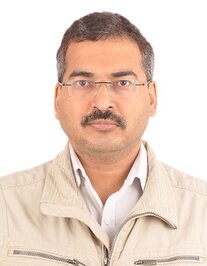
Gajendra Thakur
A PARALLEL HISTORY OF MITHILA & MAITHILI LITERATURE- PART 1
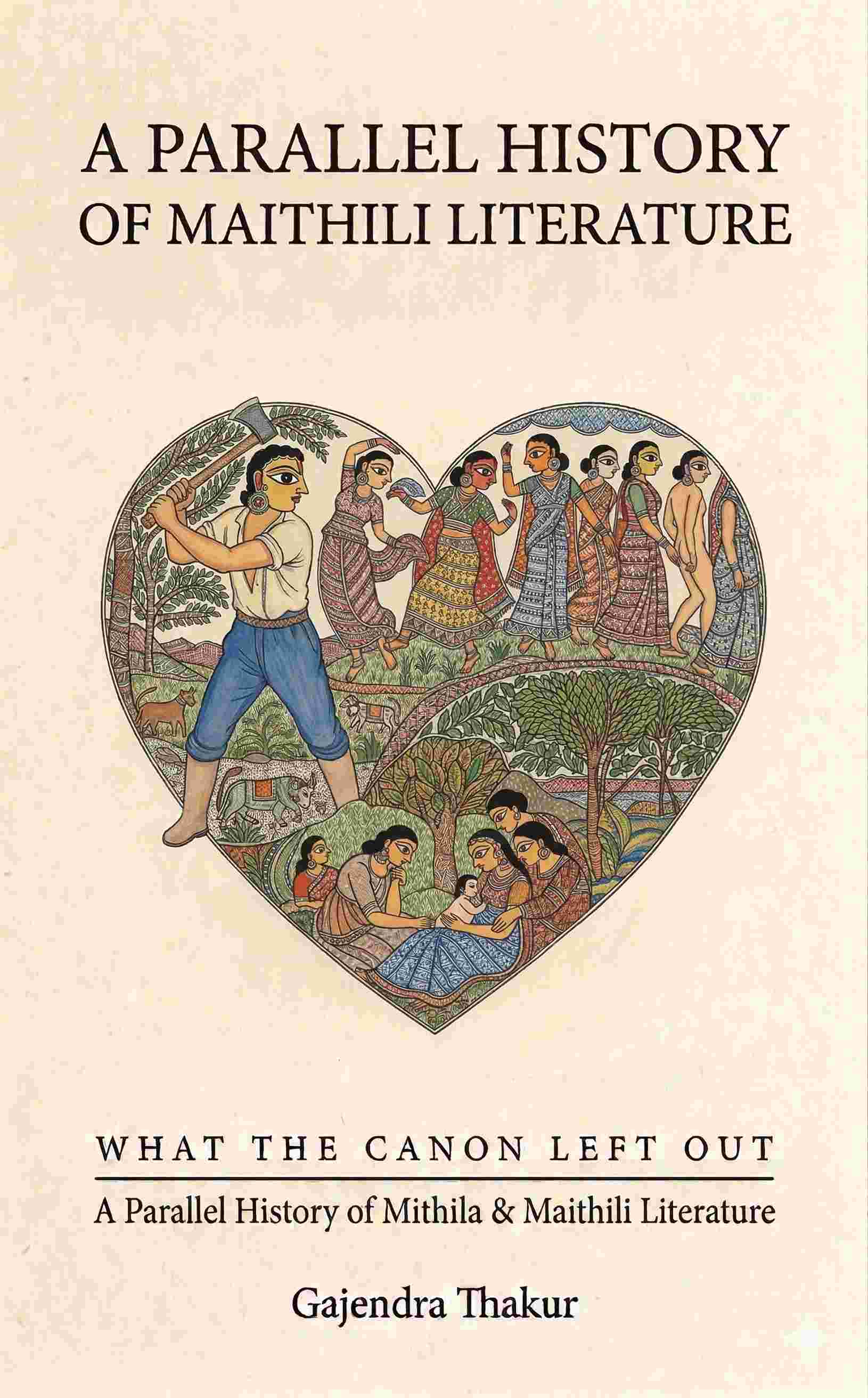
Issue No. 88 (November-December 2019) of Muse India at http://museindia.com/ displays Maithili literature in an extremely poor light. Moreover, it wrongly claims to be a representative review of Maithili Literature, whereas it was only in line with the Sahitya Akademi, Delhi; a mere representation of the so-called "dried main drain". It is expected that Muse India will correct itself by announcing an issue exclusively devoted to the parallel tradition of Maithili literature.
T.K. Oommen writes in the "Linguistic Diversity" Chapter of "Sociology", 1988, page 291, National Law School of India University/ Bar Council of India Trust book: "... the Maithili region is found to be economically and culturally dominated by Brahmins and if a separate Maithili State is formed, they may easily get entrenched as the political elite also. This may not be to the liking and advantage of several other castes, the traditionally entrenched or currently ascendant castes. Therefore, in all possibility the latter groups may oppose the formation of a separate Maithili state although they also belong to the Maithili speech community. This type of opposition adversely affects the development of several languages."
T.K. Oomen further writes: "... even when a language is pronounced to be distinct from Hindi, it may be treated as a dialect of Hindi. For example, both Grierson who undertook the classic linguistic survey of India and S. K. Chatterjee, the national professor of linguistics, stated that Maithili is a distinct language. But yet it is treated as a dialect of Hindi". (Ibid, page 293)अपन मंतव्य editorial.staff.videha@zohomail.in पर पठाउ।
A PARALLEL HISTORY OF MAITHILI LITERATURE: INTRODUCTION
I
PROTO-MAITHILI: BUDDHIST CHARYAPADAC. 8TH–12TH CENT
Mainstream view: Often overlooked or treated as pre-Maithili. 50 charyapadas (mystical songs) by 23 Siddha poets rarely integrated into standard literary surveys.
Parallel view: Foundational democratic-spiritual corpus. Poets include Luipada, Kanhapada, Bhusukupada, Saraha. 16 ragas, 47 surviving padas - direct ancestors of Maithili folk lyric. Adi-Kavi Era: Pre-Jyotirishwar Vidyapatic. 13th–early 14th cent. A central thesis of parallel history: the beloved Padavali poet Vidyapati is distinct from an earlier poet of the same name who composed in Sanskrit and Avahatta. The aadi kavi (first poet) in the democratic tradition pre-dates Jyotirishwar Thakur. Mainstream historiography conflates both. Jyotirishwar Thakur: Varnaratnakar, Maithili Dhurtasamagam. Court prose, encyclopaedic register.
Gangesh Upadhyaya (Parallel recovery): Gangesh Upadhyaya - author of Tattvachintamani. Videha’s Panji research reveals he married a Charmkarini (leather-tanning caste woman) and was born 5 years after the death of his father. This fact was suppressed by Ramanath Jha. The honour-killing of his legacy is documented via original Dooshan Panji records.
CLASSICAL-MEDIEVAL: PADAVALI, NATAK & COURT POETRYC. 1350–1750
Establishment canon: Vidyapati Thakkurah (1350–1435) - Purusha Pariksha, Sanskrit & Avahatta. Brahmin-centred court culture. Govinddas (1600–1700) . Shankardev, Madhavdev - Ankiya Natak (one-act plays).
Parallel folk & Nepalese strand: Kabir (1398–1518) - Maithili padas of Kabir, recovered by Kamala Kant Bhandari and Subhadra Jha. It has anti-caste spirituality. Nepal Malla kings’ Maithili: Jagat Prakash Malla (Prabhavati Haran), Jagajyotir Malla (Hargauri Vivah). Mainstream historians wrongly call this era "Nepali". Harsnath Jha - Madhavananada Natak, Harshnath Kavyagrantthavali
COLONIAL PERIOD: SOCIAL REALISM & FAMINE LITERATUREC. 1830–1947
Mainstream / upper-caste tradition: Chanda Jha (1831–1907) - Mithila Bhasha Ramayana, religious poetry. Assisted Grierson’s survey. G.A. Grierson (1851–1941) - Maithili Chrestomathy, grammar. Scientific codification, yet filtered through colonial lens. Munshi Raghunandan Das (1860–1945), Rasbiharis Lal Das (1872–1940).
Parallel agrarian & protest voices: Faturilal - Famine poetry of 1873–74 (Akali Kavitt), documenting the Famine in vivid Maithili verse. Unpublished until Grierson’s Chrestomathy. A striking "from below" document of colonial misrule. Chanda Jha’s own protest verses attacking the courts, corruption and the plight of the poor - routinely ignored in favour of his religious work.
Modernist Turn: Harimohan Jha & the Anti-Caste Novels 1908–1984. Harimohan Jha (1908–1984), the towering Maithili satirist and novelist - directly attacking caste orthodoxy and Brahmin hypocrisy - was systematically denied the Sahitya Akademi Award. The year 1967 went unrewarded rather than give it to him. His novel Kanyadan and works like Antika remain among the most widely read Maithili texts. Establishment parallel (same era)- First Sahitya Akademi Maithili award (1966) went to a philosophy academic text, not a literary work - setting the template for caste-based selection. Acharya Ramlochan Sharan (1889–1971) - Maithili Shri Ram Charit Manas.
Parallel scholarship recovers roots: Radhakrishna Chaudhary (1921–1985) - A Survey of Maithili Literature, Mithila ka Itihas. First comprehensive secular history. Jaykant Mishra (1922–2009) - A History of Maithili Literature (2 vols), Brihat Maithili Shabdakosh. Post-Independence: Rajkamal Chaudhary & the Avant-Garde1950s–1970s
Establishment view: Nagarjun / Yatri - credited by some with giving Maithili a new direction. Parallel history contests this: his Maithili corpus is thin (25+44 poems), he won Sahitya Akademi 1968 then stopped writing Maithili. Rajkamal Chaudhary himself called him "medieval".
Parallel radical modernity: Rajkamal Chaudhary - true avant-garde of Maithili. Monograph by Subhash Chandra Yadav (Nit Naval Rajkamal) recovers the suppressed radical Rajkamal. Somdev (1934–2022) - democratic voice recovered through Aanjur( Somdev Vishesh).
The Parallel
Stage: Bechan Thakur & Dalit Theatre1970s–present; Videha identifies
three writers as the true living masters of Maithili - all ignored by
the Sahitya Akademi advisory board until 2021.
Jagdish Prasad Mandal - Maithili novelist (finally awarded Sahitya
Akademi 2021 for Pangu). His novels document the oppression and
resistance of lower-caste rural Mithila. Rajdeo Mandal - greatest living
poet of Maithili. Bechan Thakur - greatest living Maithili dramatist.
Created a parallel Maithili stage that confronts caste violence directly
- a "slap" on existing slapstick Maithili theatre.
WOMEN’S WRITING: THE SUPPRESSED CANON 18TH CENT.–PRESENT
Mainstream silence: Virtually absent from official anthologies. Women writers excluded from Sahitya Akademi assignments entirely. RTI [Right to Information Act] data confirmed by Vinit Utpal / Ashish Anchinhar(2011-14).
Parallel women tradition: Vibha Rani - playwright. Kamini Kamayani, Susmita Pathak - poetry and fiction. Arundhhati Devi - Mithilaak Vidushi Mahila (women scholars of Mithila). Premlata Mishra Prem, Panna Jha, Kalpana Jha, Munni Kamat and many others. First anthology of Maithili women poets: Ijoriyak Angaithi-Mor (ed. Mala Jha & Vibha Jha).
VIDEHA ERA: THE DIGITAL ERA 2000–PRESENT
Maithili’s internet presence in 2000 (Yahoo Geocities), launching the blog Bhalsarik Gachh on 5 July 2004 (ISSN 2229-547X VIDEHA)- earliest Maithili presence online. Rechristened Videha from 1 January 2008, it became a fortnightly international e-journal . Key achievements of the parallel movement: Digital & archival; thousanda of Maithili books digitised; 11,000 palm-leaf Tirhuta manuscripts transcribed. Tirhuta Unicode proposal contributed to Unicode consortium. First Maithili website aggregator; first Maithili Braille site; first Tirhuta-script site online. Google Translate & Wikipedia Maithili localisation. Successfully opposed "Bihari Language" misclassification.
Parallel awards & institutions: Parallel Sahitya Akademi prizes and Kavi Sammelans. Videha Samman in literature, art, music, craft and drama. RTI exposé (Vinit Utpal/ Ashish Anchinhar, 2011-14): 90%+ Sahitya Akademi assignments went to friends/relatives of 10-member advisory board. Zero assignments to authors of parallel tradition. 1000+ contributing authors; a million pages (hundred million words) of Maithili corpus created.
The mainstream Maithili literary historiography - as curated by the Sahitya Akademi since 1965 - has systematically promoted an upper-caste (predominantly Maithil Brahmin) canon while suppressing democratic, folk, Dalit, feminist, and Nepal-side traditions.
The history unfolds across nine layers: 1. Buddhist foundations - The 50 Charyapadas of 23 Siddha poets (Luipada, Kanhapada, Saraha and others) are treated as true roots of Maithili lyric, not a peripheral curiosity. 2. The two Vidyapatis - One of Videha’s most significant scholarly interventions: the famous Padavali poet (pre-Jyotirishwar) is distinct from the Sanskrit/Avahatta writer Vidyapati Thakkurah (1350–1435). Conflating them distorts both. 3. The suppressed Gangesh - Original Panji (genealogical) manuscripts prove that philosopher Gangesh Upadhyaya, author of the Tattvachintamani, was born of an inter-caste union and his family was of cobbler-caste descent. Ramanath Jha concealed this from historian Dinesh Chandra Bhattacharya, and Sahitya Akademi’s 2016 monograph on Gangesh perpetuated the suppression. 4. Colonial-era protest poetry - The famine verses of Faturilal (1873–74) document agrarian suffering in visceral detail and represent a "literature from below" that never entered the canon. 5. Harimohan Jha’s exclusion - The satirist who most powerfully attacked Brahmin orthodoxy from within was denied the Sahitya Akademi award even when the year went unrewarded. 6. The living masters - Rajdeo Mandal, and Bechan Thakur are identified as the truly great contemporary voices, all long ignored by the official machinery. 7. The RTI exposé - A Right to Information application by Vinit Utpal/ Ashish Anchinhar (2011-14) revealed that over 90% of Sahitya Akademi translation and publication assignments went to friends and relatives of the 10-member advisory board. 8. Nepal side - The Maithili of the Nepal Terai and the Malla-era literary output is treated as equally central, not as a regional footnote. 9. The digital counter-archive - Videha itself, with thousands of digitised books and 11,000 transcribed palm-leaf manuscripts, constitutes a living parallel institution.
II
It is structured as an alternative archive that challenges the "onslaught on dignity" perpetrated by government academies. The specific contents of the "A Parallel History of Maithili Literature" section include several key components:
1. Key points: The portal features a series of foundational texts and studies that redefine the Maithili canon of Parallel History of Maithili literature. The philosophical necessity of creating a history that represents the "ignored and non-represented" aspects of society. Rajdeo Mandal – Maithili Writer: A dedicated study of Rajdeo Mandal, a poet and novelist who represents the subaltern voice in modern Maithili fiction. 2. The "Vidyapati of Parallel Tradition": A central fixture of this is the reclaiming of the poet Vidyapati. The movement uses a logo based on a sketch by Panaklal Mandal (a Videha Samman recipient), which depicts a "subaltern Vidyapati". This version emphasizes that the poet’s caste is historically uncertain and contests his appropriation by Brahmin-centric organizations that have "invested" him with elite caste status. 3. Archival Resistance: The Dooshan Panji: The Videha website hosts the "Dooshan Panji" (The Blackbook), a series of digitized genealogical records released in 2009. This archive is used to expose "secrets" that elite historians reportedly suppressed to maintain social hierarchies, such as the marriage of the philosopher Gangesh Upadhyaya to a woman from a lower caste (Charmkarini). 4. Digital and Linguistic Democratization: Maithili in English Translation: A repository of Maithili works translated into English to provide a "representative review" of Maithili literature to a global audience, bypassing the "leftover material" found in institutional anthologies.
Tirhuta Revitalization: The Videha site provides resources for Tirhuta (Mithilakshar), the original script of Maithili, which the movement views as essential for cultural sovereignty in the digital age. e-Learning: A portal for learning the Maithili language is integrated to foster a new generation of writers outside the traditional academic system. The movement asserts that this parallel approach is necessary because institutional recognition has historically "strengthened the hands of obscurantist elements" who have marginalized liberal and subaltern writers like Harimohan Jha.
III
The Dialectics of Maithili Historiography: A Parallel History of Literary and Cultural Resistance: The construction of Maithili literary history has long been a site of significant contestation, oscillating between a centralized, institutional narrative and a fragmented, subaltern "parallel history" that seeks to reclaim marginalized voices. Traditionally, the history of Maithili literature has been understood through the lens of institutional recognition and colonial linguistics, primarily influenced by the works of George Abraham Grierson and Jayakanta Mishra. However, an examination of the parallel history-as curated by contemporary digital movements and alternative archives-reveals a profound divergence in the interpretation of key figures, the evolution of scripts, and the socio-political implications of literary gatekeeping. This report provides an exhaustive analysis of this parallel tradition, contrasting it with established historiography and articulating the mechanisms by which digital democratization is reshaping the Maithili literary landscape.
The Historiographical Divide: Institutional Standards vs. Parallel Resistance: The mainstream history of Maithili literature achieved its first comprehensive form in the mid-20th century, culminating in Jayakanta Mishra’s two-volume History of Maithili Literature published in 1949 and 1950. This project was fundamentally an exercise in identity-building, designed to establish Maithili as an independent language rather than a dialect of Hindi. This institutionalized history was built upon the pioneering work of George Abraham Grierson, whose Maithili Chrestomathy (1882) provided the first systematic compilation of literary specimens. While these works were instrumental in securing Maithili’s eventual recognition in the Eighth Schedule of the Indian Constitution, the parallel history argues that they also established a conservative, Brahmin-centric standard that excluded liberal and subaltern voices.
The need for a parallel history arises from what critics describe as an "onslaught on literature and dignity" by public and private academies, including the Sahitya Akademi and the Maithili-Bhojpuri Akademi of Delhi. These institutions are accused of fostering a "Festival of Shame" characterized by elitism and the marginalization of non-Brahminical traditions. A parallel history, therefore, is not merely an alternative list of books but a radical re-reading of the Maithili past, emphasizing the role of Buddhist mysticism, trans-regional diaspora, and the digital subversion of caste hierarchies.
Ancient and Proto-Maithili Foundations: The Charyapada and Subaltern Mysticism: The origins of Maithili are rooted in the Charyapadas, a corpus of Buddhist mystical verses composed between the 8th and 12th centuries AD. Composed by Vajrayana Siddhas such as Kanhapa and Sarhapa, these verses were written in Sandhya Bhasha (twilight language), which is claimed as an ancestral form by several Eastern Indian languages, including Bengali, Assamese, and Odia. The institutional narrative often treats the Charyapadas as a shared linguistic heritage that eventually branched into distinct vernaculars.
In contrast, the parallel history identifies the Charyapadas as a primary site of subaltern resistance. These Siddhas were often mobile, non-sectarian monks who operated outside the sedentary, caste-bound Sanskrit discourse of the time. Scholars in the parallel tradition, such as Rahul Sankrityayan and Subhadra Jha, have provided evidence that the linguistic features of these occult songs are fundamentally proto-Maithili, reflecting the lived experience of the common folk-often referred to as Desila Vayana-rather than the elite courtly culture. This period represents a time when the "language of the people" was a vehicle for spiritual and social liberation, a theme that contemporary parallel movements seek to emulate in the digital age.
Table: Comparative Periodization of Maithili Literary Eras
|
Period |
Timeline |
Traditional Perspective |
Parallel/Alternative Perspective |
|
Proto-Maithili |
700–1300 AD |
Shared Eastern Indo-Aryan roots; Buddhist mysticism. |
Origins of subaltern linguistic resistance; mobility over sedentary caste order. |
|
Early Maithili |
1300–1600 AD |
Rise of the Karnat and Oinwar dynasties; courtly patronage. |
Suppression of vernacular realism; casteist appropriation of major poets. |
|
Middle Maithili |
1600–1830 AD |
Decline in the heartland; influence in Nepal and Assam. |
The "Great Diaspora"; development of trans-regional Maithili identities. |
|
Modern Maithili |
1830–Present |
Institutional revival; language-dialect debate; official recognition. |
Digital democratization; critique of institutional "obscurantism" and elitism. |
The Script as a Cultural Battleground: Tirhuta, Kaithi, and Devanagari
The history of the Maithili writing system is central to the parallel narrative of cultural identity. Historically, Maithili was written in the Tirhuta script (also known as Mithilakshar), which evolved from the Brahmi script by the 7th century AD. The earliest recorded epigraphic evidence is found in the Mandar Hill Stone inscriptions of Adityasena. By the 10th century, Tirhuta had reached its mature form, sharing significant structural similarities with the Bengali and Assamese scripts.
The parallel history emphasizes that the decline of Tirhuta over the last century is a primary reason for the erosion of Mithila’s distinct cultural identity. While Tirhuta was used for all academic, cultural, and religious affairs for nearly a millennium, the advent of the Kaithi script-used by bookkeepers and administrators-and the subsequent dominance of Devanagari in the 20th century marginalized the original script. The institutional switch to Devanagari was driven by the availability of printing types and a desire for administrative convenience within the Hindi-speaking belt.
Table: Functional Domains of Historical Maithili Scripts
|
Script Name |
Domain of Usage |
Historical Context |
Current Status |
|
Tirhuta / Mithilakshar |
Academic, religious, and cultural affairs; genealogical records (Panji). |
Dominant from 7th to 20th century; closely related to Bengali. |
Declining; used for ceremonial and religious documents. |
|
Kaithi |
Administration, trade, commerce; day-to-day business of the masses. |
Used primarily by the Kayastha community for bookkeeping. |
Obsolete; replaced by Devanagari. |
|
Newari |
Administration and literary production in Nepal courts. |
Used throughout the Malla dynasty (1380–1775) in Nepal. |
Replaced by Devanagari in the modern era. |
|
Devanagari |
Education, official documents, digital media, and general literature. |
Adopted in the 20th century due to printing facility and popularity. |
Officially recognized and dominant script for Maithili. |
The parallel movement, spearheaded by digital platforms like Videha, views the revitalization of Tirhuta as a revolutionary act. Efforts to standardize the script in Unicode (achieved in 2014) and the development of digital fonts represent a technological attempt to reclaim linguistic sovereignty.
The Contested Legacy of Vidyapati: Courtly Icon vs. Subaltern Rebel
No figure in Maithili literature is more central or more contested than Vidyapati Thakur (1350–1450). The institutional history portrays him as a courtly poet and a devout Brahmin whose Padavali (songs of Radha and Krishna) achieved legendary status across Eastern India, influencing the religious literature of Bengal, Odisha, and Assam. This version of Vidyapati is often depicted in stylized Brahminical attire, and his works are celebrated for their sophisticated synthesis of Sanskrit aesthetic standards with vernacular melody.
The parallel history, however, seeks to strip away the "casteist attire" imposed by organizations like the Mithila Sanskritik Parishad. This alternative perspective, often referred to as the "Vidyapati of Parallel Tradition," highlights several key points of divergence:
Caste Identity: The parallel tradition asserts that Vidyapati’s specific caste remains historically uncertain, but he was certainly not a Brahmin in the sense that later hagiographers have claimed.
Linguistic Rebellion: Vidyapati is celebrated for explicitly choosing the "language of the people" (Desila Vayana) over the official Sanskrit of the court.
Historical Distinction: The parallel narrative critiques mainstream historians for confusing the Sanskrit and Avahatt writer "Vidyapati Thakkurah" with the genuine vernacular Padavali writer, emphasizing the work of the latter as the true representative of Maithili spirit.
A visual symbol of this parallel movement is a specific sketch of Vidyapati created by Sh. Panaklal Mandal, which serves as the logo for the Videha e-journal. This "subaltern Vidyapati" is a figure of populist empowerment, contrasting sharply with the institutionalized icon used to reinforce Brahminical dominance.
The Great Diaspora: Maithili Literature in the Courts of Nepal
While the Oinwar dynasty in Mithila (India) eventually grew weaker, literary activity shifted to the Malla dynasty of Nepal (1201–1779), where Maithili flourished as a language of the court and the stage. This phase of Maithili literature, often overlooked in Indian-centric institutional histories, is a vital component of the parallel tradition.
The Malla kings, claiming descent from the Licchavi and Karnat lineages of Mithila, were noted for their exceptional patronization of Maithili. Maithili was afforded equal status to Sanskrit in the Malla court, serving as a medium for royal correspondence, poetry, and drama. During this period, the tradition of Maithili songs was integrated into Sanskrit plays, eventually evolving into purely Maithili Geetinatya (musical dramas).
Table: Key Maithili Works and Patrons of the Malla Dynasty in Nepal
|
King / Patron |
Region |
Notable Works / Contributions |
Genre |
|
Jagatprakash Malla |
Bhaktapur |
Prabhavatiharan Natak |
Drama / Geetinatya. |
|
Jagatjyotirmalla |
Bhaktapur |
Hargauri Vivah Natak, Kunjavihar Natak |
Drama. |
|
Bhupatindra Malla |
Bhaktapur |
Composed 26 plays in Maithili |
Drama. |
|
Siddhanarayanadeva |
Patan |
Harishchandranrityam (1620–57) |
Multilingual Drama. |
|
Ranjit Malla |
Bhaktapur |
19 identified plays |
Drama. |
The parallel history views this Nepali period as a "classical age" of Newar-Maithili civilization, where the language operated as a cosmopolitan vehicle across the India-Tibet trade route. The sudden end of this tradition in 1768, following the conquest by Prithviraj Narayan Shah, led to a second migration of scholars back toward the Indian heartland, carrying with them a rich theatrical legacy that would eventually inform the Kirtaniya traditions of Mithila.
IV
The Ankia Nat and the Brajavali Synthesis in Assam
Simultaneously with the Nepali renaissance, Maithili literature found another home in Assam through the Ankia Nat tradition established by Srimanta Sankardeva (1449–1568) and his successor Madhavdev. These plays were written in Brajavali, an artificial literary dialect that was fundamentally medieval Maithili with minor Bengali/Assamese alterations.
The parallel history highlights the Ankia Nat as a unique genre evolution where the entire drama was written in prose, and the narrator played a central role. Unlike the courtly dramas of Nepal, these plays were intended for the promotion of the Vaishnava religion among the masses, specifically focusing on the Vatsalya Leela (childhood sports) of Krishna.
Notable Ankia Nat Plays archived in the Parallel Tradition:
Sankardev: Parijatharan, Ramvijay.
Madhavdev: Bhumi Lutiya Jhumura, Pimpara-Guchura-Jhumura.
Daityari Thakur: Shyamant Haran Yatra.
This trans-regional influence demonstrates that Maithili was once the lingua franca of Eastern Indian devotionalism, a status that the institutional history often downplays in favor of a more localized, caste-centric identity.
Institutionalization and the Politics of Exclusion: The Sahitya Akademi Critique
The modern era of Maithili literature is dominated by the Sahitya Akademi (National Academy of Letters), established by the Government of India in 1954. While the Akademi’s recognition of Maithili in 1965 was a landmark event, the parallel history offers a scathing critique of the institution’s subsequent trajectory.
The critique centers on what it calls the "booty distribution" of Sahitya Akademi awards. The foundation of this elitism is traced back to Ramanath Jha, the first convener of the Maithili language at the Akademi. Jha is described by parallel historians as "casteist, conservative, and confused," accused of using his position to suppress liberal writers who attacked social hierarchies. A notable example cited is the denial of the prize to Harimohan Jha, a popular satirist whose works like Kanyadan and Khattar Kakak Tarang were eligible but were ignored in favor of academic philosophy. This institutional "obscurantism" is seen as a deliberate attempt to keep Maithili as the exclusive domain of a small elite, thereby alienating the broader speech community and hindering the demand for a separate Maithili state.
The Dooshan Panji and the Honour Killing of Gangesh Upadhyaya
A pivotal moment in the parallel historiography is the exposure of the Dooshan Panji (the black book of genealogical records). The Panji system, established in the 14th century, is a sophisticated genealogical record-keeping method used to maintain caste purity among Maithil Brahmins. The institutional history treats the Panji as a mark of cultural distinction. However, the parallel tradition, led by Gajendra Thakur, released digitized copies of these secret records in 2009 to expose their use in social engineering.
The parallel history documents what it calls the "honour killing" of the great Navya-Nyaya philosopher Gangesh Upadhyaya (12th century) by institutional historians like Ramanath Jha. While Gangesh is recognized globally for his Tattvacintamani, the parallel narrative reveals that he married a "Charmkarini" (a woman from the leather-worker caste) and that his family was born five years after his father’s death-facts that elite genealogical records attempted to suppress. By exposing these "secrets," the parallel movement seeks to dismantle the myth of perpetual caste purity that underpins institutional Maithili identity.
Genre Evolution: From Epic Poetry to Subaltern Realism
The development of literary genres in Maithili reflects the broader social shift from courtly elite to subaltern commoner. While early and middle periods were dominated by lyrical poetry and devotional drama, the modern era has seen the rise of prose as a powerful tool for social critique.
The Evolution of the Maithili Novel
The Maithili novel emerged in the early 20th century under the influence of Bengali and Hindi literatures. The parallel history categorizes this development as follows:
Early Modern Phase: Characterized by translations and early social narratives by Rasbiharilal Das and Janardhan Jha.
The Satirical Turn: Harimohan Jha’s Kanyadan (1933) used satire to attack the conservative marriage customs of Mithila, making it one of the most popular works in the language.
The Subaltern Breakthrough: Jagdish Prasad Mandal’s Pangu (2021) represents a shift toward depicting the "crippled agricultural system" and the raw realities of village life, away from the romanticized past.
Contemporary Maithili novels now tackle complex issues such as "love jihad," political corruption, and the struggles of the "third gender". Works like Subhimani Jingi explore previously untouched social terrains, providing a "new perspective" that the institutional guard often ignores.
Digital Democratization: The Videha Movement
The establishment of the Videha e-journal in 2000 was a response to the perceived stagnation and exclusion of official literary bodies. As the first Maithili fortnightly e-journal, Videha represents a technological-literary movement aimed at bypassing institutional gatekeepers.
The Videha movement’s philosophy is built on several pillars:
Digital Sovereignty: By archiving thousands of Maithili books and manuscripts in the "Videha Pothi" and archive, the movement ensures that the language’s heritage is accessible to anyone with an internet connection, regardless of caste or geographic location.
Global Translation: Translating Maithili works into English and other languages to provide a "representative review" that contrasts with the "dried main drain" of institutional publications.
Inclusive Archiving: Actively seeking out "non-representative" and subaltern works that have been ignored by official academies.
The journal also promotes "Videha e-Learning" to facilitate the study of the language among the youth, specifically those who may have been alienated by the conservative academic standards. This digital shift is seen as the most viable path forward for Maithili to survive as a modern, living language in the 21st century.
V
Sociopolitical Implications and the Demand for Statehood
The history of Maithili literature is inextricably linked to the demand for a separate Mithila state. In the 1940s, this demand was repeatedly raised on linguistic grounds, fueled by the rich literary heritage documented by Grierson and Mishra. However, the movement failed due to perceived caste dominance. Sociologist T.K. Oommen argues that because the Maithili region is "culturally dominated by Brahmins," other castes feared that a separate state would merely formalize an elite monopoly.
The parallel history supports this sociological insight, suggesting that the "onslaught on dignity" by casteist literary associations has directly hindered the political aspirations of the Maithili speech community. By promoting a "parallel" tradition that includes the stories of all castes and classes, contemporary movements like Videha are attempting to build a broader, more inclusive cultural base that could eventually support a renewed demand for linguistic and political autonomy.
Conclusion: Toward a Synthetic Maithili Future
The parallel history of Maithili literature serves as a critical counter-narrative to the institutionalized standards that have dominated the language since the mid-20th century. By reclaiming the subaltern mysticism of the Charyapadas, celebrating the trans-regional diaspora of the Malla kings, and exposing the gatekeeping mechanisms of the Sahitya Akademi, this parallel tradition offers a more comprehensive and democratic view of the Maithili past.
The digital turn, led by the Videha movement, has successfully shifted the locus of literary power from the physical academy to the decentralized internet. This democratization allows for the inclusion of marginalized voices-the third gender, the landless laborer, and the non-Brahminical intellectual-who were previously excluded from the "mainstream" record. As Maithili continues to navigate the challenges of the 21st century, its survival will likely depend on its ability to integrate these parallel perspectives into a synthetic, inclusive identity that transcends the narrow elitism of the past. The history of Maithili literature is no longer just a history of books; it is a history of resistance, technology, and the ongoing struggle for cultural dignity.
VI
The Dialectics of Tradition and Hegemony: A Parallel History of Maithili Literature
The intellectual and cultural historiography of Mithila presents a profound study in the tension between institutionalized canon-building and the organic, often suppressed, voices of a diverse linguistic community. To understand Maithili literature in its entirety, one must navigate between two distinct but intersecting narratives: the "Official History," often associated with the patronage of the Sahitya Akademi and the scholarly lineage of Jayakant Mishra, and the "Parallel History," a critical movement that seeks to reclaim the subaltern, trans-border, and non-elitist dimensions of the Maithili experience. This parallel tradition, exemplified by the works of Radhakrishna Chaudhary and the contemporary Videha movement led by Gajendra Thakur, posits that the standard literary record has functioned as a "dried main drain," filtering out the vibrant contributions of marginalized castes, the Nepal legacy, and the radical realism of modern dissenters.
The geographic and spiritual landscape of Mithila provides the foundational stage for this literary drama. Bounded by the Himalayas and the Ganges, and intercepted by fifteen rivers, the land of Tirabhukti or Mithila has been synonymous with intellectual pursuit since the Vedic age. It is the site where King Videgha Mathava inaugurated Aryan colonization, where Yajnavalkya legislated the Madhyanandini branch of the Shukla Yajurveda, and where Gautama meditated on the foundations of Nyaya philosophy. However, the parallel history movement argues that this classical heritage has been utilized by entrenched elites to create an exclusionary cultural identity, often reducing a thousand-year-old language to a mere instrument of Brahminical prestige.
The Linguistic Foundation: Evolution and Contest
The genesis of Maithili as an independent speech form represents the first major point of contention in its history. Emerging from the Magadhi Prakrit or Eastern Apabhramsa between the 8th and 11th centuries A.D., Maithili is a senior member of the Eastern Indo-Aryan language family, alongside Bengali, Assamese, and Odia. Institutional historians often emphasize the role of learned scholars in refining the tongue, yet the parallel narrative highlights its survival through strolling bards and common folk who maintained the language despite centuries of "dialectization" by colonial officials and Hindi expansionists.
The Branching of Magadhan Speeches
Linguistic evolution in Eastern India was not a series of isolated events but a parallel development of sister dialects. While Magadhi Prakrit was the court language of the Mauryan Empire and the tongue of the Buddha and Mahavira, it eventually fractured into regional variants.
|
Language Period |
Developmental Stage |
Key Characteristics |
|
500 BC - 100 BC |
Pali (Early Prakrit) |
Canonical Buddhist language |
|
100 BC - 500 AD |
Middle Indo-Aryan |
Dramatic Prakrits, vernacular usage |
|
500 AD - 1100 AD |
Apabhramsa/Avahatta |
Transitional "popular" speech |
|
1100 AD - Present |
New Indo-Aryan |
Emergence of Maithili, Bengali, Assamese |
The distinction between Maithili and its neighbors, particularly Magahi, is often framed by social bias rather than purely linguistic criteria. George Abraham Grierson noted that while Maithili enjoyed the influence of "learned Brahmanas" for centuries, Magahi was condemned as the "uncouth" speech of the south. The parallel history seeks to bridge this gap, recognizing that the "boorish" elements of the language are actually the repositories of original, unadulterated Maithili forms that have survived institutional sanitization.
VII
Scriptural Identity: Mithilakshara vs. Devanagari
The Maithili script, known as Mithilakshara or Tirhuta, is of great antiquity, evolving from an eastern variety of the Gupta script distinct from the Nagari forms. It is an ornamental script, often associated with Tantric Yantra motifs, and was used throughout North-Eastern India, including Tibet and Nepal. The 20th-century transition to Devanagari is often celebrated by institutionalists as a move toward pan-Indian unity, but parallel historians view it with suspicion, as it facilitated the "dialectization" of Maithili under the umbrella of Hindi.
The Early Medieval Synthesis: Siddhacharyas and the Natha Cult
The earliest recorded specimens of Maithili are found in the Charyapadas, the mystical songs of the Buddhist Siddhacharyas composed between the 8th and 12th centuries. These songs, written in "Sandhyabhasha" (twilight language), were designed to provide hints for the esoteric Sahajiya cult.
The parallel history of Maithili places these songs at the center of its narrative, arguing that they represent a proto-vernacular stage where Maithili, Bengali, and Assamese were still a common linguistic pool. The Charyapadas were not merely religious texts but social documents that criticized caste distinctions and ritualistic pomposity, themes that the institutional history often downplays in favor of their linguistic archaism.
The Subaltern Natha Literature
Closely linked to the Siddhacharyas was the Natha cult, a heterodox tradition of accomplished yogis like Matsyendranath and Gorakshanath. These Naths often belonged to the lower strata of society-sweepers, arrow-makers, and cowherds-and their literature, captured in ballads like Goraksha Bijoy, reflects a fusion of Shaiva philosophy and secret yogic disciplines.
The Varnanaratnakara of Jyotirishwar Thakur, the oldest prose work in any North-Eastern Indian language (14th century), meticulously records the names of eighty-four Siddhas, confirming the deep integration of this heterodox tradition in the Maithili cultural landscape. The parallel history emphasizes that this early prose was "stuccato" and "rimed," serving as a handbook for storytellers and common narrators, rather than just a courtly exercise.
Vidyapati Thakur: The Contested Icon
Vidyapati Thakur (c. 1360–1448) is the epicenter of the struggle between official and parallel Maithili histories. To the institutional scholar, he is the "Abhinava Jayadeva," the courtly poet who perfected the Padavali and enjoyed the patronage of the Oinwara kings. However, the parallel history movement, particularly through the Videha movement, critiques the "casteist attire" placed upon him.
The Rejection of Sectarian Labels
Vidyapati was a polymath who wrote in Sanskrit, Avahatta, and Maithili. While official histories often label him a "Shaiva" due to his family lineage, the parallel tradition highlights his universalist and realist inclinations. His Purushapariksha, for instance, is perhaps the first text in the Indian subcontinent to discuss notions of masculinity and political realism, yet it is often ignored by historians who prefer to view him solely as a singer of divine love.
The parallel history asserts that Vidyapati’s "Desila Bayana" (country speech) was a conscious choice to bridge the gap between the elite and the masses. The movement argues that institutional attempts to claim him as a purely Brahminical icon by organizations like the Chetna Samiti have essentially "murdered" the trans-sectarian and humanist spirit of his poetry.
The Trans-Border Legacy: Maithili in Nepal, Assam, and Bengal
A major blind spot in institutional Maithili historiography is the "Maithili Diaspora," where the language functioned as the primary literary and courtly medium outside the borders of Tirhut for centuries.
VIII
The Malla Kings and the Nepal Tradition
After the Muslim conquest of Tirhut, many Maithila scholars fled to Nepal, where they found sanctuary under the Malla kings of Bhatgaon, Patan, and Kathmandu. Maithili became the language of education and culture in the Nepal Valley.
|
Nepal Ruler |
Literary Contribution |
Impact on Parallel History |
|
Vishwamalla |
Earliest Maithili drama (Vidya Vilap) |
Proves the early maturity of Maithili theatre |
|
Jagajyotirmalla |
Authored Haragaurivivaha (1629) |
Integrated Shiva-Parvati themes with court drama |
|
Jitamitramalla |
Multi-lingual playwright |
Demonstrated Maithili’s role as a regional bridge |
|
Ranjitamalla |
Prolific Maithili poet-king |
Represented the zenith of the Nepal-Maithili school |
Parallel historians point out that modern scholars often wrongly categorize this as "Nepali" literature, effectively erasing the Maithili roots of this heritage. This "Nepal Legacy" is a core pillar of the parallel tradition, representing a time when Maithili was an official state language.
Brajabuli and Brajavali: The Artificial Syntheses
In Bengal and Assam, Maithili provided the staple for an artificial literary language known as Brajabuli (in Bengal) and Brajavali (in Assam).
Brajabuli: Popularized by Vidyapati’s followers, it became the vehicle for the entire medieval Bengali Vaishnava lyric movement. Bengali poets like Narottama Dasa and even Rabindranath Tagore (under the pseudonym Bhanusingha) utilized this Maithili-based dialect.
Brajavali: Created by Srimanta Sankardeva in the 15th century, it mixed Maithili with Assamese to propagate the Ek-Sarana-Naam-Dharma movement through Borgeets and Ankia Nats.
The official history of Bengali and Assamese literature often absorbs these developments, while the official history of Maithili often overlooks them. The parallel history, however, insists that these "Mongrel Languages" are legitimate and vital branches of the Maithili literary tree, demonstrating its historical role as a civilizational lingua franca.
The Drama Traditions: Kirtaniya and Ankia Nat
Maithili literature is unique for its early development of the vernacular drama. The tradition of Kirtaniya Natak in Mithila, beginning with Umapati’s Parijataharana, was based on the "Naradiya" style of kirtan. These plays were intended for the common folk, using a stylized mix of Sanskrit, Prakrit, and Maithili songs.
IX
Comparative Theatrical Traditions
|
Feature |
Kirtaniya Natak (Mithila/Nepal) |
Ankia Nat (Assam) |
|
Originator |
Umapati Upadhyaya (14th C) |
Srimanta Sankardeva (15th C) |
|
Language |
Sanskrit/Maithili/Prakrit |
Brajavali (Assamese-Maithili mix) |
|
Structure |
One-act plays, song-heavy |
One-act plays, "Bhaona" performance |
|
Role of Sutradhar |
Leaves stage after Purvaranga |
Remains till the end of the performance |
The parallel history argues that Srimanta Sankardeva’s travel through Mithila (1481–1493) was the direct catalyst for the Ankia Nat tradition. He observed the Kirtaniya plays and, inspired by Vidyapati, created a distinct theater form that enlightened the people of Assam. This historical link underscores the "trans-regional" nature of the parallel tradition, which institutionalized histories often fragment into separate provincial narratives.
The Modern "New Awakening" and Institutional Hegemony
The 19th century witnessed a "New Awakening" in Maithili, moving away from decadent documentary prose toward a refined literary style. This renaissance was led by the "Golden Trio"-Chanda Jha, Raghunandan Das, and Lal Das. While this period is often cited as a revival, parallel historians view it as a time when Maithili was simultaneously being "saved" by scholars and "colonized" by the official structures of the British-era permanent settlement.
The Sahitya Akademi and the Politics of Recognition
The official recognition of Maithili by the Sahitya Akademi in 1965 is the most controversial event in the modern period. To Ramanath Jha, the first convener, this meant the language was "saved". To parallel historians like Gajendra Thakur, it marked the beginning of a period of "casteist conservatism".
The parallel tradition asserts that the Akademi’s advisory boards have consistently been pocket-run by elite caste organizations like the Chetna Samiti and Mithila Sanskritik Parishad, who have used their power to exclude non-Brahmin voices and suppress revolutionary literature. A notable example cited is the "honour killing" of the legacy of Gangesh Upadhyaya, the philosopher whose non-Brahmin or inferior social status was deliberately obscured by institutional scholars to fit a specific caste narrative.
The Gaslighting of Harimohan Jha
Harimohan Jha (1908–1984), arguably the most popular and radical voice of 20th-century Maithili, serves as a primary example of this institutional suppression in the parallel narrative. Despite his immense literary impact through satires like Khattar Kakak Tarang, he was consistently denied the Sahitya Akademi award by the "obscurantist elements" who controlled the board. The parallel history views Jha as a figure who "shook the foundations of orthodoxy," which led to his marginalization by the "dried main drain" of official historiography.
Subaltern Heroes and the Folk Heart of Parallel History
While official histories focus on kings and court poets, the parallel history centers on the "Throbbing Human Heart" of folk literature. These traditions, preserved through the oral memory of Dalits and lower castes, represent the true demographic reality of Mithila.
The Pantheon of Subaltern Heroes
|
Folk Hero |
Narrative Theme |
Cultural Significance in Parallel History |
|
Lorika |
Heroic Yadava/Ahir strength |
Mentions of "Lorikanacha" as a popular subaltern art |
|
Salhesa |
Dusadha guardian spirit |
Established as a "Harijan hero" in Mithila painting |
|
Dina-Bhadri |
Resistance to bonded labor |
Preserved by the Mushahar community; heroic hunters |
|
Bihula |
Feminine sacrifice and power |
Universal appeal across caste lines; snake cult themes |
These folk epics, such as the Lorik Gita, which takes thirty-six hours to sing, represent a "living Maithili" that exists independently of printed manuscripts or state academies. The parallel history posits that these are as important to the Maithili heritage as Vidyapati’s Padavali, but they were historically ignored until researchers like Grierson began to compile them in the 19th century.
X
The Videha Movement and Contemporary Parallel Literature
The contemporary "Parallel History of Maithili Literature" is synonymous with the Videha movement. This movement utilizes digital platforms to bypass institutional gates and give voice to the "missing portions" of society-the non-represented aspects of caste, gender, and socio-economic struggle.
New Dimensions in Contemporary Fiction
Contemporary parallel writers like Rajdeo Mandal and Jagdish Prasad Mandal have broken the traditional erotic and devotional molds to tackle stark realities.
The Third Gender: Subhimani Jingi is cited as the first Maithili work to vividly depict the struggles of an adolescent of the "other sex," using the imagery of Ardhanarishwar to advocate for a dignified life.
Environmental Migration: Kekra Lel Kelau explores the disconcerted village life following the migration of families to urban centers.
Post-Independence Developmental Critique: Herayal Jingi critiques the "faulty development model" and the persistence of caste-based exclusion in rural Mithila after 1947.
The "Non-Caste" Writer: The movement actively promotes writers like Subhash Chandra Yadav (author of Gulo), whose works are often dismissed or ignored by "syndicated critical articles" written by elite caste academics.
Philology and the Critique of the Panji System
A central component of the institutional narrative is the Panji Prabandh-the highly organized genealogical records of Maithil Brahmins and Kayasthas. While institutional historians like Mm. Parmeshwar Jha present this as a monumental social achievement, the parallel history movement denounces it as a tool of "Brahminical patriarchy" and social exclusion.
Parallel research into the Panji files suggests that sub-castes like the "Srotriyas" did not exist before 1800 C.E. and were an artificial creation of the permanent settlement era to consolidate elite power. This critique is vital to the parallel tradition because it deconstructs the "sacred" basis upon which much of the institutional Maithili identity is built.
Conclusion: Toward a Synthetic Historiography
The "Parallel History of Maithili Literature" is more than a list of alternative texts; it is a fundamental shift in perspective that refuses to see Maithili as the exclusive preserve of a courtly or priestly elite. It is an "exhaustive in its detail" attempt to reintegrate the Nepal legacies, the Assamese Brajavali dramas, the Dalit folk heroes, and the modern progressive dissenters into a unified, democratic account of the Maithili-speaking world.
The history of Maithili literature remains a contested terrain. On one hand stands the "Official Tradition," focused on classical poise, institutional recognition, and the sanitized memory of the past. On the other stands the "Parallel Tradition," rooted in the "throbbing human heart," subaltern resistance, and the "clean slate" of a representational future. As Maithili writers navigate the complexities of the 21st century-from the 8th Schedule of the Indian Constitution to the digital archives of Videha-the synthesis of these two histories will be the ultimate measure of the language’s vitality and dignity.
XI
MAITHILI LITERATURE IN PARALLEL HISTORY: based on Radhakrishna Chaudhary’s A Survey of Maithili Literature (2010)
Synthesised with External Scholarly Sources
This research examines the history of Maithili literature as presented in Radhakrishna Chaudhary’s authoritative survey (Shruti Publications, 2010), placed in the light of parallel literary developments across eastern India-Bengali, Assamese, Oriya, and Nepali traditions. The study traces Maithili’s evolution from its proto-Magadhi roots through three broad epochs: Early (c. 900–1350 A.D.), Middle (c. 1350–1830 A.D.), and Modern (1830 to date). It analyses how Maithili did not develop in isolation but acted as a lingua franca, a donor language, and a civilisational anchor for a vast trans-regional literary culture. Central to the study is the figure of Vidyapati Thakur (c. 1360–1480), whose influence on Bengali Vaishnavism, Assamese Ankianata drama, Oriya Brajabuli poetry, and Nepali court literature constitutes one of the most remarkable instances of literary transfusion in pre-modern India. The report also examines how modern Maithili’s revival under Chanda Jha, the Grierson grammar, and twentieth-century writers parallels similar vernacular renaissances across colonial Bengal and Bihar, and concludes with an assessment of Maithili’s current status as a Scheduled Language still seeking classical recognition.
XII
Introduction: A Language in Historical Context
Maithili occupies a unique position in the literary history of the Indian subcontinent. Among the oldest of the new Indo-Aryan languages, it emerged as an independent speech around the tenth century A.D. from the eastern branch of Magadhi Prakrit. Unlike many regional languages that grew in relative isolation, Maithili from its earliest period functioned as a cultural bridge-exporting its literary forms to Nepal, Bengal, Assam, and Orissa while absorbing impulses from Sanskrit, Avahatta, Arabic, and Persian. Its homeland, the historic region of Mithila (bounded by the Himalayas to the north and the Ganges to the south, encompassing modern Darbhanga, Madhubani, Muzaffarpur, and parts of Nepal’s Terai), was renowned since Vedic times as a seat of philosophy, law, and music.
Radhakrishna Chaudhary’s survey, originally prepared for the Sahitya Akademi but eventually published independently, stands as one of the most comprehensive accounts of Maithili literature in the English language. Written in the tradition of exhaustive scholarly surveys, it traces the language’s development from its Charyapada origins to the mid-twentieth century, covering poetry, prose, drama, and folk literature. This report places that internal history in dialogue with parallel developments in neighbouring literary traditions and with contemporary scholarship, to illuminate what makes Maithili’s trajectory both distinctive and representative of a wider eastern Indian literary modernity.
A foundational premise of this study is that literary histories are best understood comparatively. Just as one cannot understand Italian Renaissance literature without French and Latin parallels, Maithili literature reaches its fullest significance when read alongside the Bengali Vaishnava Padavali, the Assamese Ankianata, Nepali Malla court poetry, and the colonial-era revival movements that swept eastern India from the 1830s onward.
XIII
Linguistic Origins and Parallel Evolution
Descent from Magadhi Prakrit
The linguistic genealogy of Maithili is traced by Chaudhary-and confirmed by Grierson, S.K. Chatterji, Sukumar Sen, and Subhadra Jha-to the Magadhi Prakrit that served as the speech of the Maurya eastern empire. The Ashokan edicts, inscribed in a vernacular close to this Magadhi, reveal at least four regional varieties by the third century B.C. The eastern variety, developed in the Mithila-Magadha corridor, gave birth not only to Maithili but also to Bengali, Assamese, and Oriya. This shared genealogy means that the literary histories of these languages are not simply parallel-they are, in their earliest phases, intertwined and mutually constitutive.
Sarvananda’s eleventh-century commentary on the Amarakosha preserves some four hundred Maithili words, offering the earliest lexicographic evidence of an independent Maithili speech distinct from Apabhramsa. The Charyapadas (c. 700–1200 A.D.), Buddhist mystical songs written in Sandhya-bhasha by Vajrayana siddhas from the Mithila-Assam-Bengal corridor, are claimed as ancestral texts by all the eastern languages. Scholars like Rahul Sankrityayan, Subhadra Jha, and Jayakant Mishra have argued that several siddhas-including Kanhapa and Sarhapa-were from Mithila, and that the language of these padas shows particular affinity with early Maithili morphology. This claim is disputed by Bengali scholars, and the debate is itself emblematic of the rivalry over literary priority that has long complicated eastern Indian literary historiography.
The Script Tradition: Tirhuta / Mithilakshara
The Maithili script-known as Tirhuta or Mithilakshara-is itself a parallel tradition to the Bengali and Assamese scripts, all descending from the Siddhamatrika script of the Gupta period. The earliest epigraphic evidence of a proto-Maithili script is found in the Mandar Hill Stone inscriptions of Adityasena (seventh century A.D.), now preserved at the Baidyanath temple in Deoghar. By the medieval period, this script had spread to Nepal (where it was used for royal documents) and to Bengal and Assam (where scholars writing Maithili texts employed it alongside their own scripts). The parallel spread of scripts mirrors the parallel spread of literary forms-both driven by the cultural prestige of Mithila as a centre of Sanskrit and Nyaya learning.
XIV
Early Maithili Literature (c. 900–1350 A.D.): The Triumph of the Vernacular
Historical and Dynastic Context
The real history of Mithila as an independent cultural unit begins, as Chaudhary notes, in 1097 A.D. with the Karnata dynasty under Nanyadeva. This coincides, significantly, with the period in which many north Indian vernacular literatures were crystallising out of Apabhramsa. The Karnatas were not only warriors but connoisseurs of music and Sanskrit scholarship. Nanyadeva’s Saraswatihridayalankarahara (c. 1097–1147) is among the earliest texts linking the joining of metre with melody-a feature that would become the defining characteristic of Maithili lyric poetry. His work influenced Jayadeva’s Gitagovinda (c. 1180), which in turn cast its shadow over all subsequent Maithili and Bengali lyric poetry.
This is the first major parallel: as Bengali literature was gestating its own lyric tradition through the Charyapadas and proto-Vaishnava devotional poetry, Maithili was developing a complementary but distinct lyric vocabulary rooted in Sanskrit prosody, Apabhramsa melody, and vernacular diction. The two traditions would converge explosively in the Brajabuli synthesis of the fifteenth and sixteenth centuries.
Jyotirishwar Thakur and the Varnanaratnakara
The single most important monument of early Maithili prose is the Varnanaratnakara of Jyotirishwar Thakur (c. 1280–1340), composed under the patronage of Harisimhadeva, last great ruler of the Karnata dynasty. Chaudhary describes it as ‘the earliest and the longest specimen of the early new Indo-Aryan prose’-a staccato, rhymed prose encyclopaedia in seven Kallolas (chapters) covering urban life, heroic ideals, seasons, the arts, military campaigns, music, and cosmology. Its importance is parallel to that of the Manasollasa of Someshvara (twelfth century Sanskrit) or the Lilavati of Mahendra Suri-texts that perform both literary and encyclopaedic functions.
S.K. Chatterji’s introduction to the Varnanaratnakara recognises it as a document of ‘first-rate importance in the study of culture in early and mid-medieval times in northern India.’ The work’s language is more archaic than anything in the later Vidyapati corpus, suggesting a rich pre-existing tradition of Maithili prose cultivation. Crucially, the VR was studied in Mithila, Nepal, and Bengal as late as the sixteenth century, evidencing its status as a pan-eastern standard text.
Umapati Upadhyaya and Early Lyric Drama
Umapati Upadhyaya’s Parijataharananataka (drama, with twenty-one lyrical songs in Maithili) is the earliest surviving Maithili drama and predates the vernacular drama of Bengal and Assam by at least a generation. The songs display, as Sukumar Sen noted, features more archaic than anything in Vidyapati-forms closer to Avahatta Apabhramsa-yet they are also finished literary compositions of considerable sophistication. The drama’s introduction of vernacular songs within a Sanskrit-Prakrit dramatic framework establishes the model that would characterise Maithili dramatic literature for centuries and that would be emulated in the Ankianata tradition of Assam under Sankaradeva.
XV
The Age of Efflorescence: Vidyapati and His World
Vidyapati Thakur (c. 1360–1480):
Born at Bishaphi in the second half of the fourteenth century into a family of distinguished Maithila Brahmin scholars (his ancestor Chandeshwar compiled the seven-volume Ratnakaras, still the foundation of Maithili social law), Vidyapati was polymath, courtier, law-giver, philosopher, and poet. His influence on making Avahattha into a literary language has been compared to that of Dante in Italian and Chaucer in English-a comparison that captures the simultaneous act of vernacularisation and canonisation he performed.
His works span multiple genres and languages: the Kirtilata and Kirtipataka in Avahatta (Maithili Apabhramsa), the Purushapariksha and other Sanskrit treatises on ethics, law, and ritual, the Gorakshavijaya drama, became the standard against which all subsequent Brajabuli poetry was measured.
Vidyapati and Sivasimha: Court, Exile, and Creative Freedom
The relationship between Vidyapati and his principal patron Sivasimha (who ascended the Oinwara throne in Saka 1324 / 1402–3 A.D.) is one of the defining creative partnerships in Indian literary history. From a copper plate grant, we learn that Sivasimha called Vidyapati ‘the new Jayadeva’ and granted him his home village of Bishaphi. The courtly environment-and Sivasimha’s own love of music and sensuous beauty-freed Vidyapati to compose his erotic and devotional lyrics in Maithili, breaking with the tradition of composing love poetry exclusively in Sanskrit. After Sivasimha disappeared in battle with a Muslim army in 1406, Vidyapati and the court took refuge at Rajabanauli in modern Nepal-an exile that deepened his devotional poetry and extended Maithili’s reach into the Malla court.
Chaudhary observes that Vidyapati was driven by a dual compulsion: to satisfy courtly demand for erotic poetry, and to use that poetry as a vehicle for fortifying Hindu identity against Muslim political pressure. The result was an extraordinary synthesis-sensuous, devotional, politically resonant-that spoke simultaneously to multiple audiences. This is paralleled in the Bengal of Chandidasa, where a similar synthesis of erotic and devotional Vaishnava poetry was taking place at roughly the same time, and the two traditions-Maithili and proto-Bengali-fed and reinforced each other.
Poetic Technique and Influence
Vidyapati’s poetic technique draws on Sanskrit aesthetics (the eight rasas, the nayika-nayaka typology, the standard images of erotic poetry) but deploys them in the ‘simple, musical, and direct’ Maithili vernacular. His verse is characterised by moraic metre, alliterative texture, the use of the Bhanita (poet’s signature in the final stanza)-a practice found across all eastern Indian medieval literatures-and an extraordinary range of imagery drawn from contemporary village and court life. As Chaudhary writes, ‘Because of the raciness and crispness of the language, many of his lines have passed into common speech.’
Scholarly consensus, across both Maithili and Bengali traditions, is that the Vaishnava saints of Bengal-most crucially Chaitanya Mahaprabhu (1486–1534)-encountered Vidyapati’s songs not as literary artifacts but as lived spiritual expression. Biographies of Chaitanya report that he would sing the songs of Jayadeva, Vidyapati, and Chandidasa through the night. This encounter between a Maithili literary tradition and a Bengali devotional movement was catalytic: it generated the hybrid literary language known as Brajabuli and launched the most prolific phase of Vaishnava lyric poetry in eastern India.
XVI
The Mongrel Language: Brajabuli as Pan-Eastern Literary Medium
The emergence of Brajabuli is the most striking instance of Maithili literature’s trans-regional influence and deserves extended treatment in any parallel history. Brajabuli is described by Chaudhary, following S.K. Chatterji, as ‘a kind of Maithili, mixed with Bengali in Bengal and Assamese in Assam, with some earlier Apabhramsa and contemporary western Brajabhasha forms.’ It developed from the fourteenth century onward as Vaishnava singers from Bengal and Assam-having absorbed Vidyapati’s Maithili lyric tradition through the Bengali students who studied Nyaya in Mithila and carried songs back with them-began composing their own padas in an artificial literary language modelled on Maithili but inflected with their own mother tongues.
Grierson, who first analysed Brajabuli systematically, called its emergence ‘an unparalleled circumstance in the history of literature.’ Sukumar Sen argued that Brajabuli was created in the hands of Bengali poets imitating Vidyapati’s Padavali; at a later stage he revised this view and related it more closely to Avahatta ancestry. More recent scholarship-including a 2019 essay in the Journal of South Asian Languages and Linguistics analysing manuscripts at the Asiatic Society of Bengal-has confirmed that while thousands of padas in Bengali padavalis are attributed to Vidyapati, only a small fraction can be directly traced to authenticated Maithili sources; the majority represent Bengali poets writing in Brajabuli under Vidyapati’s prestige.
Bengali Brajabuli
The great Bengali Brajabuli poets-Govindadasa Kabiraja, Jnanadasa, Narottamadasa, Balaramadasa-composed padas in this hybrid tongue that became liturgically central to Gaudiya Vaishnavism. Govindadasa, described by Chaudhary as ‘almost the greatest after Vidyapati,’ excels in ‘verbal harmony’ and ‘matchless alliterations.’ Balaramadasa surpasses all Bengali Brajabuli poets in metrical skill. The tradition persisted until the late nineteenth century when Bengali reformers adopted contemporary Bengali as their literary medium. Significantly, Rabindranath Tagore-at the height of the Bengal Renaissance-composed his early Bhanusingha Thakurer Padavali (1884) in Brajabuli, initially promoting these lyrics as the work of a newly discovered medieval poet named Bhanusingha. The hoax, though eventually revealed, testifies to Brajabuli’s living literary vitality even in the era of print and colonial modernity.
Assamese Brajavali
In Assam, the parallel development is known as Brajavali. Sankaradeva (c. 1449–1586), the founder of Ekasarana Vaishnavism and the Ankianata dramatic tradition, composed his Baragitis (celestial songs) and much of his drama in Brajavali-a medium that drew on Maithili morphology, Assamese vocabulary, and some Avadhi and Brajabhasha elements. Chaudhary notes that in Assamese Brajavali, Maithili words predominate, reflecting the depth of Sankaradeva’s debt to the Mithila tradition. A 2015 contrastive linguistic study (published in Language in India) confirms that while Assamese Brajavali and early Maithili share significant morphological features, they are distinct language forms-the Assamese tradition developing independently under its own formal constraints.
Oriya Brajabuli
In Orissa, the Brajabuli tradition is inaugurated by Ramananda Raya, governor of the Godavari province under the Gajapati king Prataprudra Deva and disciple of Chaitanya. His language is described as Maithili mixed with Brajabhasha, Bengali, and Oriya. Vidyapati’s influence reached Orissa through Bengal, and other notable Oriya Brajabuli poets include Champati Ray and King Pratap Malla Dev (1504–32). Chaudhary characterises this as a ‘case of direct participation in a common literary life in eastern India’-a phrase that captures the essentially collaborative nature of the Brajabuli phenomenon.
XVII
Maithili Drama: Nepal and the Kirtaniya Tradition
The history of Maithili drama constitutes another major strand of the parallel history of eastern Indian literature. Maithili’s dramatic tradition, which predates the vernacular drama of Bengal and Assam, spread to Nepal under the Malla kings and became for a period the court language of Kathmandu, Patan, and Bhatgaon.
The earliest extant Maithili drama-Jyotirishwar’s Dhurtasamagamanataka-was discovered in Nepal, where the manuscript tradition of Maithili literature was better preserved than in Mithila itself (much as early Bengali manuscripts were preserved in Nepal). Umapati’s Parijataharananataka established the model of Sanskrit-Prakrit drama with interspersed Maithili songs. Vidyapati followed and extended this model in his Gorakshavijaya, and the tradition crossed the border into Nepal, where from the seventeenth century onward Maithili drama flourished at its height under the Malla kings. Chaudhary notes that in Nepal, ‘For about one hundred and fifty years, Maithili drama flourished at its height, replacing the Sanskrit drama for all practical purposes.’
Among the Malla poet-kings, Jagajyotirmalla (1613–1633), Jagatprakashamalla, Siddhinarayana Malla, and Bhupatindra Malla (1695–1722) composed extensively in Maithili. Bhupatindra Malla alone wrote twenty-six Maithili plays-an output comparable to any professional dramatist of the period. The Kirtaniya drama tradition-combining devotional song, gesture, and narrative in a form peculiar to Mithila-parallels the Ankianata of Assam as an instance of how Vaishnavism generated new dramatic forms across eastern India simultaneously.
XVIII
Heritage Without Glamour: Decline and the Mongrel Middle Period
The period roughly between 1600 and 1830 is characterised by Chaudhary as one of ‘decadent documentary prose’ and literary decline. The political context is significant: the Khandwala dynasty (from c. 1556 A.D.) revived Maithili patronage briefly under Mahesha Thakur and his successors, but the growing influence of Brajabhasha (the Hindi lingua franca of north Indian Vaishnava devotion, associated with the birthplace of Krishna) created a competitive environment for Maithili literature. The hybrid ‘mongrel language’ of the period-blending Maithili with Brajabhasha-lacked the polish of either. As Chaudhary puts it, ‘The growing popularity of Brajabhasha was due to the fact that it was associated with the birth-place of Krishna, whose legends grew popular in the middle ages in the wake of the growing Vaishnava faith.’
This decline is paralleled in Bengal, where the sixteenth and seventeenth centuries saw a similar tension between vernacular Bengali and Brajabhasha in devotional literature, and in Assam, where the post-Sankaradeva period saw a gradual petrification of the Ankianata tradition. Yet the parallel histories diverge in one crucial respect: Bengali literature, buttressed by its larger demographic base and the economic energies of Mughal Bengal, maintained a richer literary output through the seventeenth and eighteenth centuries, while Maithili experienced a more pronounced fallow period.
XIX
The New Awakening: Colonial Modernity and the Maithili Revival
The Grierson Effect
The colonial period brought a paradoxical intervention in Maithili literary history. George Abraham Grierson-the Irish civil servant and linguist who served in Bihar-was the first to produce a systematic grammar of Maithili (1881), a comprehensive bibliography of Maithili manuscripts, and a catalogue of Mithila MSS. His insistence that Maithili was a distinct language (rather than a dialect of Bengali or Bihari, as some contemporary scholars claimed) provided the intellectual armature for a Maithili nationalist movement. This is closely parallel to the role played by English Orientalists in legitimising Bengali and Sanskrit literary traditions during the Bengal Renaissance: the colonial gaze, however condescending, inadvertently catalysed native literary self-consciousness.
Chanda Jha and the Modern Renaissance
The figure of Chanda Jha (1831–1907) in modern Maithili literature is analogous to Bankimchandra Chattopadhyay in Bengali-both men who, in the mid-to-late nineteenth century, redirected their literary tradition toward new social and aesthetic purposes while anchoring it in a recovered vernacular pride. Chanda Jha’s Mithila Bhasha Ramayan demonstrated that Maithili was capable of sustaining a sustained epic narrative-not merely devotional songs and documentary prose-and thereby challenged the dominant view of Maithili as a language ‘fit only for light literature.’ He served the court of Maharaja Lakshmishwar Singh of Darbhanga, and his work represents the best example of what colonial patronage and personal conviction could achieve for a subordinated literary tradition.
The website dedicated to Chanda Jha’s legacy describes his contribution in terms that consciously parallel Vidyapati: ‘What Vidyapati did for Maithili in the 14th Century has been done by Chanda Jha in the 19th Century and perhaps his contribution is more profound than the former.’ This is the kind of retrospective canonisation that marks the consolidation of a literary tradition-the construction of a lineage that gives the present moment its authority.
The First Maithili Journal and Linguistic Politics
The first Maithili journal, Maithil-Hit-Sadhana, was founded in 1905 by Madhusudan Jha and Chandra Dutta Jha from Jaipur-the same year as the Partition of Bengal and the height of the Swadeshi movement. The parallel with Bengali and other regional literatures is unmistakable: across India, the early twentieth century saw a proliferation of vernacular journals and literary societies that functioned as vehicles of cultural nationalism. In Mithila, this movement was complicated by caste politics: the Darbhanga Raj’s lackadaisical approach to Maithili, the literacy rate of barely five percent (concentrated almost entirely in upper-caste households), and the subordination of the lower castes to forms of cultural production they could not easily access, all constrained the emergence of a broad-based Maithili literary nationalism.
As the scholarly paper published in JETIR (2019) observes, ‘these developments, detrimental to the emergence of a homogenous elite group, constricted their sense’ of Maithili as a unified political identity. Vidyapati became the icon of the Maithili revival-but the revival’s social base remained narrow compared to the Bengali and Hindi renaissances.
XX
The Golden Trio and Twentieth-Century Modernity
Chaudhary’s chapter ‘The Golden Trio’ refers to the cluster of eminent early-twentieth-century Maithili writers who synthesised the lyric heritage of the medieval period with the social and aesthetic concerns of modernity. Maithili prose fiction-the novel and short story-emerged in this period, with Hari Mohan Jha’s satirical fiction and B.K. Verma ‘Manipadma’s dramas representing the two major achievements of mid-century literary modernism. The short story, in particular, developed in Maithili in close dialogue with the Bengali short story tradition-itself shaped by Tagore, Prabhat Kumar Mukhopadhyay, and Manik Bandyopadhyay-with Maithili writers adapting the form to the distinctive social textures of north Bihar: the joint family, the Panji genealogical system, the rituals of Maithila Brahmin life, and the poverty of the Kosi flood plain.
The poetry of the modern period extended the lyric tradition of Vidyapati while absorbing the influence of English Romantic and modernist forms. Sitaram Jha pioneered blank verse (Muktakakavya) in Maithili. Later poets engaged with the free verse revolution that swept across Indian literatures in the 1930s–50s, producing a genuinely modern Maithili poetic idiom while continuing to compose in the traditional Nacharis, Maheshvanis, and folk song forms that remained living parts of Mithila’s cultural life.
The inclusion of Maithili in the Eighth Schedule of the Indian Constitution in 2003-after decades of advocacy-represents the most significant institutional recognition the language has received. It enables Maithili to be used as a medium of instruction, examined in competitive examinations, and supported with state resources for publication and cultural preservation. However, as the Wikipedia article on Maithili language notes, Maithili missed out on Classical Language status in the October 2024 round of recognitions (which included Assamese, Bengali, Marathi, Pali, and Prakrit) due to the absence of a formal proposal from the Bihar state government-a telling example of how political indifference can retard the recognition of literary traditions of great antiquity.
XXI
Critical Assessment: Strengths and Limitations of Chaudhary’s Survey
Contributions
Radhakrishna Chaudhary’s survey is a work of genuine scholarship and evident love for his subject. Its strengths are considerable. It is the most comprehensive single-volume account of Maithili literature in English, covering poetry, prose, drama, and folk literature across all three periods. Its treatment of the pre-Vidyapati period is particularly valuable, drawing on manuscript evidence and epigraphic records to reconstruct a literary tradition that is poorly known even among specialists. Its discussion of Brajabuli and Maithili’s trans-regional influence is nuanced and well-sourced, drawing on the best scholarship of S.K. Chatterji, Sukumar Sen, and P.C. Bagchi.
Limitations and Gaps
The survey has several significant limitations that a parallel historical reading makes apparent. First, the treatment of lower-caste and non-Brahmin literary traditions is thin. The rich oral and folk traditions of the Yadav, Kayastha, Dom, and other communities-including the great ballads of Salhesa, Bihula, and Lorika, which Chaudhary acknowledges but does not analyse in depth-remain outside the survey’s primary focus. Second, women’s literary contributions are marginalised. Chandrakala, granddaughter of Vidyapati, is mentioned; but the rich tradition of women’s folk songs (Sohar, Samadauni, Lagni) and occasional named women poets receives no sustained treatment. Third, the modern period is dealt with more as a bibliography than as a critical literary history-the appended lists of recent publications are informative but analytically thin.
Fourth, and perhaps most significantly for a parallel history, Chaudhary’s survey is insufficiently comparative. The Bengali, Assamese, and Nepali parallels are acknowledged but rarely drawn out analytically. A twenty-first-century reader seeking to understand how Maithili’s trajectory relates to those of its sister traditions would need to supplement Chaudhary extensively with Sukumar Sen’s History of Bengali Literature, Birinchi Kumar Barua’s History of Assamese Literature, and Jayakant Mishra’s two-volume history of Maithili language and literature.
XXII
Parallel History: A Comparative Timeline
The following represents a synthesis of Chaudhary’s periodisation with the parallel developments in Bengali, Assamese, Nepali, and Oriya literatures:
|
Period |
Maithili |
Bengali |
Assamese / Nepali |
Shared Event |
|
c.700–1100 |
Charyapadas (proto-Maithili); Daka, Ghagha aphorisms |
Charyapadas claimed by Bengali tradition |
Charyapadas; proto-Assamese dialect |
Common Buddhist Doha tradition |
|
c.1097–1350 |
Karnata dynasty; Jyotirishwar VR; Umapati Parijataharana |
Proto-Vaishnava songs; Chandidasa emerging |
Nanyadeva music theory influences Assam |
Vernacular challenge to Sanskrit begins |
|
c.1350–1480 |
Vidyapati Padavali; Kirtilata; court of Oinwaras |
Chandidasa; early Brajabuli forms |
Vidyapati songs adopted in Nepal Malla courts |
Brajabuli synthesis begins |
|
c.1480–1600 |
Govindadasa; Kamsanarayan; Maithili drama in Nepal |
Chaitanya movement; Govindadasa Kabiraja Brajabuli |
Sankaradeva Brajavali; Ankianata drama |
Vaishnava pan-eastern literary culture peaks |
|
c.1600–1830 |
Khandwala dynasty; Lochana RT; literary stagnation |
Vaishnava padavali peak; prose emerging |
Post-Sankaradeva consolidation; Maithili plays in Nepal |
Brajabuli declines as Bengali asserts itself |
|
1830–1900 |
Chanda Jha revival; Grierson grammar (1881) |
Bengal Renaissance; Bankim; Brajabuli nostalgia (Tagore) |
Assamese literary society; Orunodoi journal (1846) |
Colonial modernity reshapes all vernacular traditions |
|
1900–2003 |
Mithil-Hit-Sadhana journal; 8th Schedule agitation |
Tagore Nobel; Bengali modernism |
Assamese gains state language status (1960) |
Constitutional recognition of vernacular identities |
XXIII
Conclusion: Maithili as a ‘Donor’ Civilisation
The parallel history of Maithili literature reveals a tradition that, despite its geopolitical confinement to a relatively small region of north Bihar and the Nepal Terai, exercised an outsize influence on the literary cultures of eastern India for nearly six centuries. From the Charyapadas to the Brajabuli synthesis to the Kirtaniya drama, Maithili has been more often a donor than a recipient of literary forms-exporting prosody, imagery, vocabulary, and aesthetic norms to Bengali, Assamese, Oriya, and Nepali traditions that were simultaneously developing their own autonomous literary identities.
This paradox-a tradition of enormous influence that has long struggled for political and institutional recognition-is explained by a combination of factors: the domination of Sanskrit (which delayed vernacular self-consciousness among Maithila Brahmin scholars), the political weakness of Mithila under successive Muslim and British administrations, the narrow social base of the literary revival, and the absorption of Maithili cultural prestige into the larger Bengali and Hindi literary systems without adequate acknowledgement. The debates over whether Vidyapati was ‘really’ Maithili or Bengali, whether the Charyapadas belong to Maithili or Bengali or Assamese literary history, whether Brajabuli is a dialect of Maithili or a Bengali creation-all these are symptoms of this structural paradox.
Radhakrishna Chaudhary’s survey, for all its limitations, performs an invaluable act of cultural assertion: it insists on the integrity and coherence of Maithili as a literary tradition, refuses the reduction of that tradition to a branch of any other language, and lays out the evidence for Maithili’s historical primacy in the lyric, prosodic, dramatic, and encyclopaedic traditions of eastern India. Read alongside the scholarship of Jayakant Mishra, Sukumar Sen, S.K. Chatterji, and the growing body of postcolonial and sociolinguistic research on Maithili identity, it remains an essential foundation for understanding the literary history not just of Mithila, but of the entire eastern Indo-Aryan cultural sphere.
As of March 2026, Maithili continues to campaign for Classical Language status from the Government of India-a status that would acknowledge the antiquity and influence documented in this report. The campaign’s eventual success would not merely be a political achievement; it would be a recognition that the parallel history of eastern Indian literature has a name that too long went unrecorded: Maithili.
Bibliography:
1. Chaudhary, Radhakrishna. A Survey of Maithili Literature. New Delhi: Shruti Publications, 2010.
2. Chatterji, Suniti Kumar. The Origin and Development of the Bengali Language. 3 vols. Calcutta: Calcutta University Press, 1926.
3. Grierson, George Abraham. A Grammar of the Maithili Dialect of Bihari. Calcutta: Asiatic Society of Bengal, 1881.
4. Jha, Subhadra. The Formation of the Maithili Language. London: Luzac, 1958.
5. Mishra, Jayakant. History of Maithili Literature. 2 vols. Allahabad, 1976.
6. Sen, Sukumar. A History of Brajabuli Literature. Calcutta: Calcutta University, 1935.
7. Sen, Sukumar. History of Bengali Literature. New Delhi: Sahitya Akademi, 1960.
8. Mahanta, Subasana. ‘Brajāvalī Form of Early Assamese and Early Maithilī: A Contrastive Study.’ Language in India, 15:6, June 2015.
9. Sheridan, Daniel H.A. ‘The Strange Afterlife of Vidyāpati Ṭhākura.’ Journal of South Asian Languages and Linguistics, 2019.
10. Wikipedia: Vidyapati (en.wikipedia.org/wiki/Vidyapati). Updated January 2026.
11. Wikipedia: Maithili language (en.wikipedia.org/wiki/Maithili_language). Updated March 2026.
12. Banglapedia: Vidyapati (en.banglapedia.org/index.php/Vidyapati).
13. Enroute Indian History: ‘Brajabuli: The Mischsprache of Bengal’s Lyrical Charm.’ August 2025.
14. JETIR, April 2019, Vol. 6, Issue 4: ‘History and Culture of Mithila’ (www.jetir.org/papers/JETIR1904S33.pdf).
15. Chanda Jha Legacy Blog (chandajha.blogspot.com).
16. CIIL Maithili Literature Overview (lisindia.ciil.org/Maithili/Maith_lite.html).
16. A_Survey_of_Maithili_Literature.
17. Rajdeo Mandal- Maithili Writer - विदेह प्रथम मैथिली पाक्षिक ई पत्रिका, accessed on March 15, 2026, https://www.videha.co.in/new_page_1.htm
18. A LANGUAGE WITHOUT A STATE: EARLY HISTORIES OF MAITHILI LITERATURE, accessed on March 15, 2026, http://14.139.58.199:8080/jspui/bitstream/123456789/4900/1/2.pdf
19. विदेह प्रथम मैथिली पाक्षिक ई पत्रिका, accessed on March 15, 2026, https://www.videha.co.in/new_page_4.htm
20. A Survey of Maithili Literature, accessed on March 15, 2026, https://archive.org/download/a-survey-of-maithili-literature/A%20Survey%20of%20Maithili%20Literature.pdf
21. Research Article - Heidelberg Asian Studies Publishing, accessed on March 15, 2026, https://hasp.ub.uni-heidelberg.de/journals/nidan/article/download/24334/23740/49649
22. Magahi language - Wikipedia, accessed on March 15, 2026, https://en.wikipedia.org/wiki/Magahi_language
23. Magadhi Prakrit - Wikipedia, accessed on March 15, 2026, https://en.wikipedia.org/wiki/Magadhi_Prakrit
24. MAGAHI AND MAGADH: LANGUAGE AND PEOPLE - Walsh Medical Media, accessed on March 15, 2026, https://www.walshmedicalmedia.com/open-access/magahi-and-magadh-language-and-people.pdf
25. Are there any extant languages descended from pali? - Q & A - SuttaCentral, accessed on March 15, 2026, https://discourse.suttacentral.net/t/are-there-any-extant-languages-descended-from-pali/10870
26. Language as Heritage: Maithili-Cultural Connects Volume 4, Issue 3, March 2017 Impact Factor 5.401 ISSN: (2394-1642) - aarf.asia, accessed on March 15, 2026, https://www.aarf.asia/current/2024/Apr/Te9luSFsj0SO6k5.pdf
27. Mithila, Maithili, Maithil, janak, vidyapati, janakpur, Madhubani, Madhubani pantings, Madhubani painting, maithili, mithila samaj, mithila news, mithila usa, maithili geet, maithili gaana,, mithila literature, mithila song, maithili song, janaki, mithila wedding, mithila marriage, mithila matrimonial, maithil matrimonial, mithila community, bihar, darbhanga, chaurchan, purnia, saharsa, tirhut, terai, nepal, india, khobar, Jha, jha, pathak, thakur, chaudhary, karn, kayasth, janakpur, Ujan, ujan, rajbiraj, biratnagar, sitamarhi, ramraj, veda, das, sanskriti, academi award, samastipur, saharsa, mithila script, maithil brahmin, sanskrit, Mithilanchal, Niraj kumar jha, Niraj jha, Niraj, accessed on March 15, 2026, http://mithila.50megs.com/pages/maithili_language.html
28. A Study of Select English Translations of Maithili Short Stories. - Indira Gandhi Memorial Library - University of Hyderabad, accessed on March 15, 2026, https://igmlnet.uohyd.ac.in/docs/hi-res/hcu_images/DS12397.pdf
29. Literature of Assam - APSC Preparation All subjects - APSC CCE (Assam) - EduRev, accessed on March 15, 2026, https://edurev.in/t/476386/Literature-of-Assam
30. Nath literature - Wikipedia, accessed on March 15, 2026, https://en.wikipedia.org/wiki/Nath_literature
31. Nath, Siddhacharyas, and Sabar Tantra - IndiaFacts.org, accessed on March 15, 2026, https://indiafacts.org/nath-siddhacharyas-sabar-tantra/
32. Nath Literature - Banglapedia, accessed on March 15, 2026, https://en.banglapedia.org/index.php/Nath_Literature
33. 08 - Chapter 2 Nath Cult | PDF | Nondualism | Indian Philosophy - Scribd, accessed on March 15, 2026, https://www.scribd.com/document/422236024/08-chapter-2-Nath-Cult
34. वि दे ह - विदेह प्रथम मैथिली पाक्षिक ई पत्रिका, accessed on March 15, 2026, https://www.videha.co.in/new_page_5.htm
35. Beyond the local and the universal: Exclusionary strategies of expansive literary cultures in fifteenth century Mithila - ResearchGate, accessed on March 15, 2026, https://www.researchgate.net/publication/275511599_Beyond_the_local_and_the_universal_Exclusionary_strategies_of_expansive_literary_cultures_in_fifteenth_century_Mithila
36. Mithila, its People and its Art - Jetir.Org, accessed on March 15, 2026, https://www.jetir.org/papers/JETIR2010284.pdf
37. kirtania naatak - Intangible Cultural Heritage, accessed on March 15, 2026, https://indiaich-sna.in/sites/default/files/2023-10/report_18.pdf
38. Brajabuli - Wikipedia, accessed on March 15, 2026, https://en.wikipedia.org/wiki/Brajabuli
39. Brajāvalī Form of Early Assamese and Early Maithilī: A Contrastive Study Subasana Mahanta, Ph.D. - Language in India, accessed on March 15, 2026, https://languageinindia.com/june2015/mohantabrajvalifinal.pdf
40. Brajabuli literature, its content and language, with special reference to Bengal., accessed on March 15, 2026, https://www.semanticscholar.org/paper/Brajabuli-literature%2C-its-content-and-language%2C-to-Mukhop%C4%81dhy%C4%81%E1%BA%8Fa/9dcea1e960c70e790ff6b1d7f3bdd507407e9151
41. Which literary language, based on Maithili with Assamese influence, did Sankardev use in Assam? - GKToday, accessed on March 15, 2026, https://www.gktoday.in/question/which-literary-language-based-on-maithili-with-assamese-influence-did-294477
42. The Comparative Study of Shankaradeva’s Ankiya Nat and Italian Commedia Dell’ Arte in the Context of Traditional Theatre - ijsred.com, accessed on March 15, 2026, https://www.ijsred.com/volume8/issue2/IJSRED-V8I2P343.pdf
43. “‘ANKIYA –NAAT’ - A Traditional Drama of Assamese Literature” - Pen Acclaims, accessed on March 15, 2026, https://penacclaims.com/wp-content/uploads/2020/01/Ashima-Gayan.pdf
44. Ankia Naat - Wikipedia, accessed on March 15, 2026, https://en.wikipedia.org/wiki/Ankia_Naat
45. ४. अनुलग्नक (पृ. १-३७८) - Internet Archive, accessed on March 15, 2026, https://archive.org/download/maithili_20230619/VIDEHA_ARCHIVE_JULY_2023_VERSION_3.pdf
46. JAGDISH PRASAD MANDAL: MAITHILI WRITER Era Before and After - Archive.org, accessed on March 15, 2026, https://archive.org/download/maithili_202209/JPM_MW_Gajendra_Thakur.pdf
47. The Cattle Grazer Brahmin Village (Mahisbar Brahmanak Gaam) - विदेह प्रथम मैथिली पाक्षिक ई पत्रिका, accessed on March 15, 2026, https://www.videha.co.in/new_page_6.htm
48. Mithila Painting: An Enquiry into Its Historiography and Identity - Nepal Journals Online, accessed on March 15, 2026, https://nepjol.info/index.php/bovo/article/download/83647/63862/240006
49. ४. अनुलग्नक (पृ. १-४३०) १.विदेह ई-पविकाक सभटा पुरान i - WordPress.com, accessed on March 15, 2026, https://videhasadeha.files.wordpress.com/2023/06/videha_archive_june_2023_version.pdf
50. Sanskrit Septic Revised 2 | PDF - Scribd, accessed on March 15, 2026, https://www.scribd.com/document/849903083/Sanskrit-Septic-Revised-2-Copy
ADDENDUM
A Survey of Maithili Literature- Volume II- Introduction
FESTIVAL OF LETTERS OR FESTIVAL OF SHAME
SAHITYA AKADEMI AND the DOWNFALL OF INDIAN LANGUAGES (IN SPECIAL CONTEXT OF MAITHILI LANGUAGE)
When Maithili was recognised by the Sahitya Akademi (National Academy of Letters- of India) way back in 1965, Late Ramanath Jha stated that his Maithili language is saved now (Maithilik Vartman Samasya, Ramanath Jha).
He was wrong on this on two counts. What he referred to as applicable, if it applied at all, only to the part of Maithili speaking area, geographically located in India. Maithili is spoken, natively, in India and Nepal. After the treaty of sugauli (ratified in 1816), which was in the aftermath of the Anlo-Nepalese war of 1814-16, the hilly regions were incorporated in British India, including the Nepalese-speaking Darjeeling Area. Similarly in 1816 and 1860, the Britishers ceded some Terai region to Nepal. As a result part of Maithili speaking Area, which was earlier ruled by Malla Kings (when Maithili was an official language of the region), was ceded to Nepal. Even today some Maithili scholars (!!) refer to the golden period of Maithili as the period of "Nepali (!!)" Malla Kings (Ramanath Jha, Introduction to Maithili Sahityak Itihas by Dr Durganath Jha "Shreesh").
Ramanath Jha himself admits that during his visit to "Vir Library" of Nepal (Kathmandu) he came to know about the Nepal legacy (his monograph on kirtaniya Natak, which he wrongly presents as Kirtaniya Nach) in respect of Maithili. So he cannot be blamed for his lack of knowledge in this respect. He was wrong on the second count also, and this second count was an artificial creation. He began a tradition of elitism and conservatism in Sahitya Akademi, as the first convener of the Maithili language. The tradition got stronger and stronger in the last 55 years of the Existence of Maithili in that Akademi. So he ensured that the liberal writers, like Sh. Harimohan Jha, attacking casteism and conservatism did not get the award, even though the year 1967 went unrewarded and the Ist award in 1966 was given to a non-literary book in Maithili (academic book of Philosophy!!!).
He was casteist, conservative and confused. The inter-caste marriage in Panji was well known to him, and it was apparent that the great navya-nyaya philosopher Gangesh Upadhyaya married a "Charmkarini" and was born five years after the death of his father. But he informed Sh. Dinesh Chandra Bhattacharya in a distorted way. Sh. Dinesh Chandra Bhattacharya writes in the "History of Navya-Nyaya in Mithila"-
"The family which was inferior in social status is now extinct in Mithila-Gangesha’s family is completely ignored and we are not expected to know even his father’s name.", and he writes further that all this information was given to him by Prof. R. Jha. So how would this casteist-conservative-confused allow the award to be given to Sh? Harimohan Jha. So the Sahitya Akademi saved the Maithili Language by recognizing it, as asserted by Prof. R. Jha, was wrong on those two counts.
Now come to Nepal, the Prajna Pratisthan and other organizations often recognize Indian Maithili writers, but Sahitya Akademi of India does not recognize Nepalese Maithili writers, be it the Seminars or the poets meet, be it an anthology of poems or prose published by the Akademi. Regarding the treatment of Nepalese Maithili writers by Sahitya Akademi Sh. Ram Bharos Kapari "Bhramar" laments that there is demand in Nepal that they should also not award Indian Maithili writers/ publish them in their anthologies as reciprocity demands this.
The narrow-mindedness of the Maithili advisory board of the Indian Sahitya Akademi has its origin in the organizations that are recognized by the Sahitya Akademi, the basis of which is extra-literary credentials. These are pseudo-organizations running on paper, political organizations or casteist organizations pocket-run by a few. The complete list is:
MAITHILI LITERARY ASSOCIATIONs (!!!) RECOGNIZED by SAHITYA AKADEMI
1. The Secretary, All India Maithili Sahitya Samiti, Tirbhukti, 1/1B, Sir P.C. Banerjee Road, Allahabad-211 002;
2. The General Secretary, Akhil Bharatiya Maithili Sahitya Parishad, C/o Dr. Ganapati Mishra, Lalbag, Darbhanga-846 004;
3. The Secretary, Chetna Samity, Vidyapati Bhawan, Vidyapati Marg, Patna-800 001;
4. The Secretary, Mithila Sanskritik Parishad, 6 B, Kailash Saha Lane, Kolkata-700 007;
5. The Secretary, Vidyapati Seva Sansthan, Mithila Bhavan Parishar, Darbhanga-846 004;
6. The Secretary, Centre for the Study of Indian Traditions, Tantrabati Geeta Bhavan; Ranti House, Ranti, Madhubani-847 211
Now the Literary Association lists read as under. Serial no. 1 & 6 above have been derecognised and has been replaced by other non-literary associations at sr no 5, 6 & 7 below.
(1)The General Secretary, Akhil Bharatiya Maithili Sahitya Parishad, Professors’ Colony, Digahi West
Opp. of Primary School, Darbhanga-846 004, (Bihar)
2) The Secretary, Chetna Samiti, Vidhya Pati Bhavan, Vidyapati Marg, Patna-800 001 (Bihar)
3) The Secretary, Mithila Sanskritik Parishad, 6B, Kailash Saha Lane, Kolkata-700 007, (West Bengal)
4) The Secretary, Vidhya Pati Sewa Sansthan, Mithila Bhavan Parishar, Darbhanga-846 004, (Bihar)
5) The Secretary, Anand, Samajik Sanskritik Sahityik Manch, Rajkumarganj (Mirzapur Chowk), Darbhanga-846 004, (Bihar)
6) The General Secretary, Mithila Sanskritik Parishad, Rosebery 5032, Sahara Garden City, Adityapur-2
Jamshedpur-831 014, (Jharkhand)
7) The General Secretary, Akhil Bharatiya Mithila Sangh, G-6, Hans Bhavan, Wing 2 I.T.O., Bahadurshah Zafar Marg, New Delhi-110 002, (Delhi)
What is the literary credential of the Centre for the Study of Indian Traditions (now recognised and replaced by a pocket association)? Chetna Samiti and Vidyapati Seva Sansthan are casteist political outfits, vehemently displaying the casteist attire of a great ancient poet, whose caste is still uncertain (VIDYAPATI), but who was certainly not Brahmin. All India Maithili Sahitya Samiti (now derecognised and replaced by a non-literary association) became non-existent even during the lifetime of the Late Jaykant Mishra, same is the case with Akhil Bhartiya Maithili Sahitya Parishad. Mithila Sanskritik Parishad has done a crime through an investiture ceremony of the great Vidyapati, they tried to convert Vidyapati and "Maithili" language to the language of only the Brahmins (the name of the artist who sketched the Vidyapati has still not been disclosed by this organisation). When these non-existent organizations exercise voting powers granted by Sahitya Akademi and chose a convener, it is not a coincidence that for successive times only conservative people among the Maithil Brahmin caste, are chosen. The complete list is:
1. Ramanath Jha
2. Jaykant Mishra
3. Surendra Jha Suman
4. Sureshwar Jha
5. Ramdeo Jha
6. Chandranath Mishra Amar
7. Vidyanath Jha Vidit
8. Veena Thakur
9. Prem Mohan Mishra
10. Ashok Avichal.
The result is now for everybody to see. The complete list of Sahitya Akademi awards (till 2019) is:
Total booty distribution- 50 times, Maithil Brahmins- 42 times, Kayasthas- 6 times, Rajpoots- 3 times; Others- 0 times !!! (now in 2021 Sh. Jagdish Prasad Mandal has been awarded this prize for his novel "Pangu", so the count is now not zero but one.
The result is not based on the quality of the books but solely upon the caste-based other considerations and the disease has its root in the faulty seedling that the Sahitya Akademi of India found through the faulty literary associations.
What were the objectives of the setting of this Akademi?
Sahitya Akademi was established (National Academy of Letters to be called Sahitya Akademi) by Government of India resolution No F-6-4/51G2(A) dated December 1952 "to set high literary standards, to foster and co-ordinate literary activities in all the Indian languages and to promote through them all the cultural unity of the country; to promote good taste and healthy reading habits, to keep alive the intimate dialogue among the various linguistic and literary zones and groups through seminars, lectures, symposia, discussions, readings and performances, to increase the pace of mutual translations through workshops and individual assignments and to develop a serious literary culture through the publications of journals, monographs, individual creative works of every genre, anthologies, encyclopedias, dictionaries, bibliographies, who’s who of writers and histories of literature."
The Akademi boasts of publishing "one book every thirty hours" and holding "at least thirty seminars every year" at regional, national and international levels, " along with the workshops and literary gatherings-about 200 in number per year".
The Akademi recognises " Besides the twenty-two languages enumerated in the Constitution of India", English and Rajasthani as languages. 24 language Advisory Boards have been constituted by Sahitya Akademi "to render advice for implementing literary programmes in these 24 languages".
The Akademi gives prizes in 24 languages recognised by it for original and translated works. It gives " special awards called Bhasha Samman to a significant contribution to the languages not formally recognized by the Akademi as also for contribution to classical and medieval literature"; "It has also a system of electing eminent writers as Fellows and Honorary Fellows and has also established a fellowship in the names of Dr Anand Coomaraswamy and Premchand".
FESTIVAL OF LETTERS (SHAME)!!!!
In February every year, Sahitya Akademi "holds a week-long Festival of Letters; It begins with the ceremony to present the Akademi’s Annual Awards for creative writing".
In February every year, there is a need to examine whether Sahitya Akademi is fulfilling its objective and whether Sahitya Akademi is aware of the rich cultural and linguistic variety prevalent in India.
On scrutiny it is revealed that Sahitya Akademi believes in "forced standardisation of culture through a bulldozing of levels and attitudes" and it is not "conscious of the deep inner cultural, spiritual, historical and experiential links that unify India’s diverse manifestations of literature".
The Akademi boasts of publishing "one book every thirty hours" and holding "at least thirty seminars every year" at regional, national and international levels, "along with the workshops and literary gatherings-about 200 in number per year". If we see the data in respect of Maithili it comes out that every year around 12 books should have been published in Maithili and the Maithili writers might have attended 30 seminars every year at regional, national and international levels and might have participated in 8 literary gatherings every year. The number of Maithili books published by the Akademi is pathetically low, and when we see the assignments, through which these books get artificially prepared (be it translation, anthology or monograph), then the people getting these assignments are often related to the members of the advisory board (as the answer to RTI application by Sh. Vinit Utpal brings forth). The quality suffers, and as a result, there is no readership.
How this Akademi failed? And why this Akademi failed? And what action should be taken against Akademi for its intentional failure?
Firstly, Akademi is not the name of a man or woman. Akademi or its member of the Advisory Board consists of persons, and if the group of persons is failing the Akademi, that language itself is to blame! But again the language is not the name of a man or woman. So, the people speaking that language are to be blamed for the failures of the Akademi. Really!!
Even if it is partially true, the Sahitya Akademy cannot shirk its responsibilities. How an advisory committee can be considered representative of Maithili-speaking people (even that of India), when the Convener of that language is nominated by six organisations (recognised by the Sahitya Akademi for reasons best known to it), having no remote connection with literature? Sahitya Akademi sowed seeds of Acacia and expected Mango fruit. Having said that it is also true that the Akademi or any organisation can transform itself, but only when the conservative people representing these find pressure from the literary fraternity, change themselves or are replaced.
What is the solution?
The literary fraternity has already taken initiative by establishing parallel Sahitya Akademi awards and parallel literary meets. It should be taken further. All legal means should be explored to take the Akademi to the task. On all available forums, the fact is made clear that the literature being prepared by Sahitya Akademi through assignments is not grammatically correct, that it is not up to mark and is of inferior quality. On all available forums, it should be made clear that the thin, casteist-looking (quantitatively and qualitatively) and pale Maithili literature, that is being shown by the Sahitya Akademi of India to the world, has no readership or respect in its native speaking area of India and Nepal. And that Maithili has moved not because of Sahitya Akademi but despite it.
Demand
The six organisations representing Maithili should be derecognized with immediate effect and an inquiry initiated to ascertain their genuineness. A committee should be set up to scrutinize the work done by the Sahitya Akademi (in respect of Maithili) in the last 55 years. The awards should be kept in abeyance till the results of the inquiry are made public and corrective steps are taken.
2
THE CELEBRATION BEGINS
Videha Ist Maithili Fortnightly International e-journal has e-published more than 300 issues to date. Meanwhile, We will enumerate the problems faced and the solutions found by us. The Journey began in the year 2000 at yahoo Geocities- the first words on the internet in Maithili were written by me on the yahoo Geocities sites (now yahoo has discontinued Geocities) towards the end of 2000 when I suffered a major accident which kept me confined to crutches for nearly one and a half years. But that perhaps shaped my destiny. I could concentrate on my Maithili writings and my research on Tirhuta Manuscripts. On 5th July 2004, the first blog in Maithili came (gajendrathakur.blogspot.com) as "Bhalsarik Gachh", which was rechristened as Videha ejournal from 1st January 2008. From Ist January 2008 it came to be published as a fortnightly journal. The 1st rechristened issue brought the story of the life and creations of a forgotten Maithili poet Late Ramji Choudhary (1878-1952).
Till the eighth issue of Videha the columns on Music, Mithila Painting, Children column, Learn samskrit through Maithili got strengthened. Moreover, the projects on digitalisation of Maithili Classics and Panji Manuscript-leafs got started. The searchable dictionary (Maithili-English_Maithili) was designed and strengthened. From the eighth issue, a latest unpublished Maithili Play of Nachiketa "No Entry Maa Pravish" began its e-publication in Videha. Nachiketa, the greatest dramatist of Maithili Literature was silent for the last 25 years, so far as the drama was concerned.
Technology has two aspects, bad (its chances of misuse) and good (its good use). It is a great leveller, it challenges status quo forces. It is applicable in all areas of knowledge. So school-going children today have a more clear understanding of the universe and atoms than the Aryabhata or Sir Issac Newton had. After mass-scale use of printing education and literature expanded its wings, but only after the "Internet and electronic transformation of tools of knowledge", it has become universal, it has jumped geographical boundaries. All shackles unfurled, the weak links of the chain were identified, and the chain which tried to capture knowledge, which tried to thwart its expansion, started breaking down. And the greatest beneficiary became the Maithili Literature. What is Videha, nothing, it is only its commitment to the Maithili Language, that helped it expand its base, and Videha became the means that were able to bind together the Maithili-speaking areas in both parts of the boundary (India & Nepal). Videha gave Maithili a batch of committed writers and a batch of committed readers. It challenged the status quo and casteist forces. It challenged confused writers, who were using Maithili as a tool to ride the ladder of Hindi. The lack of criticism, the lack of teeth in criticism was the reason that some writers and dramatists were using Hindi-Mix Maithili for cheap popularity, they were using derogatory language for the so-called lower castes of their society (some were finding plea in Natyashastra- when even the modern-day Samskrit Drama is not using Prakrit etc.!!), and for their mimicry, those castes started keeping distance with this kind of literature. And once the confusion of the confused thinned, a new type of awakened literature, stage and drama (top-class) became the norm.
Videha is getting regularly some excellent brains. Since its inception, Videha, the idea factory, is dependent upon them. So far as their versatile qualities are concerned, people associated with Videha are different. All are known for their perseverance and resilience. All are known for their hard work. All are known for their quality work. All are known for their discipline. And above all, all are committed; committed to Maithili and the Mithila. The cumulative force resulted in a natural revolution. A revolution in the field of Maithili Literature, art, music, craft, stage and drama. The only International e-journal in Maithili started this quality movement in Maithili. Nothing less than world standard was acceptable. The awards were instituted to recognize the parallel field of Maithili Literature, art, music, craft, stage and drama. Only the best were selected, there was no scope for the second best. The participation of readers in the decision-making processes was encouraged. The readers got full access to the digitalised Maithili Literature. More than 500 Maithili books and around 11000 palm-leaf mithilakshar manuscripts were digitalised and made available online under the "Videha Archive" section of www.videha.co.in (and the number is increasing every day). The audio-video-paintings-photographs were archived, and all these archived "art and lifestyle" of the people of Mithila were then placed online. The Videha Archive is a unique gift to the world.
So what is the ideology of people associated with Videha? Is it collective thinking? No, of course not. In Videha all are welcome. Here all are welcome to discuss their respective ideology. Having said this, it needs emphasis that there are some basic human principles where no compromise is possible. The casteists, those having genetic superiority complex (which is another name for an inferiority complex), the practitioners of plagiarism, those who are unable to take part in a healthy discussion and persons who are not able to withstand the criticism of their creation, Videha is not a platform for them. The ideology of people associated with Videha may have different tinges, not all need to toe the line taken by any member of the editorial board. Videha believes in the individuality of ideas and the editorial board never imposes its ideology upon its members. At the same time, it is being emphasized that each member of the Videha editorial board has a strong ideological leaning, the ideology of humanism is practised by all.
Videha-Maithili Literature Movement has its roots in the year 2000 when I started making Maithili Websites on Yahoo Geocities. After Yahoo Closed Geocities these sites were automatically deleted. However the early form of Videha "Bhalsari Gachh" was started on 5 July 2004, and it is the earliest presence of Maithili on the internet. Videha and its vibrant members did their utmost in translating lacs of words on Wikipedia and they successfully opposed the nomenclature "Bihari Languages" (Gerard M accepted the role of Umesh Mandal, the co-editor of Videha, go to Gerard M’s blog and click the Dasipat Aripan photo from Videha archive (Preeti Thakur) placed at his blog, you will reach https://videha.co.in/). In Google translate/Wikipedia localisation drive, in Tirhuta and Kaithi script research and the localisation of Braille in consonance with the Maithili Language, Videha shouldered the responsibility as a pioneer in technology viz-a-viz Maithili Language. It was a pioneer in many respects. It started for the first time a Maithili Websites Aggregator at http://videha-aggregator.blogspot.com/, the first braille site in Maithili, the first mithilakshar site in Maithili among others.
Videha has organised several dozen Maithili book fairs to date. The 16th Videha Maithili book fair was held at Sagar Rati Deep Jaray, Patna on 10-11th December 2011 and the 17th Videha Maithili book fair was held at Guwahati, on 22-23 December next year at the Vidyapati Parv organised by Mithila Sanskritik Samanvay Samiti. Videha also organised a parallel Sahitya Akademi Kavi Sammelan, besides awarding parallel Sahitya Akademi prizes, as corrective measures, as the awards and Kavi Sammellans of Sahitya Akademi were awarded/ organised in a unilateral manner where merit took a beating. Videha has, thus, fulfilled its obligation by interfering in the murky affairs of government organisations. Videha cannot remain a silent spectator, be it plagiarism or copyright violations. So the authors like Pankaj Parashar, and Ashok Sahu, who were engaged in lifting other articles/ stories/ poems were banned after verifying the sources and target writings.
Literature in translation is a major issue with Videha. Lack of translation in America resulted in Americans lagging in quality literature. We practise literature in translation in both directions- from Maithili into English and from other languages into Maithili. So far as translations from other languages into Maithili are concerned English, Nepali, Sanskrit and Hindi act as buffer languages in the process. Direct translations into Maithili are limited; and it is done directly only from English, Sanskrit, Hindi, Nepali and Bengali, although there are some exceptions. So far as the question of translations from Maithili into other languages is concerned, directed translations are again limited; and it is again done directly only into English, Hindi, Sanskrit, Bengali and Nepali, barring some exceptions. Videha contacted some notable personalities of class literature, took permission and translated that literature into Maithili. Most of the time English was used as a buffer language and translation work from English, Hindi, Konkani, Telugu, Gujarati, Oriya, Kannada, Nepali and Telugu into Maithili was completed; and these works were regularly published in Videha. Maithili novels, poems and short stories, on the other hand, were translated from Maithili into English and were published regularly in Videha.
VIDEHA became a Maithili Literature movement. No, VIDEHA was from day one of the Maithili Literature movement. Many established misconceptions got cleared through VIDEHA. The well-known facts, the not-so-obvious plot of some people to kill Maithili through its twin institutions the Sahitya Akademi and the CIIL was unearthed. The Right to Information came in handy. Sri Vinit Utpal asked for information from Sahitya Akademi through his RTI application dated 23.09.2011 (file no. RTI-125) sought information on "Assignment assigned by Maithili Advisory Board, Sahitya Akademi under the convener ship of Sri Vidyanath Jha ‘Vidit’". The information included a proposal received, a proposal rejected and a proposal kept in abeyance."
Similarly reply dated 30.10.2014 of Sahitya Akademi [File No RTI/310/31517] on an application filed by Ashish Anchinhar under Right to Information Act, 2005, the Sahitya Akademi gave vague and incomplete reply. Still the partial statutory mandatory information supplied by the Sahitya Akademi unearthed a vicious circle of Maithili-speaking so-called litterateurs, hell-bent upon making Maithili a language- "of the Maithil Brahmin, for the Maithil Brahmin and by the Maithil Brahmin".
More than 90% of the assignments went to the friends, relatives and acquaintances of the 10-member Maithili Advisory Board. No assignment to Sh. Jagdish Prasad Mandal, Sh. Rajdeo Mandal, Sh. Bechan Thakur (the greatest Short-story-novel writer of Maithili, the greatest living poet of Maithili and the greatest living Maithili dramatist; respectively), Sh. Umesh Paswan, Sh. Umesh Mandal, Sh. Ramdev Prasad Mandal "Jharudar", Sh. Durganand Mandal, Sh. Sandeep Kumar Safi or to Sh. Anand Kumar Jha. When every member of the Maithili advisory board is hand in glove with the Sahitya Akademi to kill the Maithili language then where lies the hope? The demand for Mithila state by these people will see that 10 Maithil Brahmin families would loot the Mithila state. Then where lies the hope? Here lies hope. Sh. Bechan Thakur has created a parallel Maithili stage and theatre, a slap on the existing slapstick humouristic Maithili theatre. Sh. Umesh Paswan is a discovery of the Parallel Sahitya Akademi Poetry festival organised by Videha. Sh. Jagdish Prasad Mandal, Sh. Rajdeo Mandal, Sh. Jharudar, Sh. Sandeep Kumar Safi and Sh Umesh Mandal have pumped their energy, wealth and time into our Maithili Language. This language will live...proofs are given below:-
Google translate
http://www.google.com/transconsole/giyl/chooseProject
then Wikipedia translate:
http://translatewiki.net/wiki/Special:Translate?task=untranslated&group=core-mostused&limit=2000&language=mai
http://translatewiki.net/wiki/Project:Translator
http://translatewiki.net/wiki/Project:Translator http://meta.wikimedia.org/wiki/Requests_for_new_languages/Wikipedia_Maithili
http://translatewiki.net/wiki/Special:Translate?task=untranslated&group=core-mostused&limit=2000&language=mai http://incubator.wikimedia.org/wiki/Wp/mai http://translatewiki.net/wiki/MediaWiki:Mainpage/mai
http://ultimategerardm.blogspot.com/2011/05/bihari-wikipedia-is-actually-written-in.html )
[Monday, May 09, 2011
The Bihari Wikipedia is written in Bhojpuri
This is the kind of article that has many people’s eyes glazed over. It is about standards and scientific documents and it is about languages most of my readers have never heard about. For the people that do speak one of the languages that are considered Bihari, it is extremely relevant and it has implications for Wikipedia.
This is information provided by Umesh Mandal that explains the "Bihari group of languages" with the Maithili language:
Kellogg (1876/1893) and Hoernle (1880) regarded Maithili as a dialect of Eastern Hindi; Beames (1872/reprint 1966: 84-85), regarded Maithili as a dialect of Bengali, Grierson has done a great service to the Maithili language, however, he erred when he gave a false notional term of "Bihari" language after that western linguists started categorizing Maithili as a dialect of "Bihari" language; although there is nothing known as "Bihari Language" and both Maithili and Bhojpuri are spoken in Bihar (of India) as well as in Nepal.
Umesh is working on the localisation of MediaWiki for the Maithili language and as this language is currently in the Incubator, the language committee does its due diligence and trying to understand if Maithili can have a place in the Bihari Wikipedia. The information provided by Umesh makes it quite clear: "no".
This still leaves us with the misnomer that is the Bihari Wikipedia. The language used for the localisation and the articles is Bhojpuri. Bhojpuri has the ISO-639-3 code "bho".
Are you still following all this? Ok, there is one question I am not asking: How about the Kaithi script?
Thanks, GerardM]
Excerpt from a Maithili e-journal published as PDF (from Videha 2011: 22; Videha: A fortnightly Maithili e-journal. Issue 80 (April 15, 2011), Gajendra Thakur [ed]. https://www.videha.co.in/ ."Gajendra Thakur of New Delhi graciously met with me and corresponded at length about Maithili, offered valuable specimens of Maithili manuscripts, printed books, and other records, and provided feedback regarding requirements for the encoding of Maithili in the UCS."-Anshuman Pandey.] ।
TIRHUTA UNICODE See the final UNICODE Mithilakshara Application (May 5, 2011) by Sh. Anshuman Pandey at Page 23 of the Videha 80th issue (Tirhuta version) is attached"Figure 11: Excerpt from a Maithili e-journal published as PDF (from Videha 2011: 22" and at Page 12 Videha is included in References Videha: A fortnightly Maithili e-journal. Issue 80 (April 15, 2011), Gajendra Thakur [ed]. https://www.videha.co.in/. and role of Videha’s editor is acknowledged on Page 12 "Gajendra Thakur of New Delhi graciously met with me and corresponded at length about Maithili, offered valuable specimens of Maithili manuscripts, printed books, and other records, and provided feedback regarding requirements for the encoding of Maithili in the UCS." ]
The Maithili Speaking area is shrinking. It is shrinking due to a conscious-subconscious policy of the Governments of India and Nepal, and the situation became critical due to the invasion of Hindi and Nepali media and the biased educational system in Maithili-speaking areas, and also due to the large-scale migration that has happened in one single generation. The question of Hindi saw to it that Vajjika, Angika and now Thethi, Surjapuri etc. languages should get the tacit support of supporters of Hindi, first in the name of religion and second in the name of caste. Through this they did not support Vajjika, Angika, Thethi or Surjapuri; but they tried to weaken Maithili, which ultimately resulted in the weakening of Vajjika, Angika, Thethi and Surjapuri. For all this, the Maithili-speaking people, more so the officials (I will explain it later on), are also responsible, as they tried to delimit Maithili within the two castes and four districts. All other people and areas, than these, were considered northern, southern, eastern and western deviations of so-called pure Maithili, which was fictitiously considered as being spoken by these Maithil Brahmins/ Karna Kayasthas of Madhubani, Darbhanga, Saharsa and Supaul districts. For the last 45 years the officials, yes I call them officials, the officials of the Maithili Department of Sahitya Akademi, did not try to accommodate the people outside this fictitiously delimited domain. But the major problem lies somewhere else. The slow poisoning was given in many disguises, be it the faulty top-heavy education system, which neglected primary and middle school education through the Mother Language Maithili, or be it through the concept of dialect, which initially conveniently declared languages like Maithili as dialects. Elementary education through Maithili was a non-starter because the Maithili books published by the Bihar State Textbook Publishing Corporation Limited seemed to be in Avahatt, it was not fit for children. Further, the authors and subjects selected for these books had a casteist bias. Maithili became a tool for caste-based politics, as once Hindi had been a tool for religion-based politics. Still, these officials, of the Maithili Department of Sahitya Akademi, are residing in their own built ghetto, bereft of any thinking or vision. Another reason for the present plight of Maithili is the policy undertaken by the tax collectors of Mithila (permanent settlement Zamindars of Cornwallis), whom the sycophants call King or the great king (Raja/ Maharaja) or Mithilesh (King of Mithila) these were mere tax collectors, the right for which were given to the highest bidders permanently; and there was not one such Mithilesh (tax collectors), but many within the borders of Mithila. These tax collectors employed mostly those two castes from four districts in their merchandise venture, and as the selection was based on sycophancy, so the work suffered. So they imported the lathiyals from outside the Mithila region. The masses of Mithila suffered a blow from the double-edged weapon. First, from their people who did not consider them as their own and second they got looted by the outsiders. Now after some time these outsiders, the non-Maithili speaking people, found it convenient to declare the masses (not belonging to the two castes from four districts) as non-Maithili speaking people, and the officials/ sycophants from those two castes from four districts tacitly agreed to it. Now these outsiders, the non-Maithili speaking people, formed a majority in many places of Mithila, and they led the rumour that Maithili, like Samskrit, is an upper-caste phenomenon, and thus they legitimized their anti-Maithili stance (all these facts have been brilliantly dealt with in the Maithili Novels of Sh. Jagdish Prasad Mandal) and they propagated the case of Hindi, first based on religion and second based on caste. But why our people fell into their trap, why these tax-collector Maharajas did not consider the masses of Mithila as their own and imported the perpetrators to loot their masses? The simple answer is that merit took a downward leap in auction-based tax collection rights allocation.
We started from one and reached number three, then thirty and now three hundred!! and we are growing-... and are 300 not out, and are creating a grand history. https://www.videha.co.in/ Videha Ist Maithili Fortnightly e-Journal ISSN 2229-547X has e-published its 300th issue recently. When I began this venture in the year 2000 with a Samsung TV net appliance, and when the existing was posted on 5th of July 2004, I moved all alone. Then on 31st January 2007, I suddenly thought to include the public, as after some groundwork I was ready for it. I decided to e-publish Videha and did publish it, on a fortnightly basis, the first issue that came on 1st January 2008 tried to include all the previous posts.
From all corners of this planet earth, the people tried to change the destiny of Mithila and Maithili. Now Sh. Ashish Anchinhar, Sh. Munnaji (Manoj Kumar Karn), are part of our team; and together we are 300 not out now. With 300 plus issues, 30,000 pages of Maithili literature (100 lac words corpora) creation and 11000 Tirhuta manuscript transcription we maintained a 50000-word Maithili-English vocabulary database. Now we are 350 strong, with 350 authors.
Videha has faced challenges and has withstood them. We never shirk from any question and/ or problem. The question of the state of Mithila is one such question which often comes calling. We are in favour of the states of Mithila within the sovereign borders of India and Nepal. We are in favour of Mithila. But which type of Mithila, that type that we had during the Zamindari Raj, where means of sustenance and avenues of existence remained limited for a few castes? Or that culture that existed within "Aryavarta-Indian Nation newspaper" and other Industries during that Raj. All of these got galloped by a dozen families of Mithila mostly from a single caste!! No, we are not in support of that Mithila, that Mithila where Maithili would be swallowed, as it is being swallowed by the Sahitya Akademi and the CIIL, swallowed by another dozen families. We are not in favour of that Mithila where the proceeding of the legislative assembly would be held in a language other than Maithili. Till the misgivings of the people of Mithila are addressed, we cannot support any Mithila state movement. So the people striving hard for Mithila state should sit on a protest before the advisory board members of the Sahitya Akademi/ CIIL and sing patriotic songs in front of their houses, and pressurise them not to misuse government funds by unscrupulously awarding functions of Akademi outside Mithila and not to misuse the power of assigning translation and other rights to themselves and to those people who are hell-bent upon destroying our language. The RTI application by Sh. Vinit Utpal has thwarted an attempt to strangulate Maithili, but if the supplementary work is not done the sinister design would resurface again. We request the Maithili advisory board members of Sahitya Akademi immediately return their assignments taken in their name and the name of the members of their family. Otherwise, pressure should be mounted to force these 10-member Maithili Advisory Board members to voluntarily resign from their membership in the larger interest of Maithili. So what is our answer viz-a-viz demand of Mithila state: it’s a categorical Yes.
The technology-centric venture called Videha became a success. The native speakers of Maithili reside in Bihar (of India) and South-East Nepal. The net connectivity had been very poor in these areas. Then how the authors, new and old, started using Unicode for writing for Videha. The Nepal Side of Mithila had been using Preeti, Kantipur, Himala etc. fonts, the Kolkata Maithili-speaking population had been using the Marathi fonts and the rest had been using the fonts based on the old Remington keyboard. All these three types of fonts are ASCII fonts. We researched these fonts and provided font converters to our Nepal-based authors. We also provided phonetic and Remington-based Unicode writers to all Maithili authors, who asked for them. We asked the authors if they may send their creations in any font, but at the same time, we encouraged them to use Unicode fonts. The technical support that we provided resulted in numerous receipts of typed entries from persons like Sh. Gangesh Gunjan, who in earlier stages had been sending their creations in their handwritings. As Sh. Gangesh Gunjan was well versed in Remington keyboard typing, so he made great use of the Remington Unicode typewriter. He sent that software to some of his friends too and he was courteous enough to intimate about this to us, although there was no need for that. Sh. Saketanand also used that software and sent his short-story कालरात्रिश्च दारुणा in Unicode, and it was published in one of the issues of Videha. The technology-centric venture called Videha became a success because we made it simple and intelligible at a time when even the technologists were not sure about the future of this Unicode. The virtual medium was being seen with anxiety by the literary fraternity, and the copy-paste system of theft was rampant in those days. But we assured the authors that with Videha they may rest assured that the copyright thieves would not be spared, while at the same time we were firm, that only for fear of misuse of technology we should not stop our venture midway. With the internet and technology, the geographic barrier became non-existing. The end of the problem of distribution in Maithili literature became possible due to our technology-friendly attitude and it proved a boon for our Maithili language. And it made the technology-centric venture called Videha a success... It is the success of the parallel Maithili literature movement.
The references to parallel literature are found in Vedas, where Narashanshi is referred to as parallel literature.
Parallel Literature in Maithili
The need for parallel literature in Maithili arose due to the constant onslaught on literature and dignity by the Public and Private Academies, for example, Maithili-Bhojpuri Akademi of Delhi, Maithili Akademi of Patna, Sahitya Akademi of Delhi, Nepal’s Prajna Pratishthan, all of which are government Academies. In addition to these Academies, the onslaught on Maithili Literature and dignity was constantly done by the so-called literary associations which were recognised by the Sahitya Akademi and were the main tool for usurping all the literary space meant for this language. Besides these, the funding to these and other parochial associations and organisations led to the presentation of an interface in the name of Maithili, which was mediocre and non-representative.
VIDEHA MAITHILI LITERATURE MOVEMENT AND A PARALLEL HISTORY OF MAITHILI LITERATURE
Therefore, the missing portions, the ignored and non-represented aspects of society, started to be chronicled. It led to the depiction marked by the richness of vocabulary and experiences and was a revolution in literature and art as far as people speaking Maithili are concerned. The quality now has not remained mediocre. The real power of the Maithili language was realised by the native speakers, mediocrity was replaced by excellence. This attempt at the writing of History of Parallel Literature for the Maithili Language arose as the mediocre agency (private and governmental) funded so-called mainstream literature, which has no readership, and no acceptance among the speakers of Maithili continued to be presented by these Akademies as representative literature. Literary journals like Museindia (www.museindia.com ) were also used for their sinister design. The mediocre interface of Maithili literature was presented by the government radio and television stations also.
ERA BEFORE AND AFTER: LITERARY SCENE IN MAITHILI AFTER THE ARRIVAL OF JAGDISH PRASAD MANDAL
Amartya Sen wrote about the famine of Bengal (1942-43), talking about how lacs and lacs of people died in that famine (15 lacs as per estimates of the Famine Enquiry Commission), but that this didn’t include his loved ones. Likewise in 1967, there happened a great famine in Mithila. When Indira Gandhi (then the Prime Minister of India) visited the area, she was shown how the people from the Mushhar community survived simply by eating bisarh (roots of lotus and other plants).
But this tragedy was written about only in 2009 by Sh. Jagdish Prasad Mandal, over forty years after it happened. And the reasons for that delay are obvious. In Maithili literature, there is a lopsided tendency which has made its journey slanted and ugly. The ones writing for mainstream Maithili literature have had no firsthand experience of tragedies of this magnitude, so they could never write on such subjects.
The coming of Jagdish Prasad Mandal on the literary scene simultaneously started a renaissance and a reformation movement in Maithili literature. It commenced a shiny new era. He gets credit for correcting the dark and ugly course the literary scene had taken. He gets credit for filling the gap and correcting the lopsided course of Maithili literature, which was hitherto moving on a one-way road.
Jagdish Prasad Mandal is an artist. He can convey the facts in such an amazing way that the reader is left in a trance.
He can present the facts directionally and purposefully. Armed with this ability he has defined the literature of the Maithili language so greatly that we could bifurcate its history into two eras: the era before Jagdish Prasad Mandal, and the era which comes after.
His facts are collated from every section of society. They’re not placed in his prose as ornaments. Instead, they flow naturally.
It’s as if a high tide has shaken the coastlines of the so-called main drain of Maithili literature, which dies completely but then regains its shape during the monsoon.
His words never present a lament. His writing never shirks from its responsibilities. No matter what hardships they face, the characters never lose hope or blame their lack of resources; they never grow dismal and resolutely keep marching on.
He has respect for the lifestyles and contributions of every stratum of society, and that is very exceptional. This becomes effective because there is no mismatch between his words and his deeds, and this is because of the greatness of his personal and social life. What he thinks, what he does, and what he writes. It makes his literature truthful.
The ups and downs of the lyrical voice of the Maithili language attracted even the great Yehudi Menuhin who, in a BBC programme, said it was one of the sweetest languages. He talked of how his entire body swung hearing this language. Jagdish Prasad Mandal uses the ups and downs of this lyrical/rhythmic language to show the affinity of mutual dependence with its society and culture.
This will bring revolution not only in literature but also in the economic arena.
Genealogical records kept in Mithila suggest that he had a wife and three sons and a daughter. One child was the famous Nyaya author, Vardhamana. Gangesa apparently achieved quite some fame during his lifetime, referred to as "jagad-guru," which would be the rough equivalent of "Distinguished University Professor" for the educational institutions of his time.
[Phillips, Stephen, "Gangesa", The Stanford Encyclopedia of Philosophy (Summer 2020 Edition), Edward N. Zalta (ed.), URL = https://plato.stanford.edu/archives/sum2020/entries/gangesa/ ]
"Gangesha Upadhyaya was the Jagadguru (Universal Teacher), but he was also the Paramguru (Supreme Teacher). Aside from him, the title of Paramguru was only later conferred upon Nutan Vachaspati (the successor of Vriddha Vachaspati).
However, the injustice done to Gangesha by Ramanath Jha and Udaynath Jha ‘Ashok’ occurred in the 20th and 21st centuries, the adverse consequences of which logicians like Stephen Phillips were cursed to endure.
It should be noted here that Stephen Phillips is the first person to have completed a full English translation of all four volumes of the Tattvachintamani."
[Jewel of Reflection on the Truth about Epistemology: A Complete and Annotated Translation of the Tattva-cinta-mani, Bloomsbury Academic (2020)]।
"V.P. Bhatta has also completed the full translation of all four volumes of the Tattvachintamani as of 2025: [(1) Pratyaksha (Perception), (2) Anumana (Inference), (3) Upamana (Comparison), and (4) Shabda (Verbal Testimony/Word)]."[Word The Sabdakhanda of Tattva Cintamani (2 Vols Set) 2005; Perception The Pratyaksa Khanda of The Tattva Cintamani 2012 (2 Vols Set); Inference the Anumana Khanda of the Tattva Cintamani (2 Vols Set) 2021 & Inference of God and Comparison The Isvaranumana and The Upamana Khanda of The Tattva Cintamani (2 Vols Set) 2025 [by V. P. Bhatta with Introduction, Sanskrit Text, Translation And Explanation; Published by Eastern Book Linkers, Delhi].
HONOUR KILLING OF GANGESH UPADHYAYA (FIRST BY RAMANATH JHA, THEN BY UDAYANATH JHA ‘ASHOK’ (A PARALLEL HISTORY OF MITHILA AND MAITHILI LITERATURE, WHY TODAY ITS NEED BEING FELT MORE INTENSELY?)
I was not surprised, though I must have been when I saw a monograph on Gangesh Upadhyaya, whose copyright is being held by Sahitya Akademi, the author of the monograph is Udayanath Jha ‘ Ashok’. I thought that Udayanath Jha ‘ Ashok’, who has been given Bhasha Samman also, by the same Sahitya Akademi, would do some justice. But truth and research seem elusive in Sahitya Akademi monographs, at least that I found in this monograph.
I searched and searched through chapters, that now the author will show courage. But the author like Ramanath Jha seems ashamed of the roots and offspring of Gangesh Upadhyaya. He tries to confuse the issue, but there is no confusion now at least since 2009. But in 2016 Sahitya Akademi seems to carry out the casteist agenda. Udayanath Jha mockingly pretends to search his name, lineage etc, where nothing is there to search for, yet he could not muster the courage, to tell the truth, and ends up just repeating the facts in 2016 that Dineshchandra Bhattacharya already has published way back in 1958.
The honour killing of Gangesh Upadhyaya by Prof. Ramanath Jha is being taken forward by Sahitya Akademi, Delhi in a most hypocritical way.
Ramanath Jha’s obscurantism vis-a-vis Panji is evident from one example. The inter-caste marriage in Panji was well known to him (but he chose to keep the Dooshan Panji secret- which has been released by us in 2009), and it was apparent that the great navya-nyaya philosopher Gangesh Upadhyaya married a "Charmkarini" and was born five years after the death of his father (see our Panji Books Vol I & II available at https://videha.co.in/pothi.htm ). Sh. Dinesh Chandra Bhattacharya writes in the "History of Navya-Nyaya in Mithila". (1958)
"The family which was inferior in social status is now extinct in Mithila-- Gangesha’s family is completely ignored and we are not expected to know even his father’s name--...As there is no other reference to Gangesa we can assume that the family dwindled into insignificance again and became extinct soon after his son’s death." [1958, Chapter III pages 96-99), which is a total falsehood. He writes further that all this information was given to him by Prof. R. Jha, and he seemed thankful to him.
The following excerpt from Our Panji Prabandh (parts I&II) is being reproduced below for ready reference:
-
"Maharaja Harasimhadeva belonged to the Karnat dynasty of Mithila. In Jyotirishwar Thakur’s Varna-Ratnakara, Harasimhadeva was portrayed as the hero or king. Born in 1294 AD, he ascended the throne in 1307 AD. Following his defeat by Ghiyasuddin Tughlaq in 1324–25 AD, he fled to Nepal.
He was the official founder of the Panji-Prabandha (the genealogical record system) among the Brahmins, Kayasthas, and Kshatriyas of Mithila. For this purpose, Gunakar Jha for the Maithil Brahmins, Shankardatt for the Karna Kayasthas, and Vijaydatt for the Kshatriyas were the first to be appointed.
Inspired by Harasimhadeva-who was a descendant of Nanyadeva, the founder of the Karnat dynasty in 1019 Shaka (as noted in the verse Nanda-Indu-Shunya-Shashi Shaka Varshe i.e., 1019 Shaka)-the scholars of Mithila decided to initiate the current form of the Panji-Prabandha in 1248 Shaka (1326 AD).
Later, in the current era, some intellectually driven individuals influenced Mithilesh Maharaja Madhav Singh in 1760 AD to order the Panjikars (genealogists) to compile the Shakha Pustaks (branch books). Following this (sometimes described as 1600 Shaka or 1678 AD, but actually around 1800 AD after Madhav Singh’s time), a new Brahmin sub-caste named Shrotriya emerged in Mithila."
So, the Srotriyas as a sub-caste arose around 1800 CE as per authentic panji files. Sh. Anshuman Pandey [Gajendra Thakur of New Delhi provided me with digitized copies of the genealogical records of the Maithil Brahmins. The panjikara-s whose families have maintained these records for generations are often reluctant to allow others to pursue their records. It is a matter of ‘intellectual property’ to them. I was fortunate enough to receive a complete digitized set of panji records from Gajendra Thakur of New Delhi in 2007. [Recasting the Brahmin in Medieval Mithila: Origins of Caste Identity among the Maithil Brahmins of North Bihar by Anshuman Pandey, A dissertation submitted in partial fulfilment of the requirements for the degree of Doctor of Philosophy (History) in the University of Michigan 2014].
Later these Panji Manuscripts were uploaded to Videha Pothi at www.videha.co.in and google books in 2009).
The so-called Maharajas of Darbhanga were permanent settlement zamindars of Cornwallis, and there were so many in British India, but in Nepal there were none. In the annexure of our book (Panji Prabandh vol I&II), we have attached copies of genealogy-based upgradation orders (proof of upgradation for cash). So, before 1800 CE, there was no srotriya sub-caste in British India and there is no such sub-caste within Maithil Brahmins in Nepal part of Mithila even today. Srotriya before that referred to following some education stream in British India, in Nepal it still has that meaning.
ORIGINAL PANJI REFERENCES ARE PLACED BELOW:
DOOSHAN PANJI- THE BLACKBOOK [https://ia601402.us.archive.org/31/items/maithili_202209/Gajendra_Thakur_Dooshan_Panji_The_Black_Book.pdf]
1
|
Sarisav 178/2 |
Valiyas Chamru maternal village of Gangadhar |
sarisav |
Sakradhi |
Panichobh |
Darihara |
Pali |
Narwal |
|
Bhavnath |
|
Nathu |
Gangu |
Kanh |
Helu |
Horai |
Chand |
|
Kamalnayan Kishai |
Unknown 238//05 |
Visho |
Goge |
Rud |
Chand |
Maternal Village of Ram |
Deodhar |
Table (1-97) of the Dooshan Panji, The Black Book by Gajendra Thakur;2023] Explanation of Example 1:
"Gunawati Himsha [Gunawati Himsha in Dooshan (impure secret book) Panji (geneology book)] belonged to a different caste (Aan Jatik); her marriage took place with Chamaru of the Valiyasa Mool, and from this union, a son named Gangadhar was born. His daughter was married to Nathu of the Sarisav Mool, and they had a son named Visho. Furthermore, Visho’s daughter married Gangu of the Sakaradhi Mool, resulting in a son named Goge.
Goge’s daughter married Kanhu of the Panichobh Mool, and they had a son named Rud (Rudra). Rud’s daughter married Helu of the Darihara Mool, and they had a son named Chand. Chand’s daughter married Horai of the Pali Mool, resulting in a son named Ram-though the maternal details (Matrik) of Ram are unknown.
The offspring (daughter) of Ram then married Chand of the Narwal Mool. Their son, Devadhar, became completely pure (Purnatah Shuddha) in the sixth generation."
49
|
188/2 |
Charmakarini (from the Charmakar clan) |
Mandar |
Babhaniyam |
Chhadan |
|
Gangesha, the author of Tattvachintamani. |
Chaadan Gangeshak |
Nain |
Ratnakar’s Maternal root unknown |
Gangesha |
|
|
Vallabha |
Bhavai |
Maheshwar |
|
|
|
|
|
Jive |
|
५०
|
Charmakarini |
Sodarpur |
Alay |
Mandar |
Naraun |
Panichobh |
Khandvala |
Deeh Darihara |
Brahmpur |
Korai |
|
Medha |
Shankar |
Gadu |
Afel |
Mushe |
Vidyapati |
Ratnakar |
Matikar |
Mangu |
Mandar |
|
189/1 |
Govind |
Shrinath |
Vasudev |
Jadu |
Ramapati |
Surpati’s mother [Charmkarini] |
|
|
Gangu-Medha |
This text is a significant genealogical record from the Maithil Brahmin Panji (ancient scrolls) concerning the family of Gangesha Upadhyaya, the founder of the Navya-Nyaya (New Logic) school of Indian philosophy.
"Record 21//10: From the Chhadan Mool (lineage) comes Jagadguru Gangesha, the author of Tattvachintamani.
From the Chhadan root, the wife (Vallabha) of Gangesha, the author of Tattvachintamani, was Charmakarini. It is recorded that Gangesha, the author of Tattvachintamani, was born five years after the passing of his father (Pitri Parokshe Panch Varsh Vyatite); he was the offspring of the lineage connected with Charmakarini Medha.
From the Chhadan root, Mahamahopadhyaya (M.M.) Gangesha, the author of Tattvachintamani.
‘Information regarding Mahamahopadhyaya (M.M.) Gangesha, the author of Tattvachintamani, is available from the Ancient Panji.’"
"Gangesha was born five years after the passing (absence) of his father-this is an ancient scribal note found in some places."["Pitri parokshe panch varsh vyatite Gangeshotpattiḥ iti prāchīn lekhaniyaḥ kutrāpi"- In Dooshan (impure secret) Panji]
Devānand Pañjī 39-2: "Chhādan-sañ Jagadguru Guru Gaṅgeś sutāy Babhaniyām-sañ Jayāditya sut Sādhukar patnī."
Devānand Pañjī 339-3: "Jagadguru Gaṅgeś sut Supan dau Bhaṇḍārisam-sañ Harāditya dau. Putra sutā-cha Gorā Jajivāl sañ Jīve patnī e sut Sandagahi Bhaveśvar. Atrāsthāne Supan-bhrātṛ Hariśarmma dāriti kvachit Jajivāl grām."
"Chhādan-sañ Tattva Chintāmaṇi kāraka Gaṅgeśak Vallabhā Charmakāriṇī pitṛ parokṣe pañca varṣa vyatīte Tattva Chintāmaṇi kāraka Gaṅgeśotpatti"["Charmakāriṇī Medhāk santānak lāgime chalanhi"]
"Tattva Chintāmaṇi kāraka Ma. Ma. Pā. Gaṅgeśak viṣayak lekh prāchīn pañjī-sañ upalabdh"
Devānand Pañjī 339-3: "Devānand Pañjī 339-3 Jagadguru Gaṅgeś sut Supan dau Bhaṇḍārisam-sañ Harāditya dau. Putra sutā-cha Gorā Jajivāl-sañ Jīve patnī e sut Sandagahi Bhaveśvar. Atrāsthāne Supan-bhrātṛ Hariśarmma dāriti kvachit Jajivāl grām."
Devānand Pañjī 30-5: "Devānand Pañjī 30-5 Chhādan-sañ Upāyakāraka Ma.Ma. Pā. Varddhamān sutā-cha Khaṇḍavalā-sañ Viśvanāth sut Śivanāth patnī Gaṅgeś-Ma.Ma. Varddvamān / Supan / Hariśarmma."
"Record 21//10: Jagadguru Gangesha, the author of Tattvachintamani, from the Chhadan lineage."
"Mahaprabhu. Gangesha Upadhyaya-Chhadan (Mool), Chhadan (Gram). Udayanacharya-Nanautivar (Mool), Nanauti (Gram) [Kariyan, Samastipur]."
"Jajivāl-sañ Sandagahi Bhaveśvar Chhādan-sañ Tattva Chintāmaṇi kāraka Gaṅgeś sut Supan dau Jallakī-sañ Sādā Mahidhar 341."
Gangesh, the author of the Tattvachintamani, wrote one text equivalent to 12,000 texts. Now come to the fact mentioned in the Panji- it clearly states that Gangesh of Tattvachintamani was born five years after the death of his father and he married a tanner, so why did Ramanath Jha hide this from Dinesh Chandra Bhattacharya? Vardhamana, son of Gangesh, calls Gangesh sukavikairavakananenduh. But the conspiracy under which the poems of a famous scholar like Gangesh are not available today is clear from the example given above. Vasudev of Bengal was a classmate of Pakshadhar Mishra of Mithila, he came to study in Mithila, passed the shalaka examination and received the title of sarvabhaum. Vasudeva memorised the tattvachintamani of Gangesh and the nyayakusumanjali karika of Udayana. Pakshadhar and other Mithila teachers did not allow writing (copying) tattvachintamani. Raghunath Shiromani, a disciple of Vasudeva, took the right of certification after he defeated his guru Pakshadhar Mishra in a scriptural debate (shastrartha). The Navya Nyaya school was founded in Navadvipa by Vasudeva-Raghunath. Pakshadhar Mishra was a contemporary of Vidyapati (distinct from the Padavali writer who was of the pre-Jyotirishwar period) who wrote in Sanskrit and Avahatta. And the arrival of Mithila students of Bengal from Bengal stopped after Raghunath Shiromani. Gangesh Upadhyaya enjoyed ’param guru’ as well as ’jagad guru’ titles, the highest titles of the time and as per Panji only Vacaspati Mishra II was the other person who enjoyed the title of ’param guru’. The extinction of Navya-Nyaya School from Mithila, as described above, was a revenge of nature against the honour killing of Gangesh Upadhyaya and his family.
[Translation of the Maithili Short Story, ‘Shabdashastram’ (based on the true Panji records of Gangesh Upadhyaya) was done by the author Gajendra Thakur himself: published as ‘The Science of Words’ Indian Literature Vol. 58, No. 2 (280) (March/April 2014), pp. 78-93 (16 pages) Published By: Sahitya Akademi]
विदेहमे सभठाम ताकू / Search all Videha
Static full-text search · Pagefindलेखक/शीर्षक/अंक/वर्ष — खोज-विधा। गद्य/पद्य/शोध current/static + पुरान Videha/Sadeha contents खोजैत अछि। पोथी pothi.htm केर पूर्ण listing, श्रव्य-दृश्य Audio_Video.htm केर पूर्ण listing, पञ्जी videha-sadeha/panji-shards GitHub data, आ थेसारस/शब्दकोश videha-ejournal.github.io/data GitHub JSON corpus केँ query करैत अछि आ दूनू Quiz corpus मे dictionary/vocabulary/शब्दार्थ-सम्बन्धी प्रश्नोत्तरी परिणाम सेहो जोड़ैत अछि। Quiz videha-quiz आ GitHub user-site दूनू bilingual quiz corpus खोजैत अछि। Roman/IAST + देवनागरी cross-script search समर्थित। Issue/Year लेल संख्या दिअ। PDF-अभिलेख archive.org/VidehaAndSadeha सूची खोजैत अछि।